edited volume · anthology
FOOD CRISIS IN INDIA — CAUSES & CURE
By B. R. Shenoy, MA Sreenivasan
FORUM OF FREE ENTERPRISE, SOHRAB HOUSE, 235 DR. D. N. ROAD, BOMBAY-1 · Bombay
27 pages
Summary
This Forum of Free Enterprise pamphlet, dated 15 February 1975, collects two short essays on India’s food crisis prefaced by an anonymous Forum introduction. The lead piece, drawn from Prof. B. R. Shenoy’s inaugural address to the Farmers’ Federation of India convention at Pathankot on 20 December 1974, argues that India’s persistent foodgrain deficits are the cumulative result of policy choices that have starved agriculture of capital while privileging heavy industry, public-sector outlays, deficit financing and below-market procurement. The companion essay by M. A. Sreenivasan, a former Agriculture Minister of Mysore, asks why Indian plantations — coffee, tea, rubber — flourish on the same earth and monsoon under which foodgrain agriculture languishes, and traces the disparity to colonial-era land-revenue provisions, security of title and the legal-political treatment of cultivation as an industry. The introduction crystallises the argumentative centre of the volume: the crisis is one of production, not distribution; food zones, monopoly procurement and deficit financing aggravate it; and the remedy lies in restoring agriculture’s claim on national investment resources.
Key points
-
This Forum of Free Enterprise pamphlet, dated 15 February 1975, collects two essays on India’s food crisis prefaced by an anonymous Forum introduction.
-
B. R. Shenoy’s lead essay, drawn from his inaugural address to the Farmers’ Federation of India convention at Pathankot on 20 December 1974, blames foodgrain deficits on policy choices favouring heavy industry over agriculture.
-
Shenoy states that India appropriated 65 per cent of total investment resources to a public sector that produces only 3.5 to 6.3 per cent of national product.
-
Shenoy attributes the 1973-74 ration cuts of 36 per cent in Bombay and 26 per cent in Calcutta to the collapse of buffer stocks after the 1972 surrender of PL-480 entitlements.
-
Shenoy argues that inflation is a monetary phenomenon caused by deficit financing of budgets rather than by farm prices, contradicting the Agricultural Prices Commission’s contrary view.
-
M. A. Sreenivasan, a former Agriculture Minister of Mysore, asks why Indian plantations such as coffee, tea and rubber flourish while foodgrain agriculture languishes on the same soil and monsoon.
-
Sreenivasan traces the disparity to colonial-era Mysore land-revenue provisions, including a waste-land grant scheme priced at Rs. 20 per 0.405 hectares with a 30-year assessment guarantee.
-
The pamphlet’s introduction crystallises its shared argument that the crisis is one of production rather than distribution, worsened by food zones, monopoly procurement, and deficit financing.
Essays
FOOD CRISIS IN INDIA — CAUSES & CURE
By B. R. Shenoy
Shenoy opens by reminding readers that India, like the pre-war United States, is a nation of farmers — yet two decades of policy have inverted the natural order of investment, taxing the countryside to subsidise heavy industry. Marshalling evidence from the Reserve Bank of India’s Rural Credit Survey 1951-52 and Rural Debt and Investment Survey 1961-62, from rising hundi and bazar bill rates, and from the post-1961 collapse in per-capita farm investment, he argues that the apparent 1971 food self-sufficiency was an artefact of favourable weather and a one-crop wheat shift, not a structural improvement. He chronicles the 1972 surrender of PL-480 entitlements, the rapid collapse of buffer stocks, the 1973-74 ration cuts in Bombay and Calcutta, the 1974 renationalisation of the wheat trade that produced ‘lathyrism’ from Kesari dal substitution in U.P. and M.P., and famine-like conditions across the deficit states.
Two preconditions, Shenoy insists, must be met: a drastic scaling-down of public-sector and industrial outlays to release credit and capital for agriculture, and the abolition of zoning, monopoly procurement and arbitrary ceilings on foodgrain prices, so that food farmers receive competitive market returns on the same logic by which exporters of foreign exchange are offered incentives. Inflation, he insists against the Agricultural Prices Commission’s contrary view, is a monetary phenomenon driven by printing-press finance of Union and State budget deficits — not by farm prices — and the corrective lies in fiscal discipline, not in further hidden taxation of cultivators through procurement. Quoting his own PL 480 AID AND INDIA’S FOOD PROBLEM (1974), he closes by warning that the wheat farmer, branded variously hoarder, smuggler and Kulak under MISA-era policing, will rationally shift land away from wheat — and that only parity treatment with other entrepreneurs can put India on the road to Garibi Hatao.
- India has appropriated 65 per cent of total investment resources to a public sector that produces only 3.5 to 6.3 per cent of national product, leaving 87-92 per cent of the economy with the leftover 35 per cent — the structural cause of agriculture’s capital starvation.
- Per-capita investment in farming dwindled from 1.7 per cent per year in the decade ending 1961 to 0.3 per cent per year in 1961-72; output growth fell from 0.8 per cent to negative in step.
- Nationalised commercial banks operating 6,175 rural branches collect Rs. 459 crores in deposits but advance only Rs. 191 crores back to the rural sector, functioning as ‘suction pumps’ draining capital to urban manufacturing.
- The 1972 decision to forego PL 480 imports and the 14,300-tonne Basmati export were premised on a one-crop wheat illusion; production then declined 3.3 million tonnes in 1972 and another 8 million tonnes in 1973, forcing the 1973-74 ration cuts of 36 per cent in Bombay and 26 per cent in Calcutta.
- Inflation is a monetary phenomenon traceable to printing-press financing of Union and State budget deficits; the Agricultural Prices Commission’s price-ceiling logic confuses consequence with cause and arbitrarily caps the incomes of food-producing farmers who are already among the poorest in the world.
- Food zones are ‘a device of taxing farmers to finance the subsidy’ and instrumental in retarding production in granary states; the public distribution system’s needs should instead be met through all-India tenders at competitive prices.
- Under the wheat-trade renationalisation of March 1974, the wheat farmer who stocks, sells, transports or shifts grain risks being branded a hoarder, black-marketeer or smuggler — even attracting MISA detention — making rational withdrawal from wheat cultivation a certainty.
TREAT AGRICULTURE AS AN INDUSTRY
By MA Sreenivasan
In the rendered opening of his essay, Sreenivasan poses a paradox: how did the green hills of Coorg and the Bababudans come to be clothed with coffee, pepper and orange while the same Indian soil, sun and monsoon produce rice yields that rank India only 50th in the world and cotton yields 40th? Drawing on his January 1918 entry into the Mysore Civil Service at Chikmagalur, where as a probationary assistant commissioner he processed Takavi loan applications from struggling coffee planters, he reconstructs the Mysore Land Revenue Code and Revenue Manual provisions on ‘Shraya’ — improvement of land by cultivation. Waste land was granted at Rs. 20 per 0.405 hectares with a 30-year guarantee, free of assessment for three years, half-assessed for the next two and fully assessed only from the sixth year onward; no grant was made unless the applicant could raise the capital to start the industry; one-fifth of the area had to be planted each year; and the grantee could draw toddy from Bagani trees for the bona fide bread of his household.
From this institutional history Sreenivasan turns to his central indictment: agricultural land in independent India has become the very reverse of ‘Sthira’ (permanent, certain). Title is a scrap of paper blown about by every political breeze; landholding ceilings have been ratcheted from 18 standard acres in 1961 to ten; the river of capital that once flowed to land has dried or been diverted; and the cultivator is derecognised as an investor and stigmatised as an ‘absentee landlord’ in a way no shareholder in Tata Steels, Binny’s or the Mysore Sugar Company is ever stigmatised. The rendered pages stop before his policy recommendations.
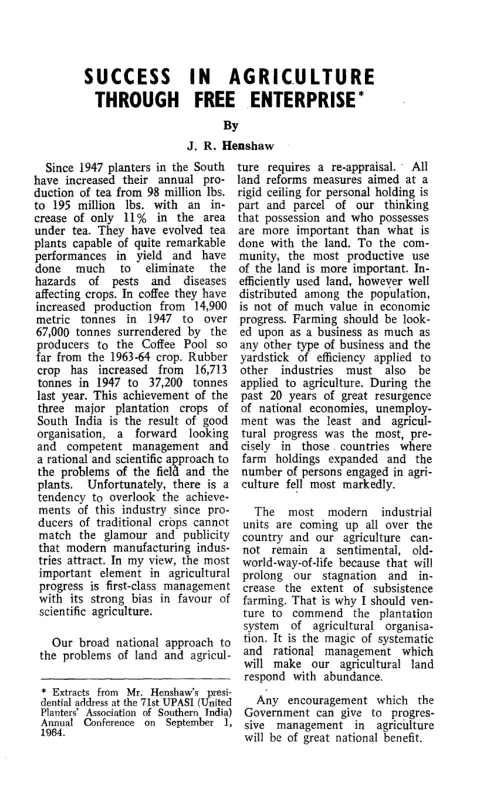
- India ranks first in the world in tea yield per hectare and fourth in coffee — but only 50th in rice and 40th in cotton — even though the same Indian soil, sun, monsoon, skills and hands work both sectors.
- Mysore’s Land Revenue Code and Revenue Manual treated waste-land grants as ‘Shraya’ (improvement by cultivation), with 30-year guarantees, graduated assessment holidays, low upset prices and capital-raising conditions designed to attract bold private investment into plantation industry.
- The Mysore Manual explicitly described coffee planting as ‘industry’ and required one-fifth of the granted area to be planted every year, demonstrating an industrial conception of cultivation that contemporary food agriculture has been denied.
- Sreenivasan invokes the ancient Indian description of land as ‘Sthira’ — permanent, certain — and the eight-fold deed-of-transfer formula (nidhi nikshepa, jala tharu, pashanadi, ashtabhoga tejas swamyam, until the sun and moon last) to argue that the constitutional and political treatment of agricultural land has betrayed a millennia-old legal tradition.
- The land-ceiling regime has been lowered from 18 standard acres in 1961 to ten and is treated as a ‘platform, if not the playground of politics’ on which every party vies to outdo the others, while the same investor in sugar, steel or textile shares faces no equivalent stigma of absenteeism.
Metadata and summary are AI-extracted from the source PDF and reviewed for editorial accuracy. The original work is available via the Read PDF tab above (where present); paragraph-level citation inside the PDF is deferred to a future engagement.