
speech
Success in Agriculture Through Free Enterprise
By JR Henshaw
Published by M. R. PAI for Forum of Free Enterprise, "Sohrab House", 235, Dr. Dadabhai Naoroji Road, Bombay 1, and printed by H. NARAYAN RAO at H. R. MOHAN & CO., 9-B, Cawasjee Patel Street, Bombay 1. · Bombay · 1964
4 pages
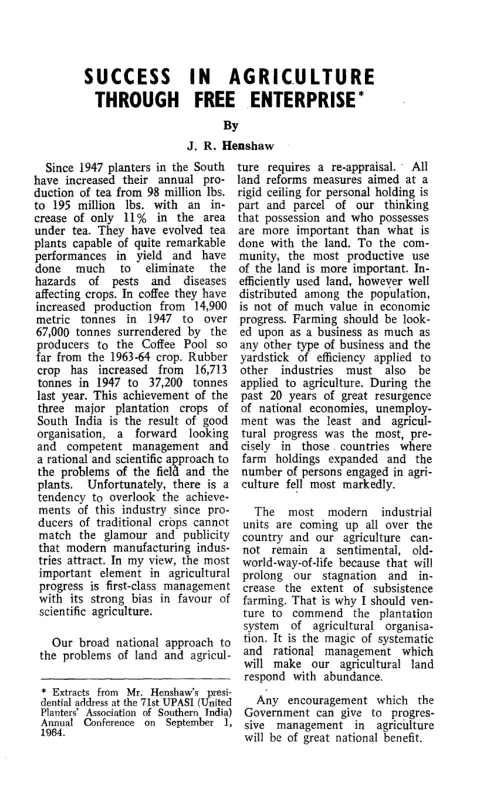
Success in Agriculture Through Free Enterprise
By J. R. Henshaw
Summary
In this Forum of Free Enterprise pamphlet — drawn from his presidential address to the 71st United Planters’ Association of Southern India (UPASI) annual conference on September 1, 1964 — J. R. Henshaw argues that the conspicuous productivity gains made by South Indian plantation industries since 1947 (tea, coffee and rubber output all sharply up despite pests, disease and rising costs) prove the case for treating agriculture as a business rather than a sentimental way of life. The ‘most important element’ in farm progress, he insists, is first-class scientific management; ceilings on personal holdings and other land-reform measures aimed only at redistribution add little to the national economic dividend.
The second half of the pamphlet is a sustained critique of India’s fiscal treatment of plantations. Henshaw argues that the cumulative weight of competing Central and State income taxes on agricultural income — uniquely Indian, in his telling — is starving the industry of the reserves it needs to expand. He calls for a uniform, capped agricultural income-tax rate (not exceeding 40 paise in the rupee), full depreciation on planted assets, restoration of the 50% development rebate on new plantings and replacements, and reversal of the 1963 Finance Act’s abolition of the direct export duty rebate on tea, which he says has made Indian tea worse off after export than before.
Throughout, he frames the choice as one between a ‘self-defeating’ policy that discourages expansion, labour and land use while squeezing revenue from a stagnating industry, and an alternative in which the Government matches its desire for higher production and exports with a corresponding willingness to modify fiscal, land, labour and administrative policy. The closing tax-coordination argument — that any concession given will ‘automatically be made good in terms of revenue’ because state revenues will expand with the industry — is offered as the supply-side payoff of free-enterprise agriculture.
Key points
-
South Indian planters have lifted production sharply since 1947 — tea from 98m to 195m lbs, coffee from 14,900 to over 67,000 metric tonnes (1963-64 crop), and rubber from 16,713 to 37,200 tonnes — despite pests, disease and rising costs.
-
Henshaw rejects sentimental, ‘old-world-way-of-life’ agriculture and argues that scientific, business-style management is the decisive variable in farm progress, more important even than the land itself.
-
Land-reform measures fixated on rigid ceilings for personal holding contribute little to economic progress; what matters is who can manage the land productively.
-
India is, in his account, the only country with a separate tax on agricultural income; the cumulative load of competing Central and State income taxes is starving plantations of resources to reinvest.
-
He calls for Central-State coordination on agricultural income tax, a uniform rate capped at 40 paise in the rupee, full recognition of depreciation on planted/soils assets, and restoration of the 50% development rebate withdrawn for new plantings, replacements and extensions.
-
He attacks the abolition of the direct export duty rebate on tea by the 1963 Finance Act, arguing that the enhanced non-refundable excise duty makes exporters worse off than producers selling at home.
-
The Mysore Government’s increases under the Mysore Land Revenue Act 1964 — in some cases a 34-fold rise from Rs. 2 to Rs. 76 per acre — are flagged as ‘an intolerable exaction’ that the industry cannot bear on top of existing burdens.
-
Overall thesis: government desire for higher production and exports must be matched by a willingness to modify fiscal, land, labour and administrative policy; concessions to a growing industry pay for themselves in expanded revenue.
Generated by the v1.5 extraction pipeline. Awaiting editorial review.
Metadata and summary are AI-extracted from the source PDF and reviewed for editorial accuracy. The original work is available via the Read PDF tab above (where present); paragraph-level citation inside the PDF is deferred to a future engagement.
People in this work
Related across the archive
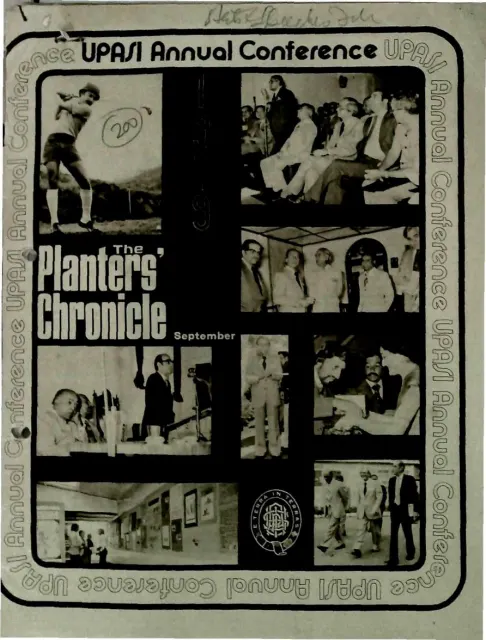 Primary workThe Planters' Chronicle
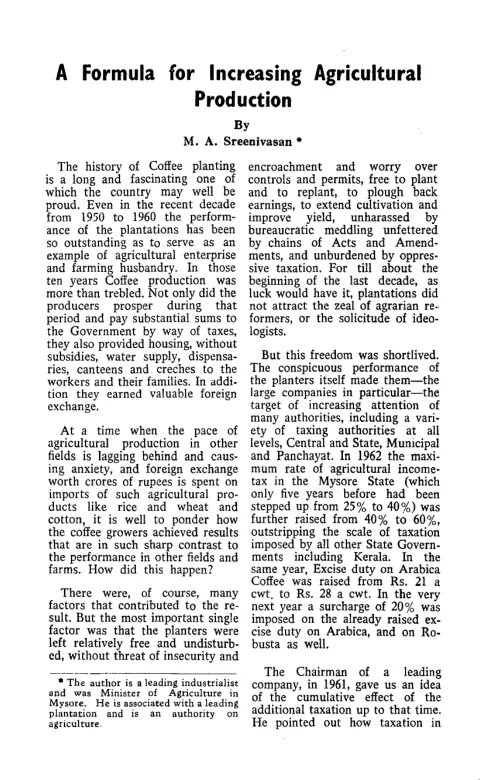 Primary workA Formula for Increasing Agricultural Production
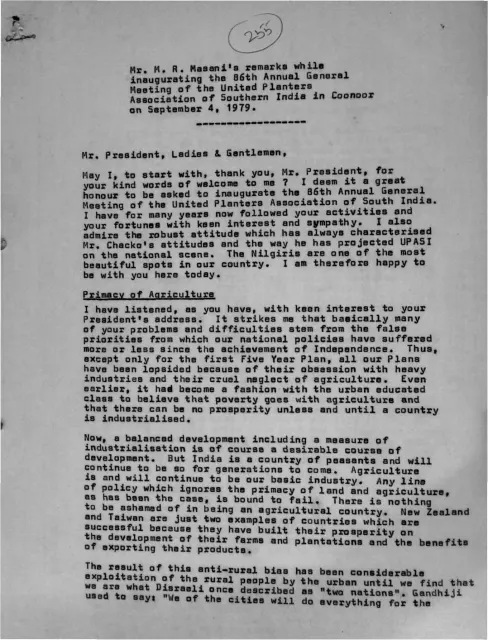 Primary workMr. M. R. Masani's remarks while inaugurating the 86th Annual General Meeting of the United Planters Association of Southern India in Coonoor on September 4, 1979.
 ExcerptEconomic Reforms In India: Where Are We And Where Do We Go?
 ExcerptThe Missed Opportunity