speech
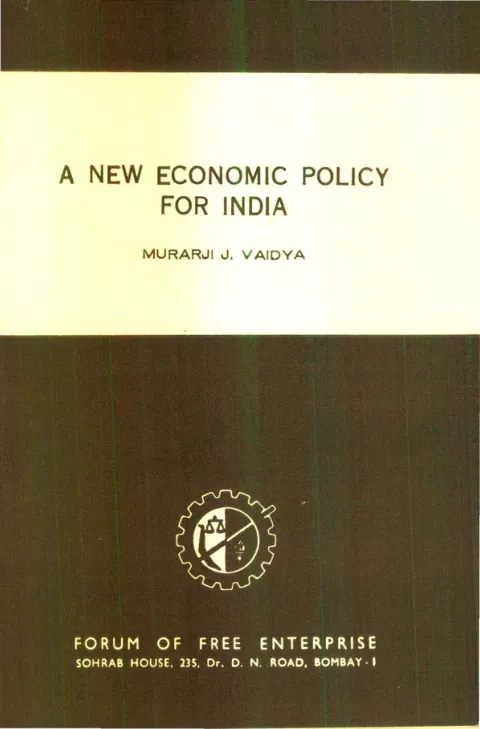
A NEW ECONOMIC POLICY FOR INDIA
FORUM OF FREE ENTERPRISE, SOHRAB HOUSE, 235, Dr. D. N. ROAD, BOMBAY-1 · Bombay · 1967
20 pages
Summary
Delivered as the eleventh annual presidential address at the Forum of Free Enterprise in Bombay on October 4, 1967, and published as a booklet by the Forum on 15 November 1967, Murarji J. Vaidya’s lecture is a sustained indictment of the Soviet-style centralised comprehensive planning that India adopted from the Second Plan onwards and a manifesto for what he calls a “new economic policy”. Vaidya opens by registering the disenchantment with planning that has reached even Indira Gandhi, Dr. S. Radhakrishnan, G. L. Nanda, Jayaprakash Narayan and Planning Commission Deputy Chairman D. R. Gadgil, and reads the 1967 election verdict, via an Indian Institute of Public Opinion analysis, as the country settling “slightly right of centre”.
He weighs the achievements of fifteen years of planning — a near-doubling of national income, food output rising to a potential 90 million tonnes, an industrial production index up from 73.5 to 200, expanded social services — against a long bill of failures: dependence on food imports, galloping inflation, idle capacity in heavy industry, foreign-exchange assets crashing from Rs. 1,030 crores to barely above the statutory minimum, public debt swelling to Rs. 15,308 crores, and unemployment back to 12 million on the eve of the Fourth Plan. The core diagnosis is that the Soviet model inverted the natural order of growth by starving agriculture to feed massive heavy industries, and that even the U.S.S.R., Burma, Britain’s Labour Party and Soviet enterprises under the Liebermann thesis are now reversing course toward markets and the profit motive.
Vaidya then unfolds three lessons. First, agriculture is the “king-pin” of the Indian economy and the farmer must be given price incentives rather than monopoly procurement, food zones and hidden export bonuses that punish both producer and consumer; he cites Ceylonese rice gains and the Administrative Reforms Commission’s call to abolish food zones. Second, plans cannot be financed beyond the country’s resources: he tracks money supply from Rs. 2,016 crores in 1950–51 to Rs. 4,529 crores by 1965–66, calls inflation “a tax on the cash holdings of the community”, and exposes the Reserve Bank’s “unfunded debts” as concealed deficit financing. Third, money is more productive in private than in state hands: he marshals Auditor-General figures showing Rs. 9.93 crores returned on Rs. 2,226 crores of central public-sector capital, Punjab audit objections worth Rs. 74 crores, chronic losses at Durgapur, and an Economic and Scientific Research Foundation estimate of Rs. 100 crores per year of lost industrial output from public-sector inefficiency.
The prescription is a turn from centralised comprehensive to French-style indicative planning, scrapping of controls, drastic cuts in government expenditure, abolition of confiscatory and Annuity Deposit taxation, and firm restoration of law and order against gheraos and bandhs. Citing Malaysia under Tun Abdul Razak, Britain under James Callaghan and President Lyndon Johnson’s Asian Development Bank appeal, Vaidya closes that a new economic policy which releases “the creative energies of the people” is the only route out of stagnation toward prosperity in a free society.
Key points
-
The text is the eleventh annual presidential address of the Forum of Free Enterprise, delivered by Murarji J. Vaidya in Bombay on 4 October 1967 and printed as a booklet on 15 November 1967.
-
Vaidya registers a bipartisan disenchantment with centralised planning, citing Indira Gandhi, Radhakrishnan, G. L. Nanda, Jayaprakash Narayan and D. R. Gadgil, and reads the 1967 elections as a verdict ‘slightly right of centre’.
-
He tabulates planning’s achievements (national income, food, industrial index, social services) but argues these are dwarfed by deficits: food imports, inflation of 16.5% in 1966–67, idle heavy-industry capacity, foreign-exchange exhaustion, Rs. 15,308 crores of public debt and 12 million unemployed.
-
His central thesis is that the Soviet model inverted the natural order of growth by starving agriculture; he insists the farmer is the ‘king-pin’ of the Indian economy and must be given price incentives, not monopoly procurement and food zones.
-
He attacks inflation as a hidden tax ‘on the cash holdings of the community’ engineered by deficit financing concealed in Reserve Bank ‘support to public loans’ and ‘unfunded debts’.
-
Public-sector enterprises are pilloried with Auditor-General data: Rs. 9.93 crores return on Rs. 2,226 crores of capital, cumulative Hindustan Steel losses of Rs. 59.3 crores, Durgapur losses of Rs. 13 crores, and a national output loss of about Rs. 100 crores per year.
-
Vaidya invokes the U.S.S.R.’s Liebermann thesis, Burma’s reopening of food trade, Britain’s Labour Party under James Callaghan, and Malaysia under Tun Abdul Razak as evidence that even socialist economies are retreating toward private enterprise.
-
The prescription: replace centralised comprehensive planning with French-style indicative planning, scrap controls, abolish confiscatory taxation and the Annuity Deposit Scheme, restore law and order against gheraos and bandhs, and unleash the creative energies of private enterprise.
Metadata and summary are AI-extracted from the source PDF and reviewed for editorial accuracy. The original work is available via the Read PDF tab above (where present); paragraph-level citation inside the PDF is deferred to a future engagement.