non liberal
Jayaprakash Narayan
1902–1979
Also known as: JP, JP Narayan, Jaya Prakash Narayan, Jai Prakash Narayan, Lok Nayak, जयप्रकाश नारायण, जे. पी. नारायण, জয়প্রকাশ নারায়ণ
How Jayaprakash Narayan is discussed in this archive
Authored 45 works in the archive.
Referenced in 22 other works , including The Indian Libertarian , Towards Party-less Democracy , and The Early Years, Emergency Era and Tryst with Civil Services .
In The Early Years, Emergency Era and Tryst with Civil Services : The speaker explicitly invokes 'Lok Nayak JP' as the movement leader he and other young people were prepared to follow without question — this matches the authority list's jayaprakash-narayan entry whose aliases include 'Lok Nayak' and 'JP'.
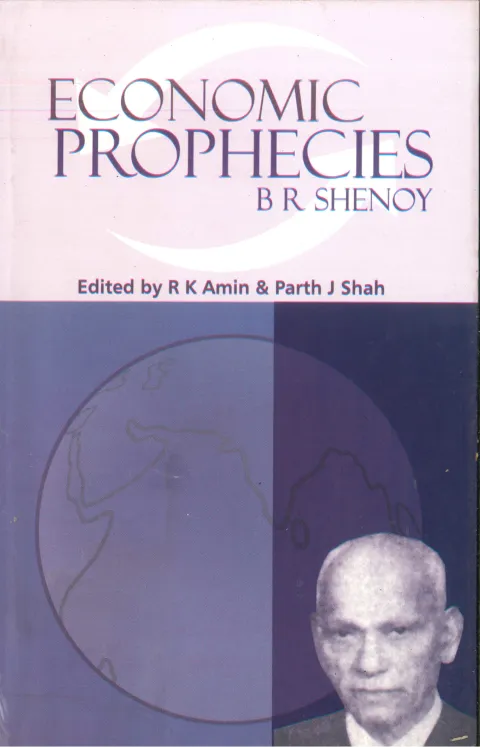
In Economic Prophecies : JP appears twice — once as a hypothetical Gandhian prime minister whose moral authority would still be insufficient to reverse the planning-era damage without structural reform, and once as an 'ostensible friend' of free enterprise whose support Shenoy finds inconsistent.
In Fifty Years After ... : Jayaprakash Narayan is listed by E.
In Inflation & Economic Growth : Iengar repeatedly returns to JP Narayan's appeal for moral renewal as the ethical foil to his diagnosis of administrative decay and political corruption.
In A NEW ECONOMIC POLICY FOR INDIA : Jayaprakash Narayan's disenchantment with planning is cited alongside other prominent figures to demonstrate that dissatisfaction with the Soviet-style model has become cross-ideological.
By Jayaprakash Narayan (45)
Showing 45 of 45
- lecture
2nd Indian Liberals Annual Lecture | The Scope for Political Liberalism in India by Dr. JP Narayan
2022 · lecture
-
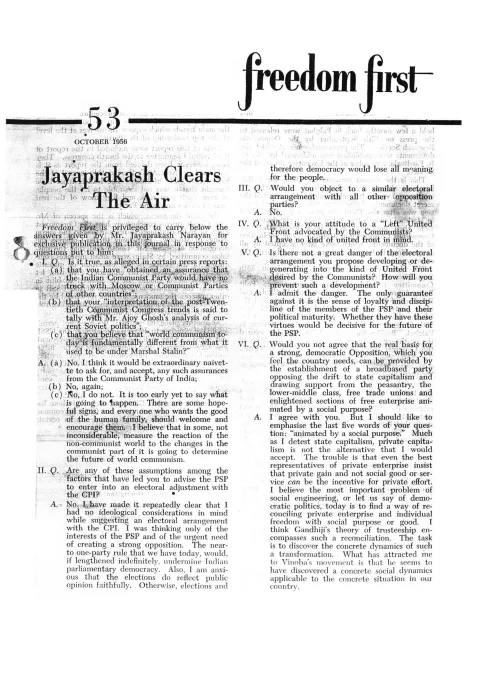
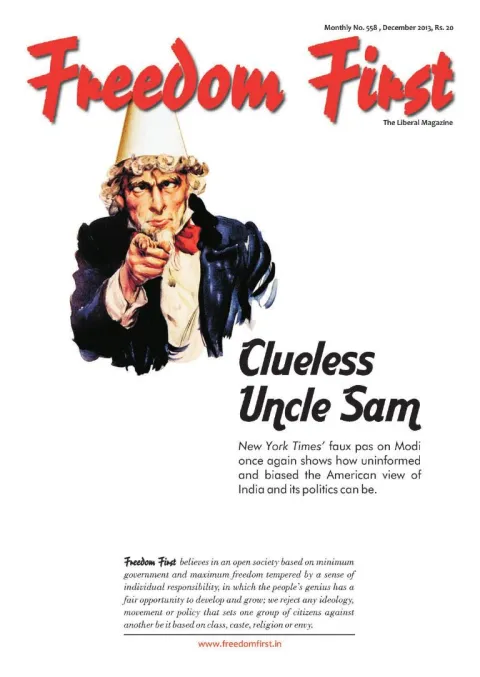
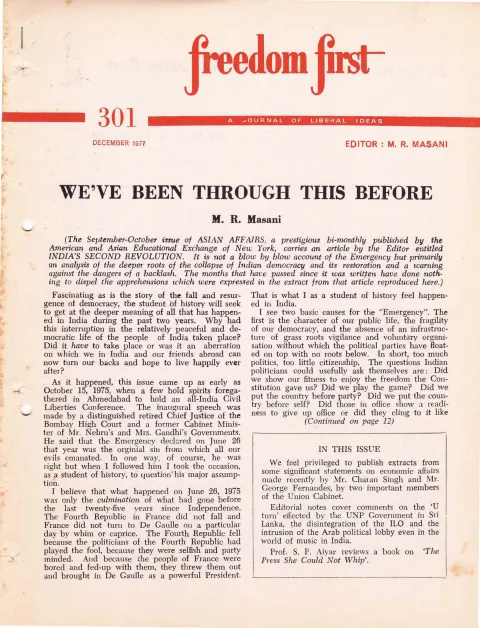
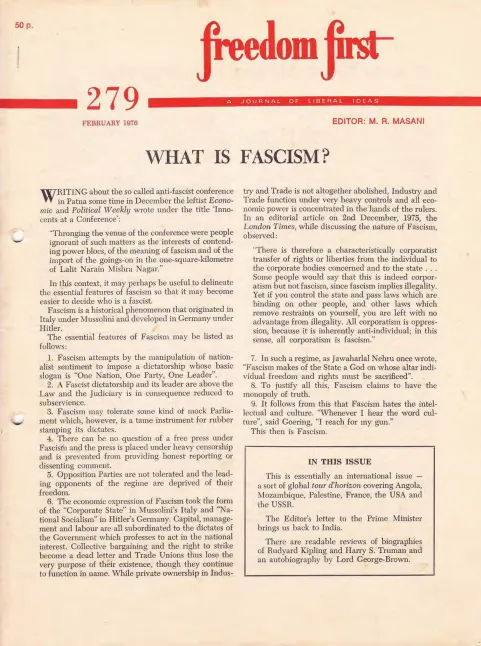
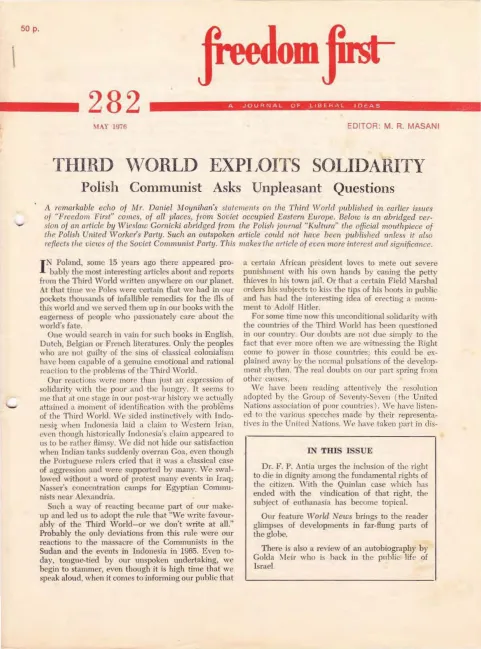
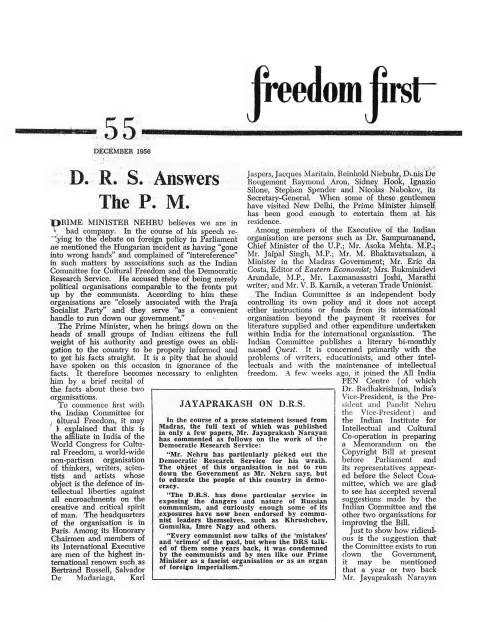
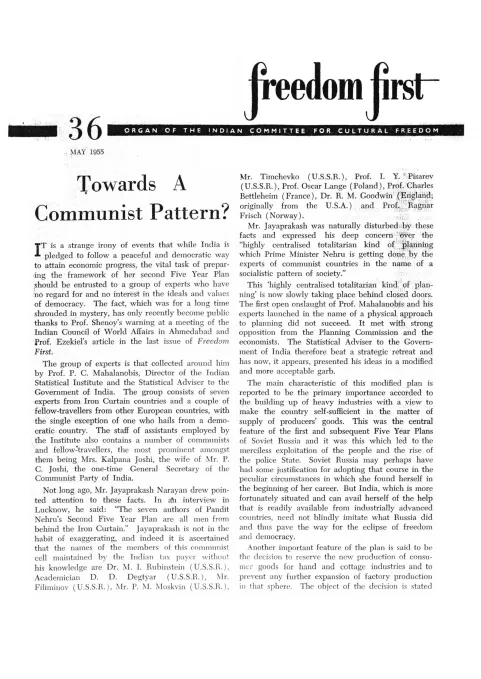
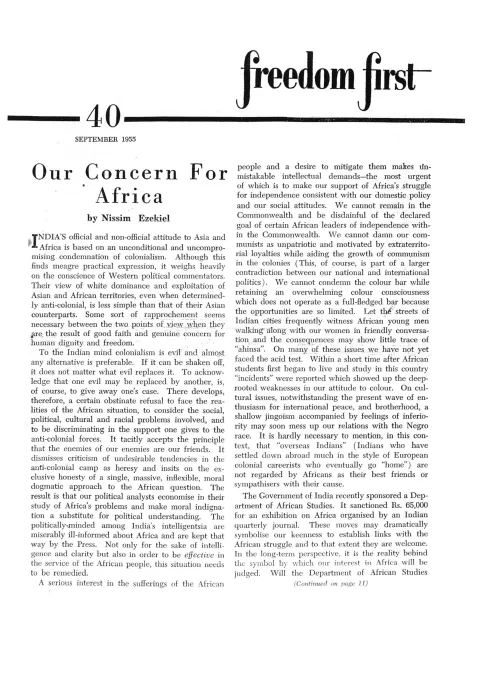
Freedom First
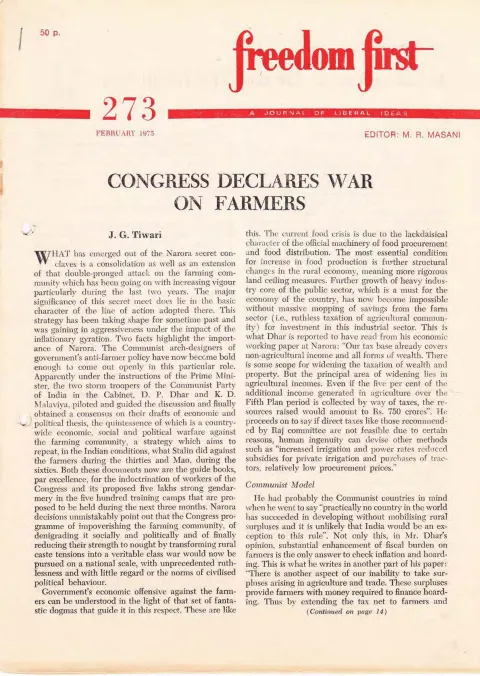
2009 · periodical issue
-
Freedom First
2002 · periodical issue
-
Freedom First
2002 · periodical issue
-
Freedom First
1988 · periodical issue
-
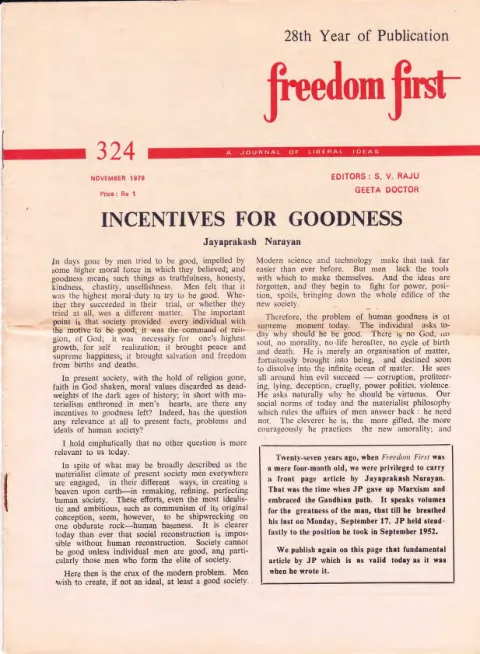
Freedom First
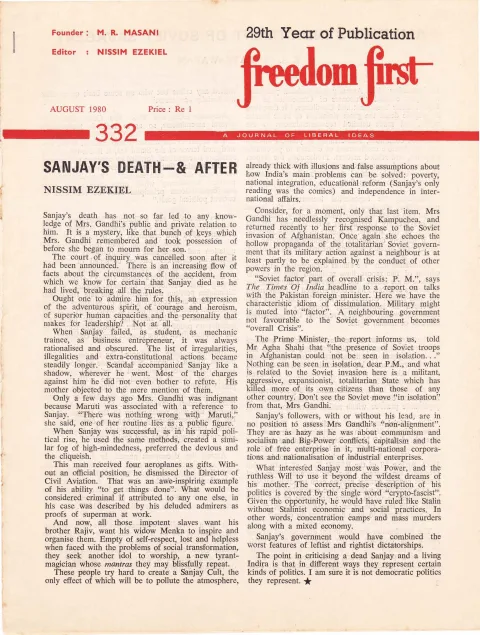
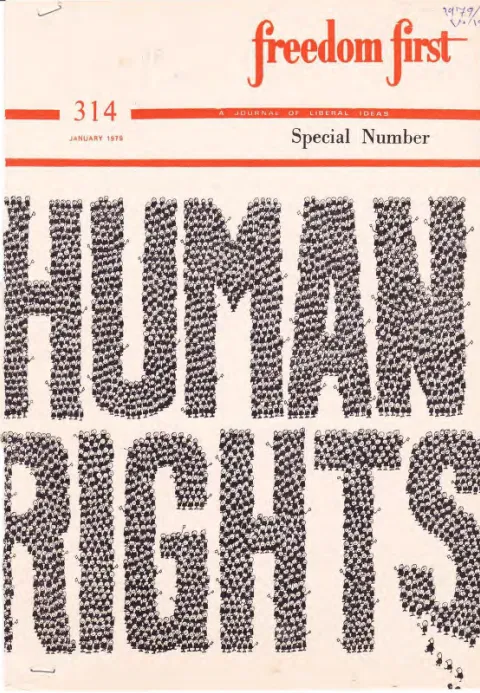
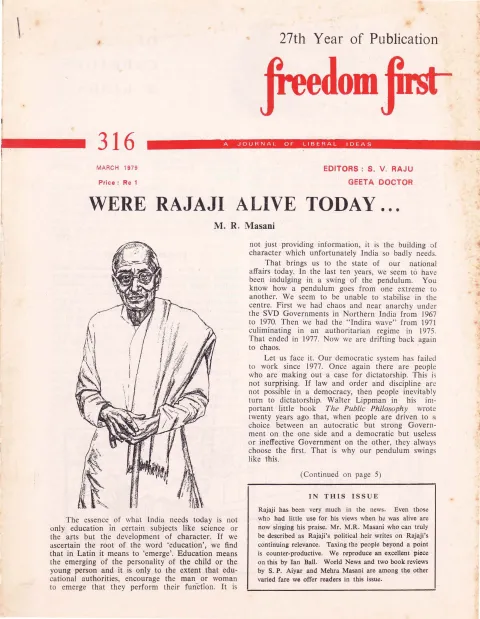
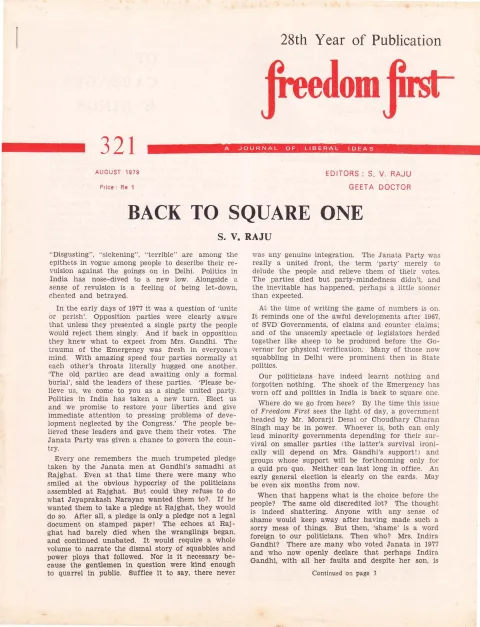
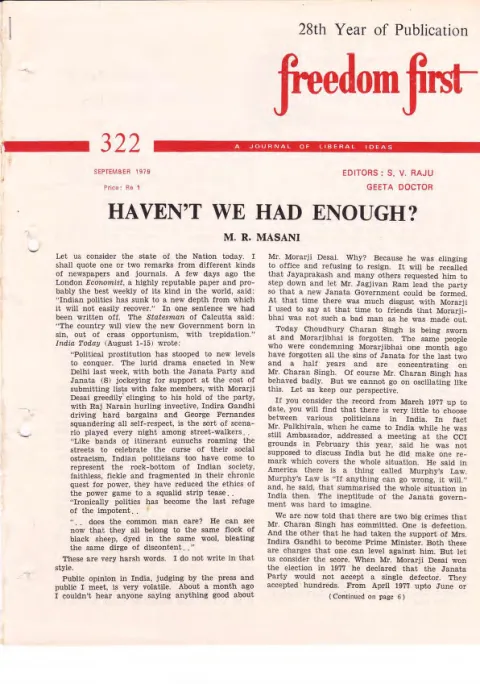
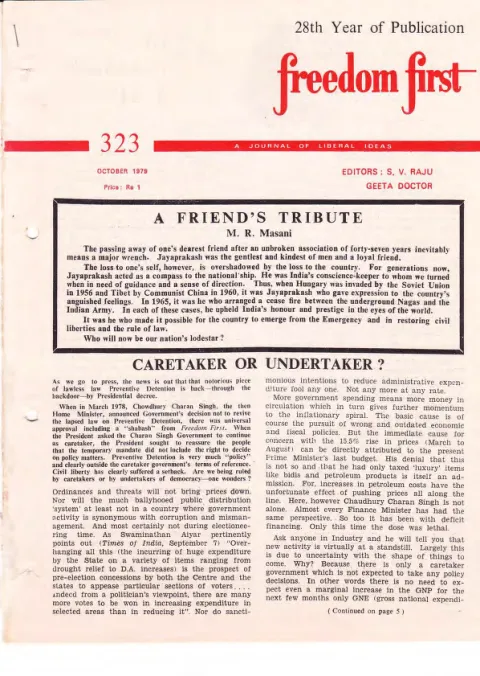
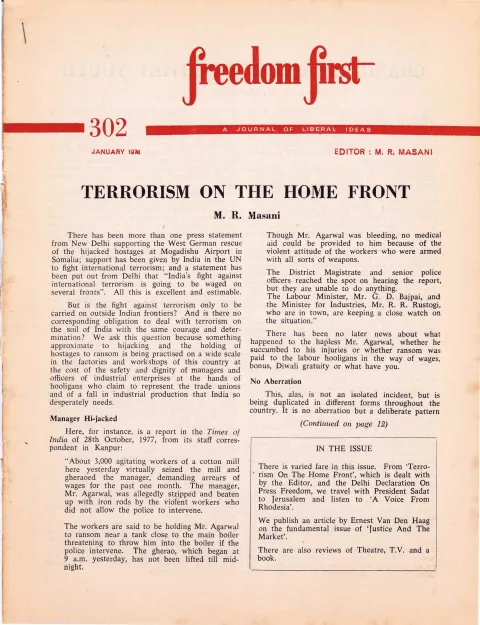
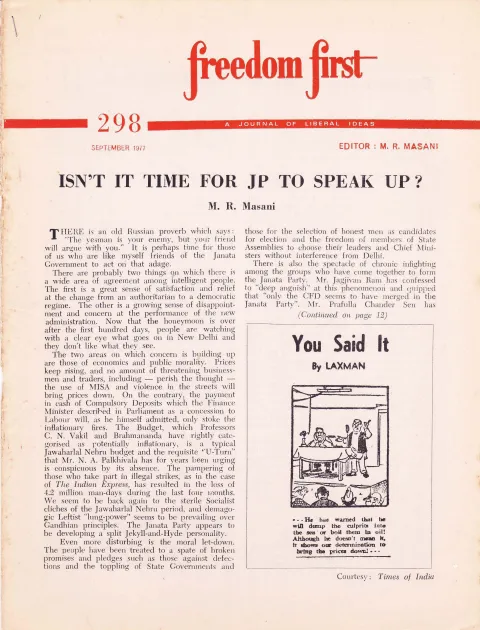
1979 · periodical issue
-
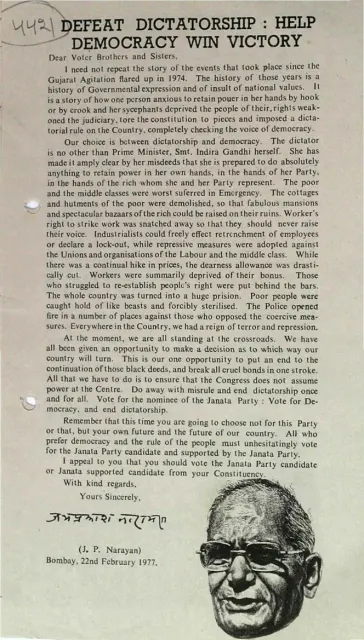
DEFEAT DICTATORSHIP : HELP DEMOCRACY WIN VICTORY
1977 · letter
-
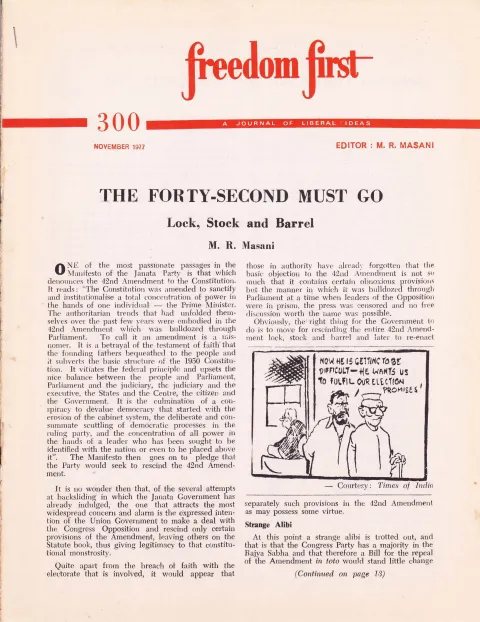
Freedom First
1977 · periodical issue
-
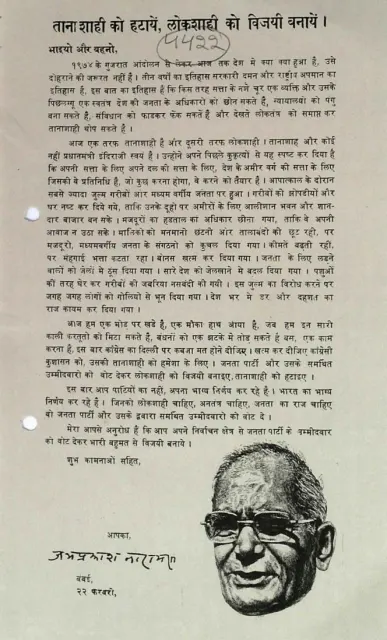
तानाशाही को हरायें, लोकतन्त्र को विजयी बनायें !
1977 · letter
-
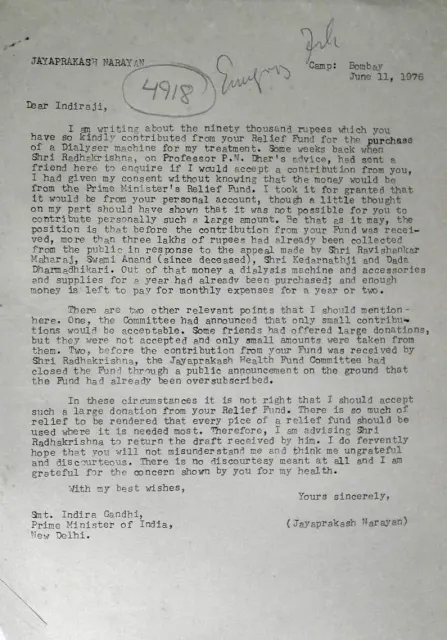
Letter to Smt Indira Gandhi
1976 · letter
-
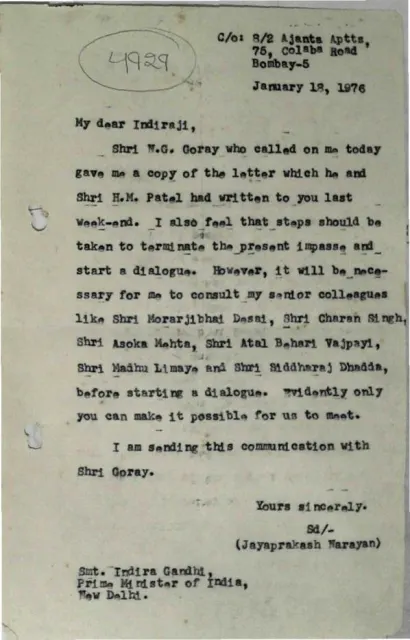
Letter to Smt Indira Gandhi
1976 · letter
-
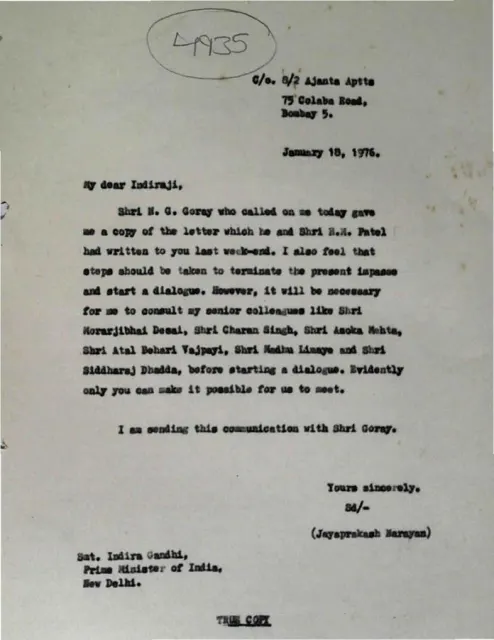
Letter to Smt Indira Gandhi
1976 · letter
-
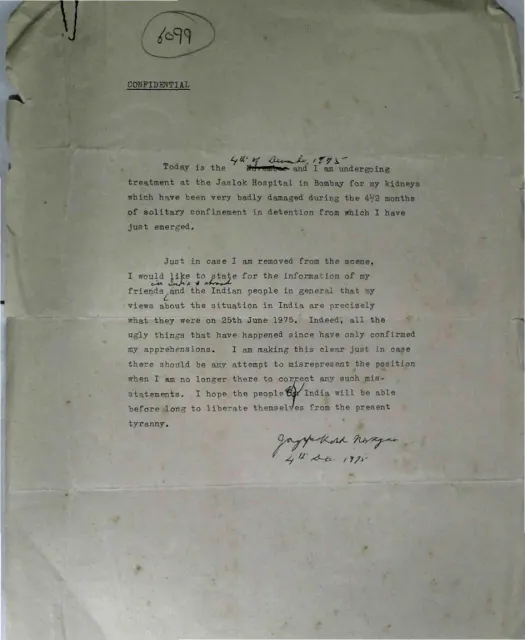
Letter to Jayaprakash Naryan
1975 · letter
-
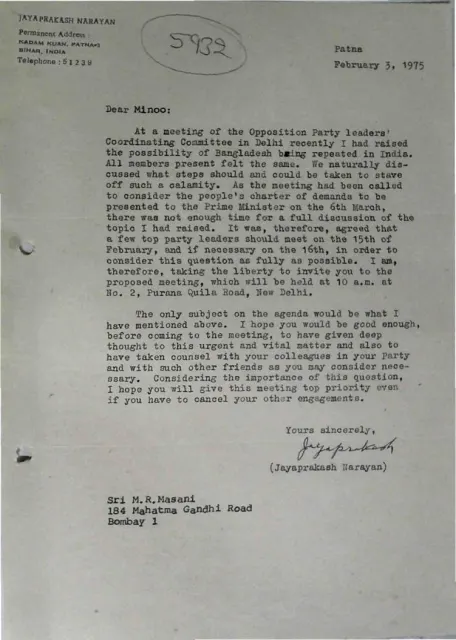
Letter to Mr Minoo Masani
1975 · letter
-
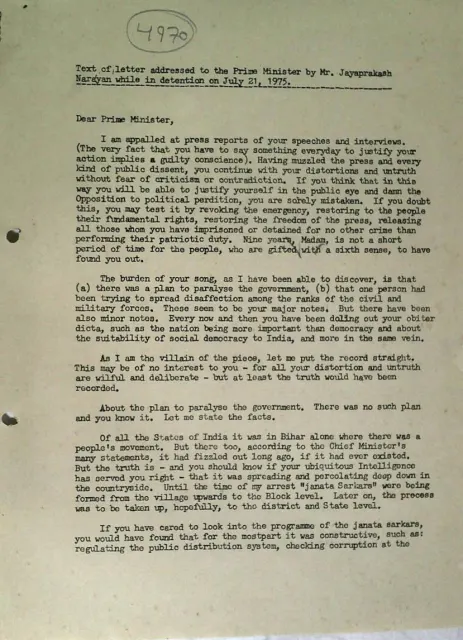
Text of letter addressed to the Prime Minister by Mr. Jayaprakash Narayan while in detention on July 21, 1975.
1975 · letter
-
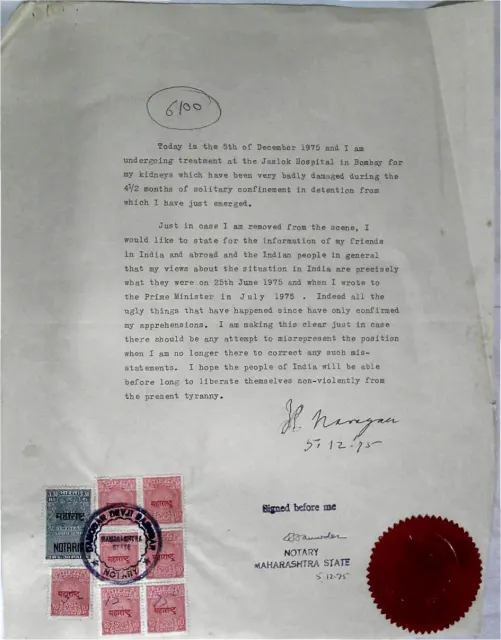
Undergoing Treatment Jaslok Hospital
1975 · essay
-
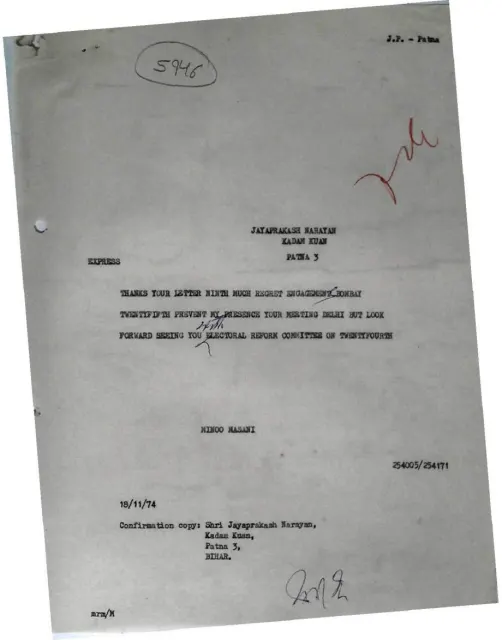
Letter to Jayaprakash Naryan
1974 · correspondence
-
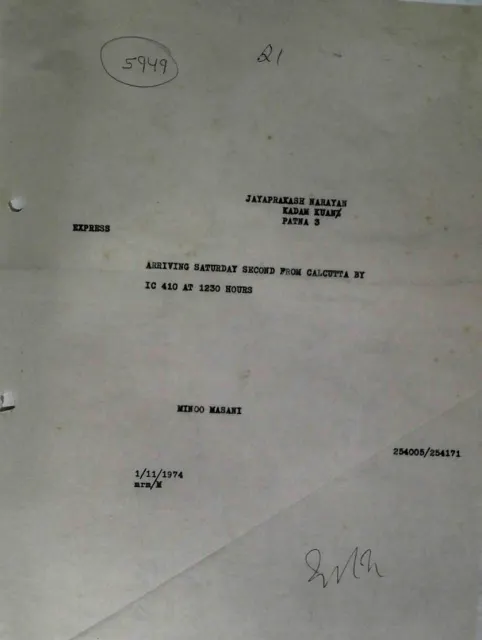
Letter to Jayaprakash Naryan
1974 · letter
-
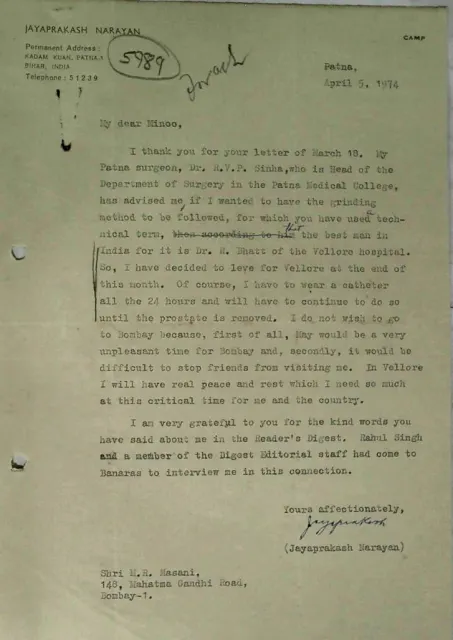
Letter to Mr Minoo Masani
1974 · letter
-
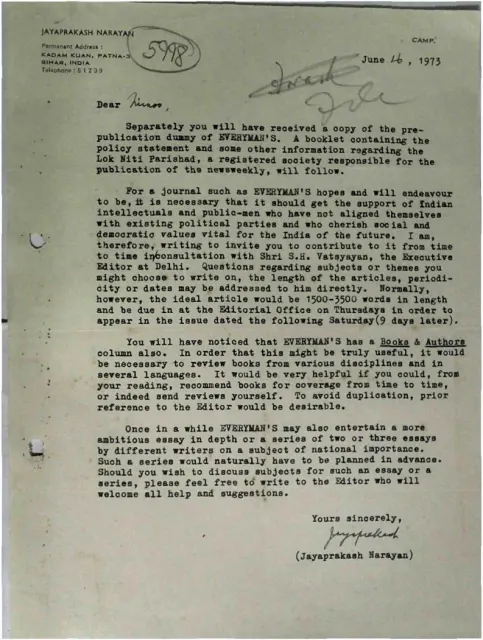
Letter from Mr Minoo Masani
1973 · letter
-
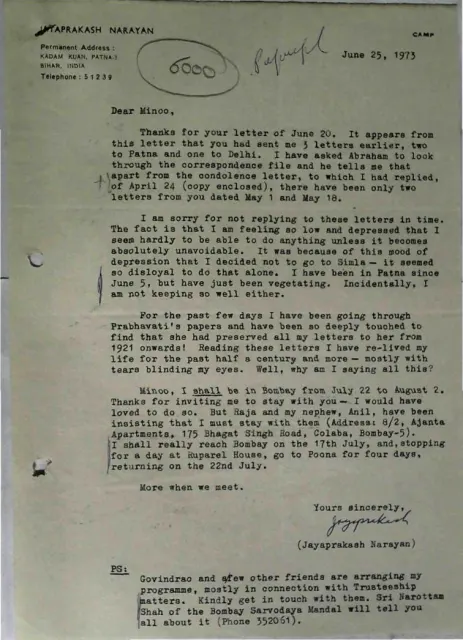
Letter to Mr Minoo Masani
1973 · letter
-
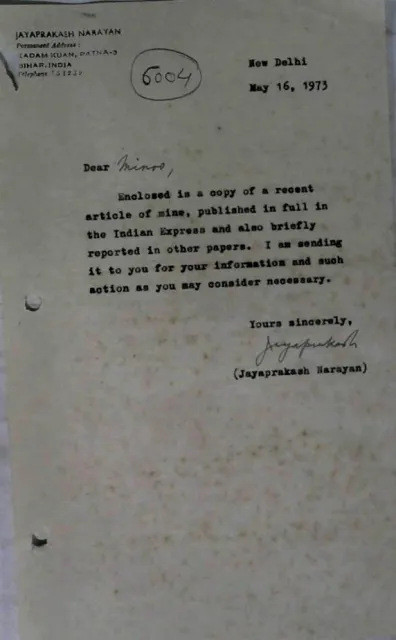
Letter to Mr Minoo Masani
1973 · letter
-
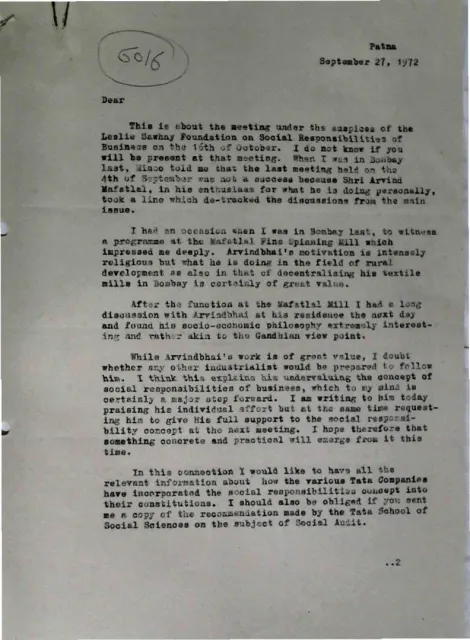
Letter from Jayaprakash Naryan
1972 · edited volume
-
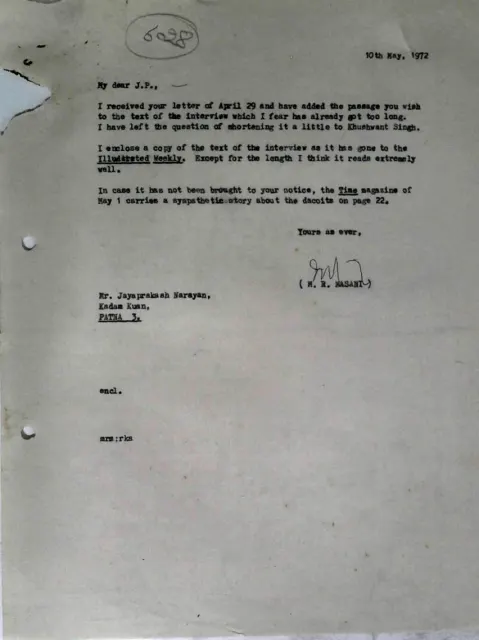
Letter to Jayaprakash Naryan
1972 · correspondence
-
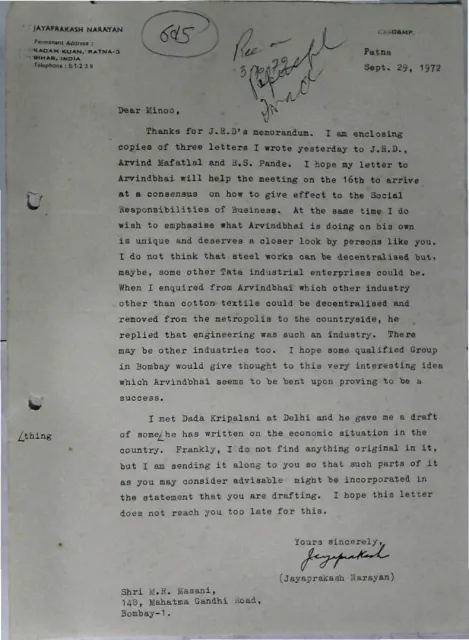
Letter to Mr Minoo Masani
1972 · letter
-
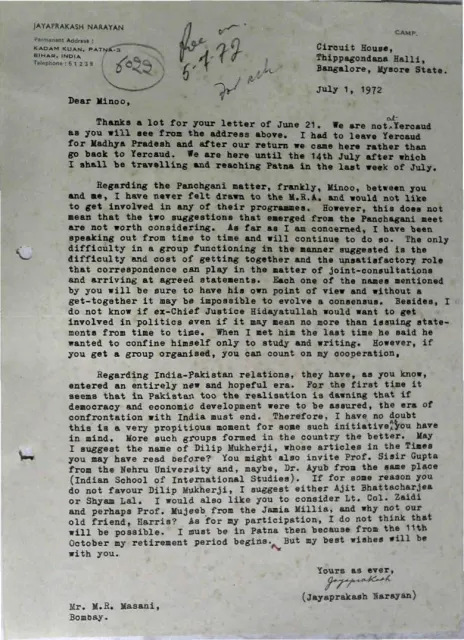
Letter to Mr Minoo Masani
1972 · letter
-
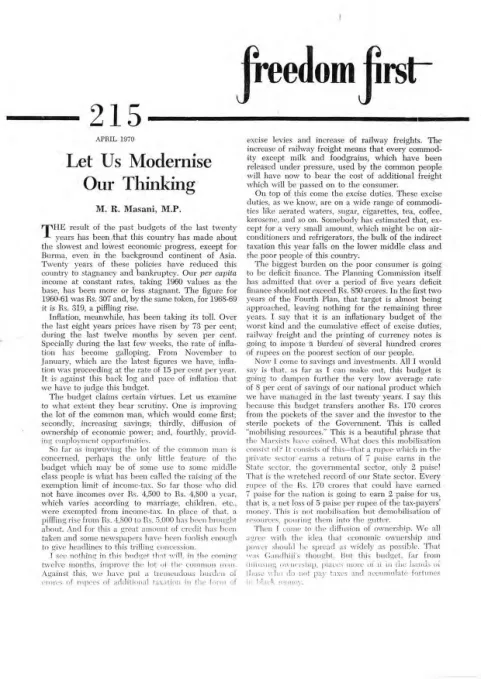
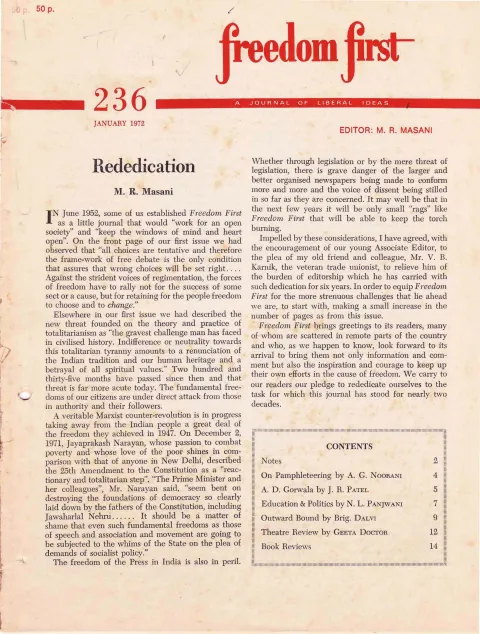
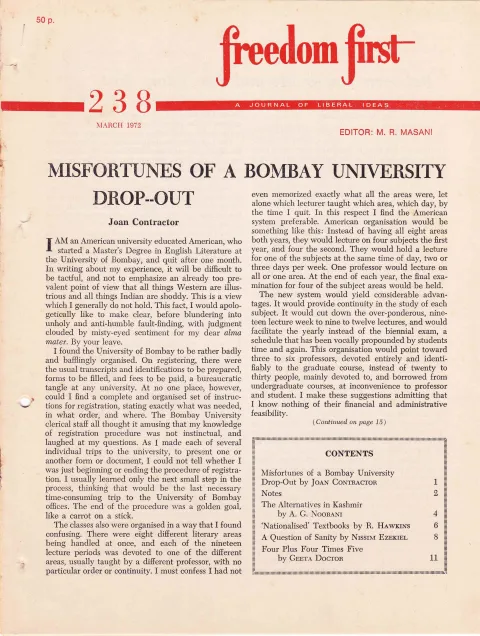
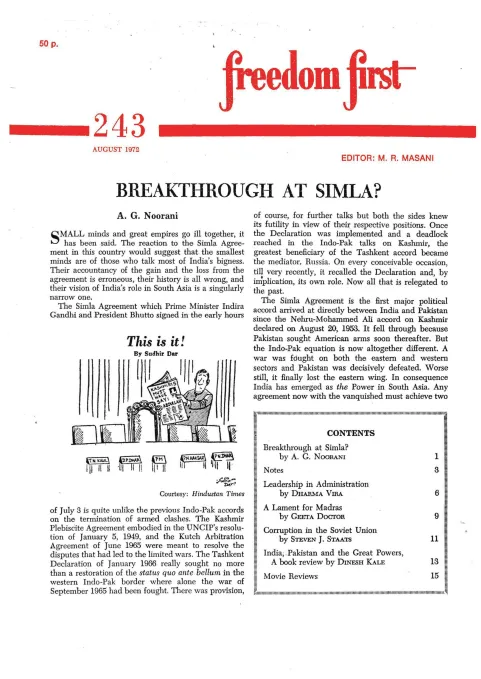
Freedom First
1970 · periodical issue
-
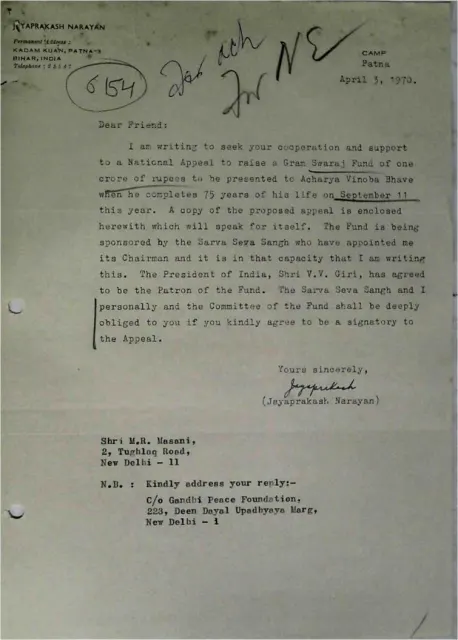
Letter to Mr Minoo Masani
1970 · letter
-
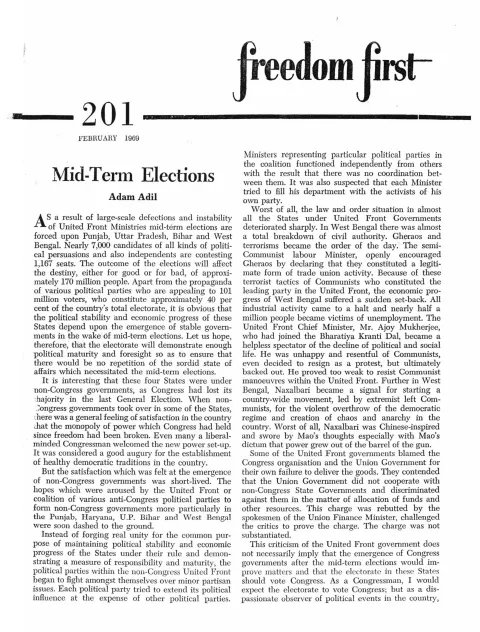
Freedom First
1969 · periodical issue
-
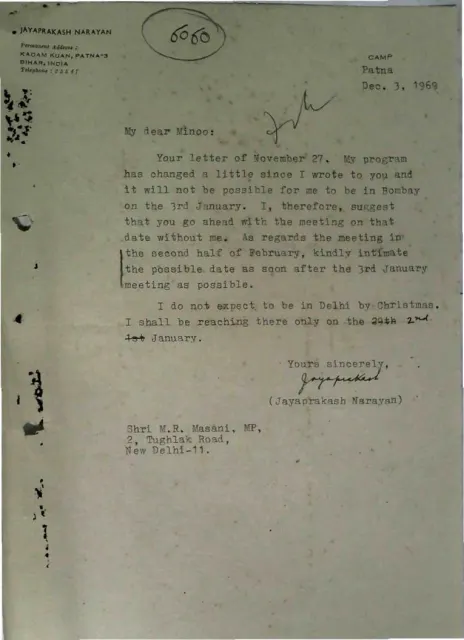
Letter to Mr Minoo Masani
1969 · letter
-
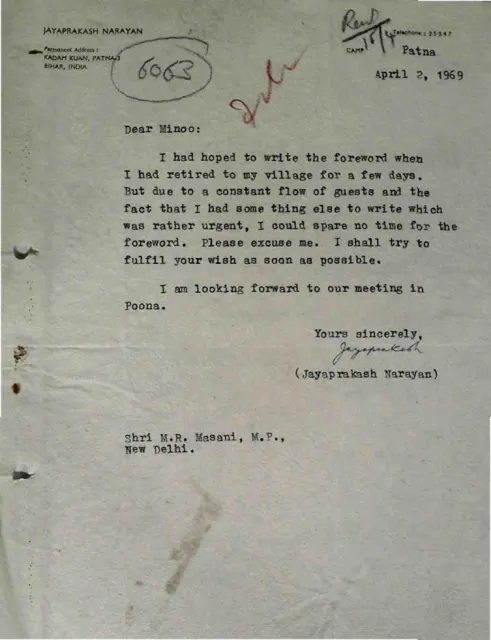
Letter to Mr Minoo Masani
1969 · letter
-
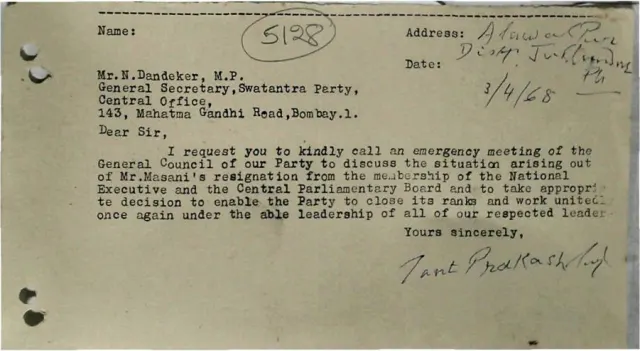
Letter to N Dandeker
1968 · letter
-
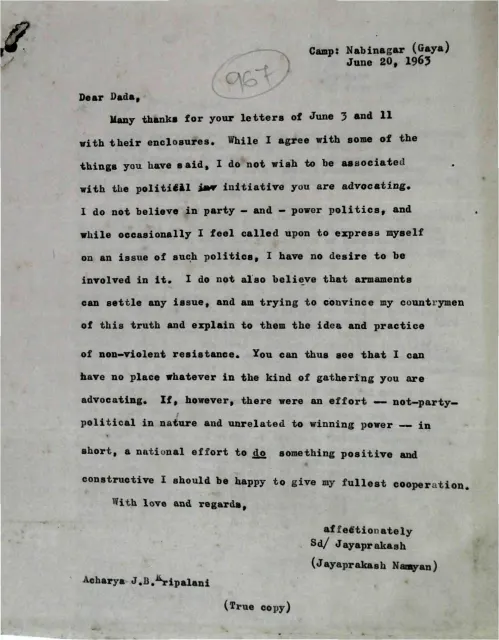
Letter to Kripalani
1963 · letter
-
Freedom First
1962 · periodical issue
-
Freedom First
1961 · periodical issue
-
Freedom First
1960 · periodical issue
-

ASIA'S FUTURE
1959 · essay
-
Freedom First
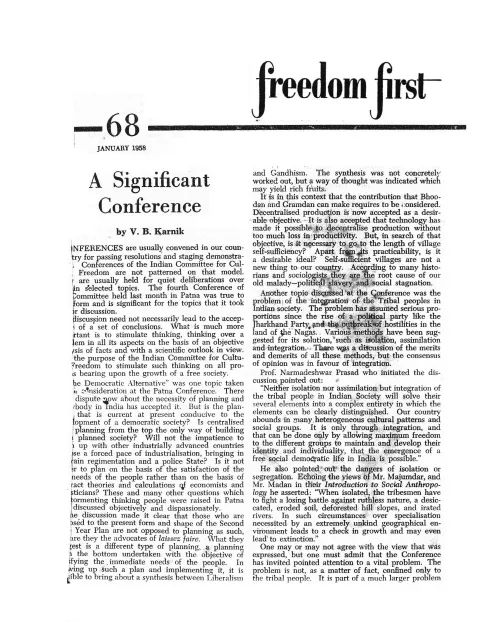
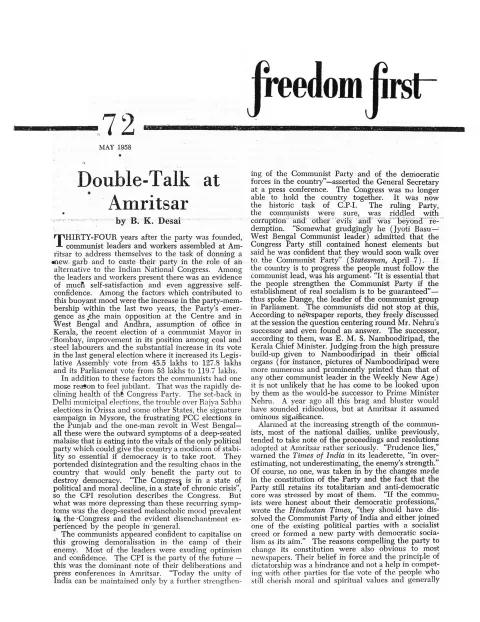
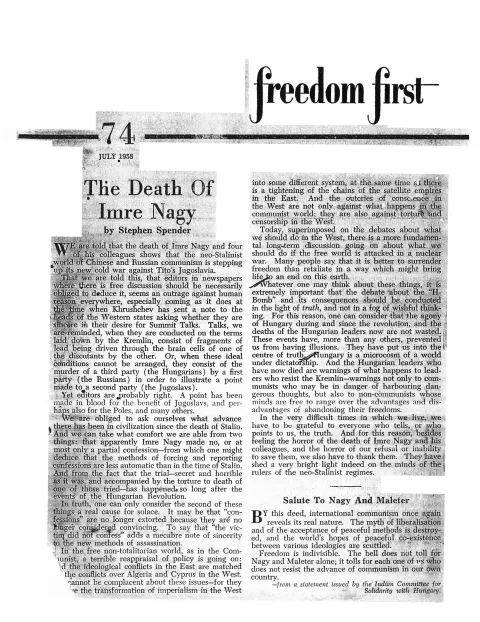
1958 · periodical issue
-

EXTRACTS FROM J.P.'s LETTER TO J.N. FROM URLI KANCHAN (POONA) DATED MARCH 7, 1957.
1957 · letter
-
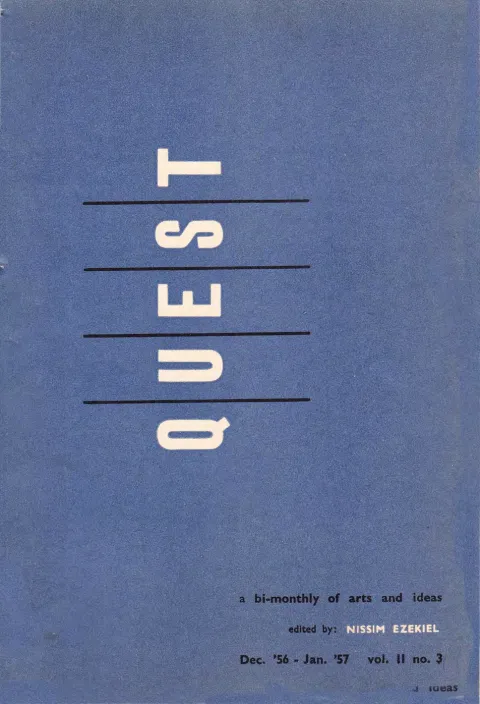
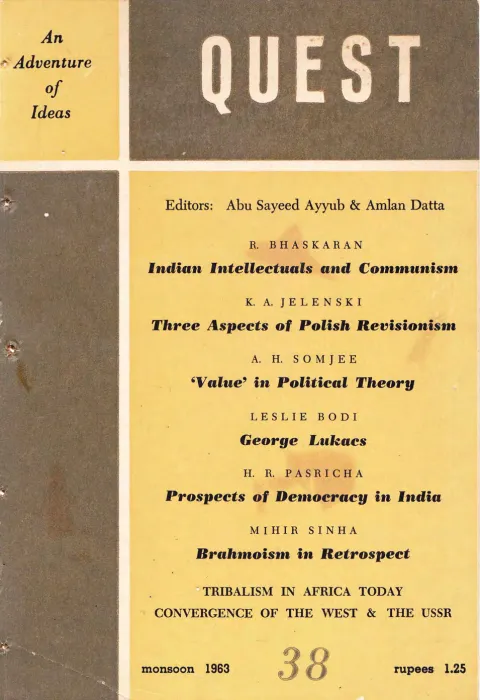
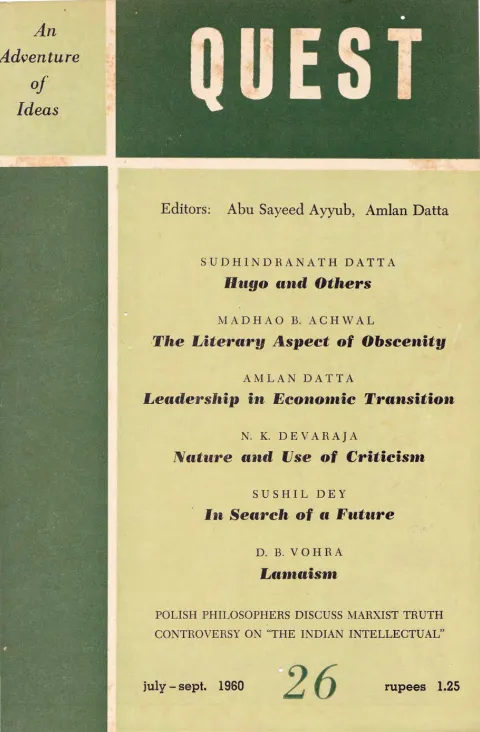
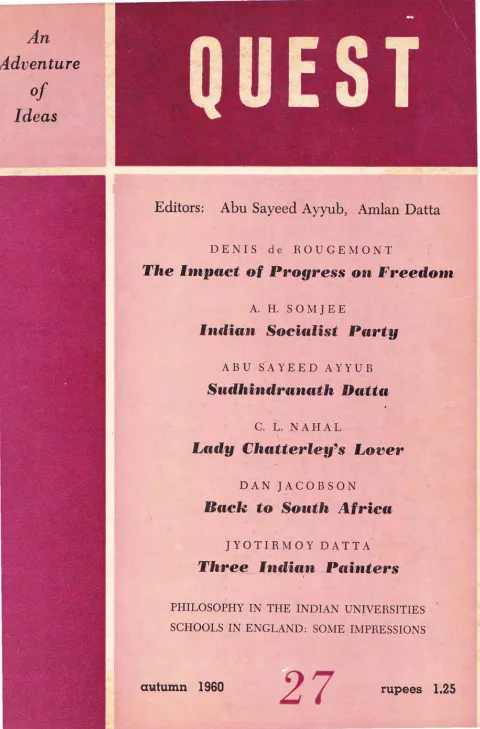
Quest
1956 · periodical issue
-
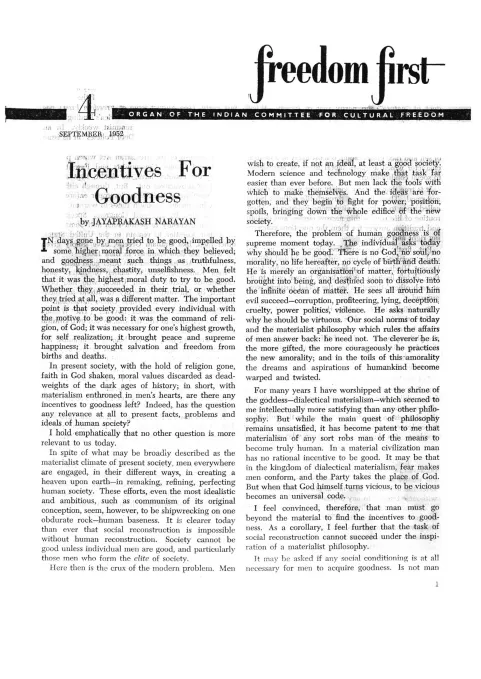
Freedom First
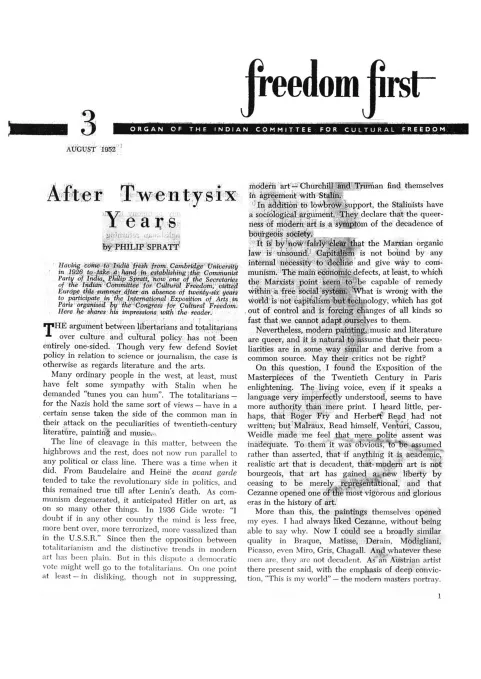
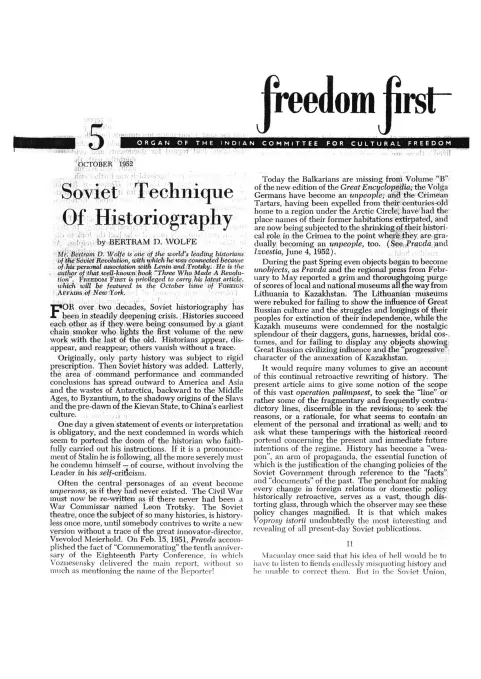
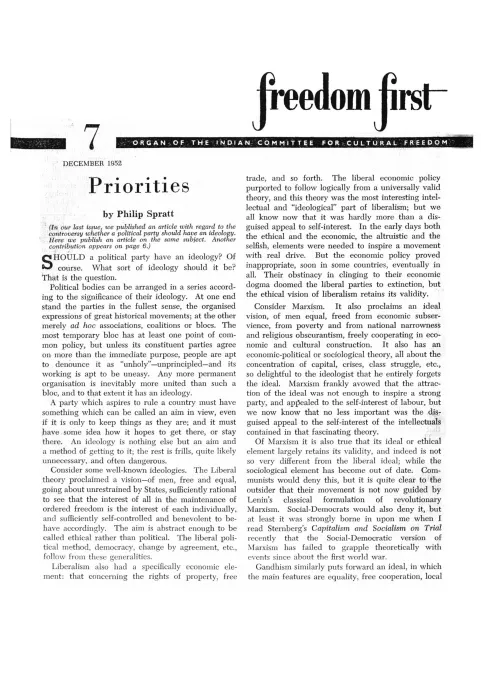
1952 · periodical issue
-
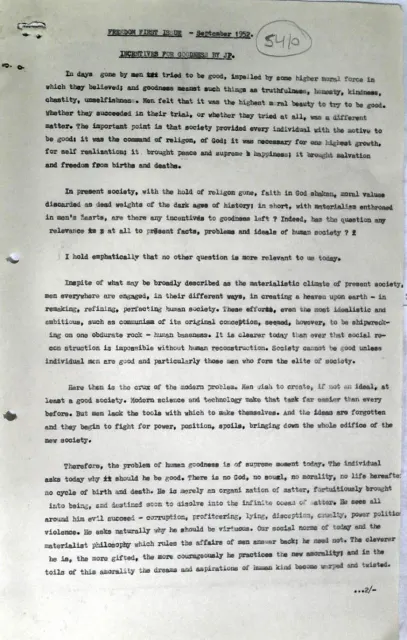
INCENTIVES FOR GOODNESS
1952 · essay
-
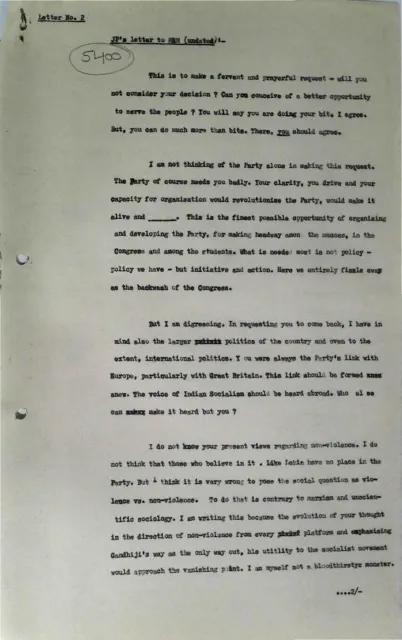
JP's letter to MRM (undated)
n.d. · correspondence
-
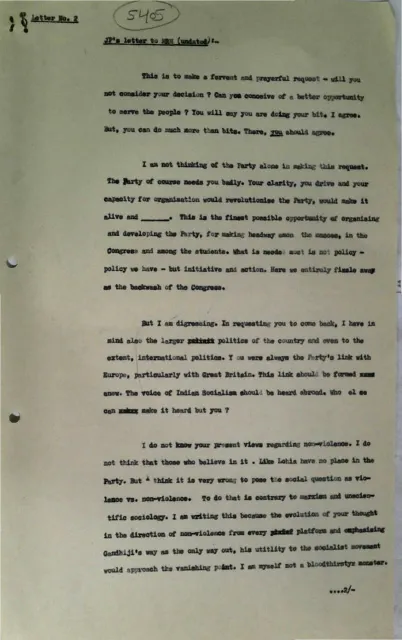
JP's Letter to MRM (undated)
n.d. · letter
-
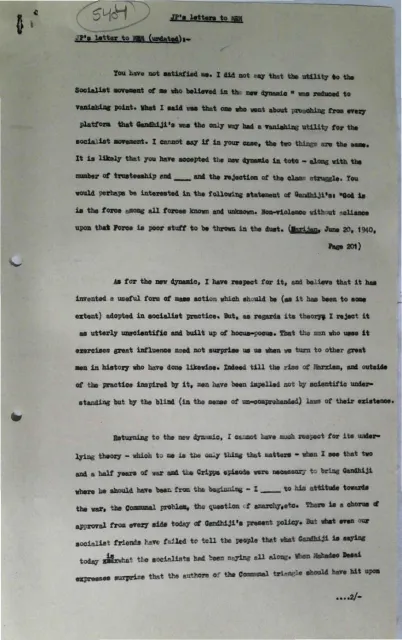
JPS letter to MRM
n.d. · letter
Nothing here matches. Clear the search or remove some filters.
Matches inside Jayaprakash Narayan's works and pages
Excerpts (1)
Short passages from the archive associated with Jayaprakash Narayan. An excerpt may be a quoted passage, a summary, or an editorial description, so these are kept separate from the works Jayaprakash Narayan authored.
Mentioned in (257)
Primary works (245)
- Liberalism and the Challenge of Polarisation · 2020
- "I think it's a challenge, as of that. I would not like to minimize the challenge. I'm a great optimist." · Opening framing of the monologue
- "I think the most important principle that we have ignored in India in fighting polarization is that ultimately individuation politics of individuation." · Stating his central thesis
- The Challenges for Liberal Grassroots Movements · 2020
- "the biggest challenge for me was twofold" · Framing the central problem he confronted as movement founder.
- "For about ten, twelve years, I traveled every single day. I must have addressed, at least at the very least, about 10,000 gatherings" · Describing his own mobilisation effort.
- The Early Years, Emergency Era and Tryst with Civil Services · 2020
- "the movements that arose out of the anger against the misgovernance and failed governance and missed opportunities resulted in Nav Nirman Samiti in Gujarat, then Lok Nayak JP movement, Chhatra Sangharsh Samiti in Bihar" · Naming the JP movement as part of the 1974-75 ferment
- "If Lok Nayak JP or somebody said, you jump off from the 3rd floor hospital of yours, and that'll help the country in some way or the other, I would have gladly jumped off." · Conveying the emotional pull JP exerted on young activists
- The Hope for a Liberal Political Alternative · 2020
- "When we founded a political party, it was with great reluctance because I'm not a — by now, you would have realized over the past twenty years that I'm not a combative person" · Self-identifies as founder of the political formation (Lok Satta) reflecting on twenty years of public life.
- "While Lok Satta is very lucky, singularly fortunate perhaps in the country and perhaps even in the world in achieving significant outcomes — three constitutional amendments, seven or eight major laws, four or five major policy changes in the country" · Speaks from within Lok Satta about its institutional achievements.
- The Relationship Between Citizen and State · 2020
- "In this #IndianLiberals monologue, Dr. Jaya Prakash Narayana ( Founder, Lok Satta Movement) discusses the liberalism's larger philosophy i.e. the relationship between Citizen and State" · Editorial description identifying the speaker
- "I'm now 64 years old. I'm pretty healthy, I believe." · First-person reference establishing the speaker's voice throughout the monologue

Show all 245
- Economic Prophecies · 2004
- "Shenoy closes by arguing that even a Gandhian government — with J P Narayan or Vinoba Bhave as prime minister — could not correct the chaos without a thorough restructuring of policies including heavy cuts in public-sector outlays." · JP invoked as a moral-authority limit case — even his leadership would be inadequate without policy restructuring
- "The essay documents how the Swatantra Party, Jayaprakash Narayan, and M R Masani — ostensibly friends of free enterprise — nevertheless hedged their support for the business community." · JP is criticised for hedged defence of entrepreneurial freedom
- Fifty Years After ... · 1997
- "citing Gandhi, J.P. Narayan, and M. N. Roy as models." · Narayan cited as one of three rational-poverty-leadership exemplars D'Souza invokes
- Inflation & Economic Growth · 1973
- "Through the discussion he keeps returning to Jayaprakash Narayan's appeal for moral renewal and contrasts Indian sloppiness with the post-revolutionary discipline he observes in China." · establishes JP's moral-renewal call as the recurring counterpoint to the lecture's institutional critique
- A NEW ECONOMIC POLICY FOR INDIA · 1967
- "Vaidya opens by registering the disenchantment with planning that has reached even Indira Gandhi, Dr. S. Radhakrishnan, G. L. Nanda, Jayaprakash Narayan and Planning Commission Deputy Chairman D. R. Gadgil" · JP's inclusion signals that even socialist leaders are questioning centralised planning, strengthening Vaidya's case for a new economic policy
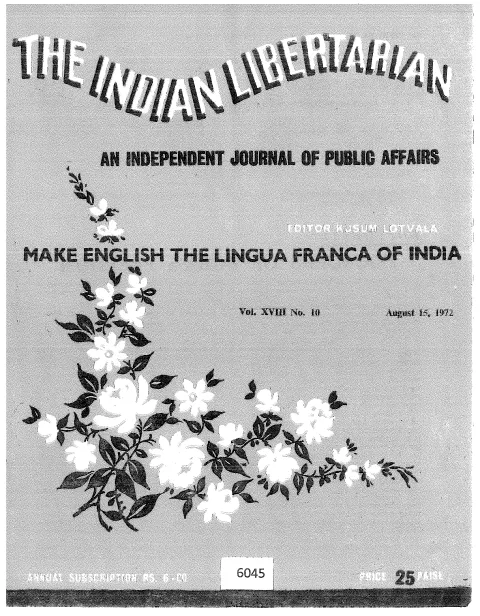
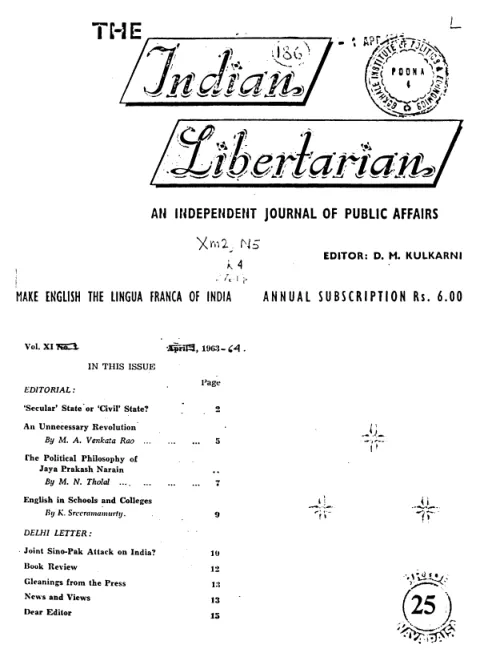
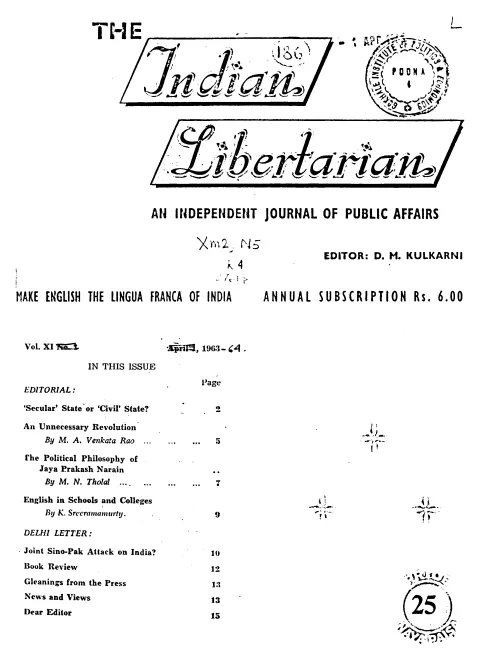
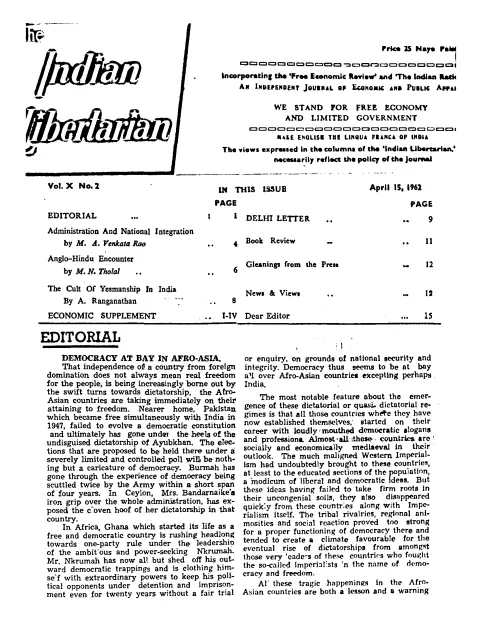
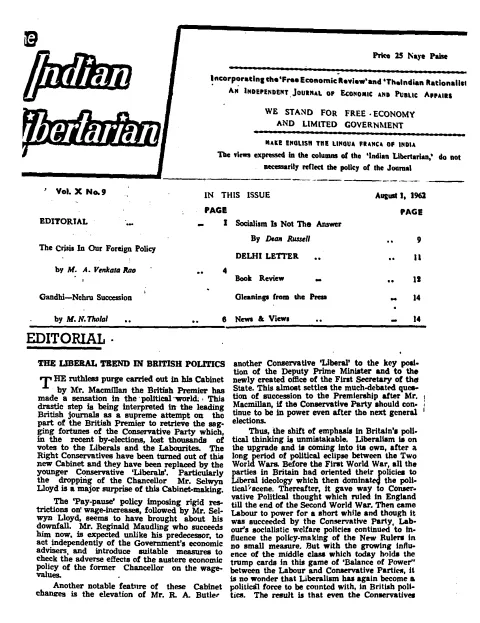
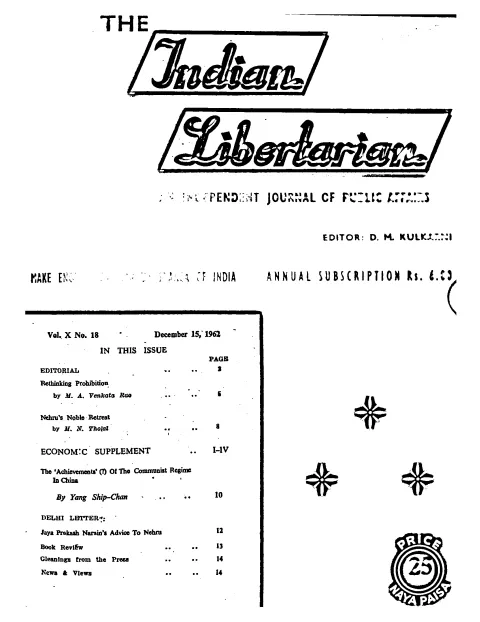
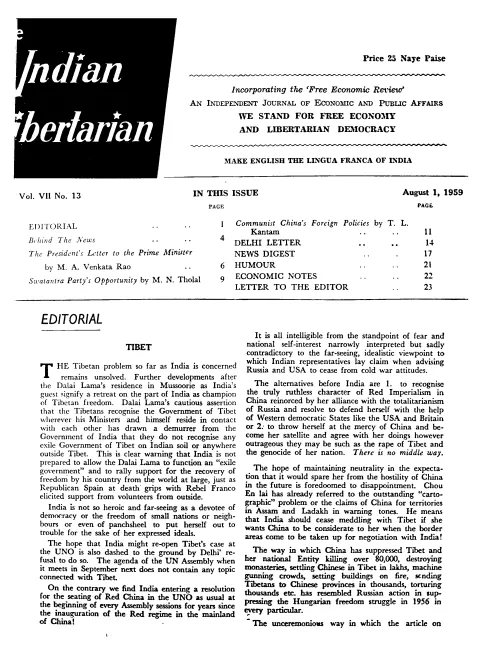
- The Indian Libertarian · 1963
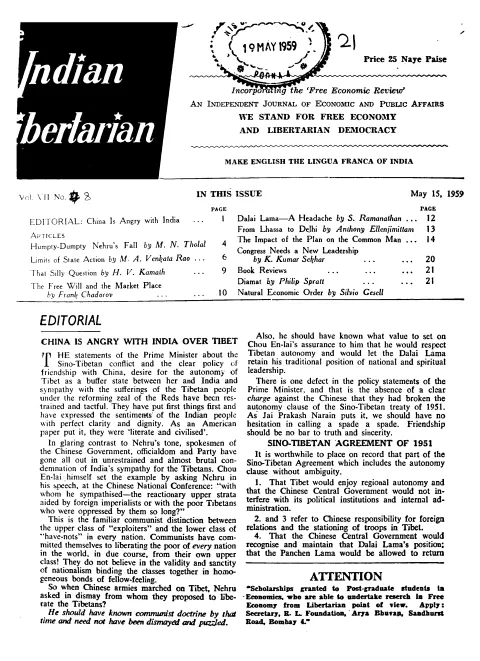
- "M. N. Tholal's essay examines Jayaprakash Narayan's political philosophy, focusing on the tension between Narayan's Gandhian commitment to non-violence and his stated support for Indian resistance to the 1962 Chinese aggression." · opens the essay summary and establishes Narayan as the analytic target
- "Narayan's belief that moral suasion could influence Chinese Communist leaders is treated as dangerously naive." · summarises Tholal's verdict on the foreign-policy application of Narayan's philosophy
- Free Enterprise in India — A Call For Leadership · 1961
- "Cites Jayaprakash Narayan's reported disillusionment with the nationalisation of big industries as evidence that even socialist founders are abandoning doctrinaire positions." · used by Shroff as a concessive argument that the intellectual wind is shifting away from doctrinaire socialism
- Free Enterprise in India - A Call For Leadership · 1961
- "Shroff opens with the observation that even committed socialists like Jayaprakash Narayan are now disillusioned with nationalisation" · opening concessive argument: if even socialists doubt nationalisation, the case against the Third Plan is doubly strong
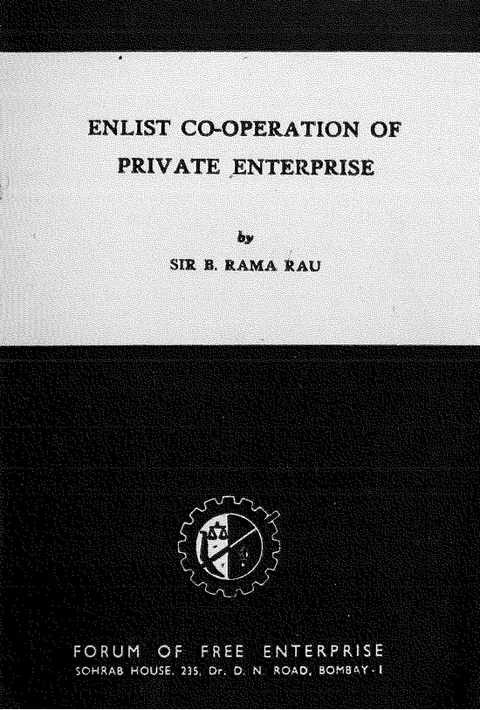
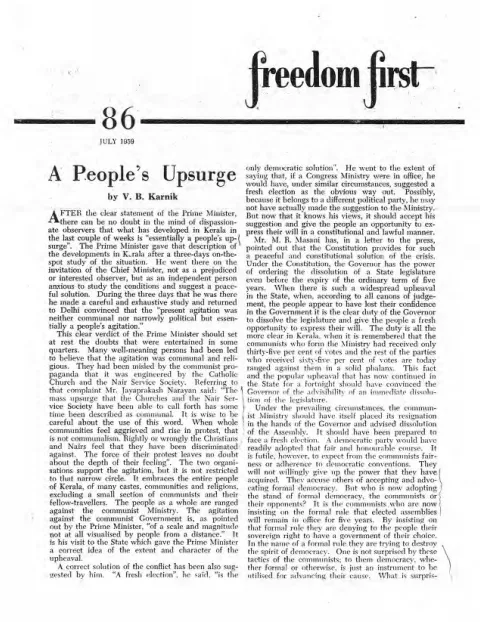
- ENLIST CO-OPERATION OF PRIVATE ENTERPRISE · 1959
- "Jayaprakash Narayan's qualified blessing and Nehru's recognition that constructive criticism would serve Congress" · Narayan cited as cross-ideological endorser of the new opposition party
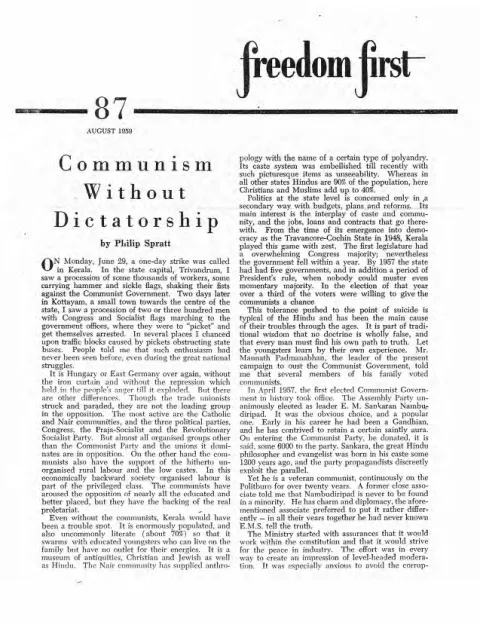
- For Freedom, Farm And Family · 1959
- "with whom Jayaprakash Narayan and Prof. N. G. Ranga share the diagnosis" · Narayan cited as a cross-spectrum ally who shares the anti-collectivist diagnosis that motivates the new party initiative
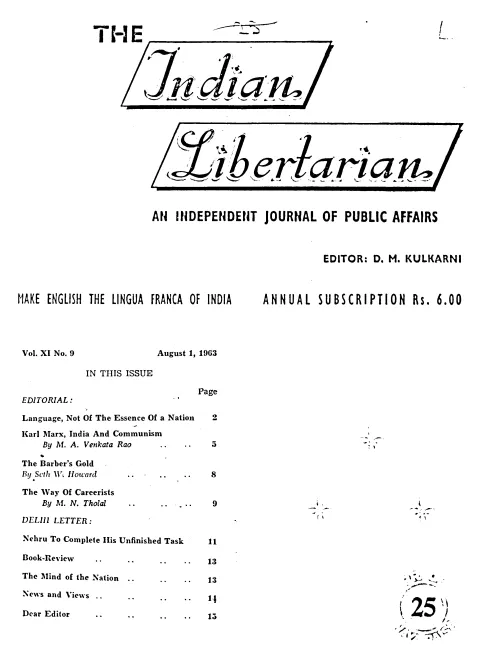
- The Indian Libertarian · 1957
- "whether Jayaprakash Narayan's acknowledged political stature is being wasted outside formal politics" · Vivek's question — JP's withdrawal from electoral politics framed as a loss to liberal democratic opposition
- "Jayaprakash Narayan's political talent is cited as a wasted resource outside the formal party system." · key-points restatement of the JP question
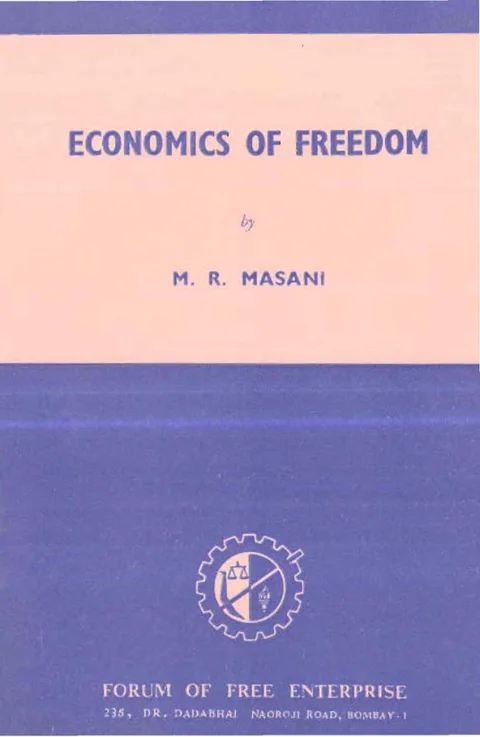
- ECONOMICS OF FREEDOM · n.d.
- "Jayaprakash Narayan's warning that the Welfare State 'threatens as much to enslave man to the State as the totalitarian'" · Narayan's warning cited as Indian socialist evidence that even the left recognised statism's dangers



Opinion pieces (2)
- A Resilient Soul: Ramadevi Chowdhuri
- "Her childhood was influenced by freedom fighters and thinkers like Mahatma Gandhi, Vinoba Bhave, Sri Aurobindo, and JP Narayan." · JP Narayan is named as one of the thinkers who inspired Chowdhuri's activism
- Minoo Masani : From Socialism to Liberal Swatantra Party
- "As a young admirer of the USSR experiment and an advocate of democratic socialism, Minoo worked with Jayaprakash Narayan and Nehru to turn Congress towards the left in the 1930s." · identifies JP as Masani's early socialist collaborator
- "A group of socialists including JP, Achut Patwardhan, and Ashok Mehta were among the political prisoners in the Nashik jail. Minoo Masani's discussions with JP paved the way for an anti-imperial socialist outfit within the Congress party." · credits their jail conversations with catalysing the CSP
Excerpts (8)
- Free Enterprise in Danger - B.R. Shenoy
- "even a hypothetical government of Gandhian ascetics - with J.P. Narayan or Vinoba Bhave as prime minister - could make no significant difference to these developments under the prevailing 'schizophrenic policies'" · Shenoy's argument that the problem is structural, not a matter of leadership character
- Free Enterprise in India: A Call for Leadership - A.D. Shroff, 1961
- "Mr Jayaprakash Narayan, a founder of socialist movement in India, is thoroughly disillusioned about nationalisation, one of the main planks of doctrinaire socialism." · Narayan's conversion from nationalisation is Shroff's rhetorical proof that economic common sense is winning over honest socialists
- Sikkim – Through Other Eyes
- "The camp boasted the likes of Jayprakash Narayan, C Rajagopalachari, and Minoo Masani." · JP named as one of three dissidents against Indian imperial overreach
- "Masani questioned the double standards of his compatriots on the 'Indian imperialism', dubbed JP the 'real anti-imperialist'" · Masani specifically singles out JP as the authentic anti-imperialist voice in Indian politics
- THE DANGERS OF JOINT CO-OPERATIVE FARMING
- "In Koraput, Acharya Vinobha Bhave and Mr. Jaya Prakash Narayan tried to ask the local people to cultivate them as a village and not to ask for distribution of the land. Mr. Jaya Prakash confessed that this experiment had not succeeded" · JP's admission of failure in the cooperative experiment cited as evidence
- "Shri Jaya Prakash Narayan has said in Banaras that co-operative farming in today's context means creating "puppets in the hands of officials."" · JP quoted directly as an opponent of cooperative farming
- The Essence of Democracy
- "Such were the disconcerting sentiments expressed by Shri Jayaprakash Narayan, the PSP leader, in the course of his whirlwind tour of Gujarat in support of Vinoba's Bhoodan Movement." · JP named as the source of the argument that prompts the editorial response
- "Perhaps it is a mistake to always imagine that in a democracy there should be a ruling party and an opposition party." · JP's own words quoted verbatim at the opening of the editorial
- The Universality of Human Values - M.R. Masani
- "Only last month Jayaprakash Narayan wrote: "For many years I have worshipped at the shrine of the goddess Dialectical Materialism" · Masani cites JP's rejection of materialism as corroboration for the universality of non-material values
- The Universality Of Human Values
- "Only last month Jayaprakash Narayan wrote, "For many years I have worshipped at the shrine of the goddess Dialectical Materialism" · JP's conversion from materialism cited as evidence that non-material values transcend ideology
- Towards Party-less Democracy
- "Mr. Jayaprakash Narayan is mobilising public opinion by means of seminars and the circulation of concrete proposals among uncommitted thinkers" · introduction of JP as the active champion bringing the idea into public discourse
- "Mr. Narayan's suggestion is that of jettisoning the party altogether" · JP's core proposal stated directly