periodical issue
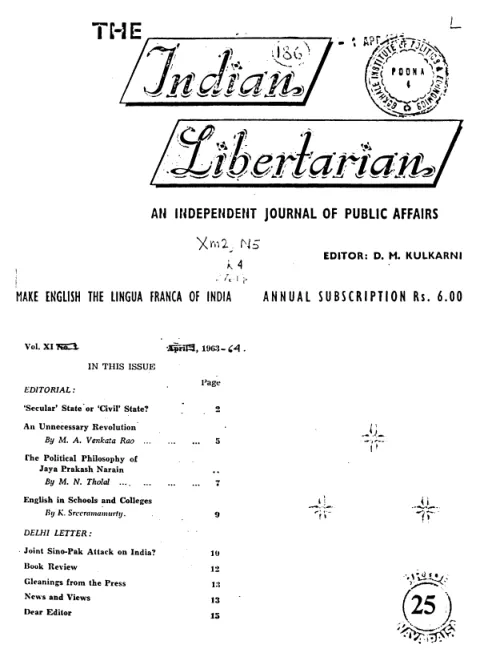
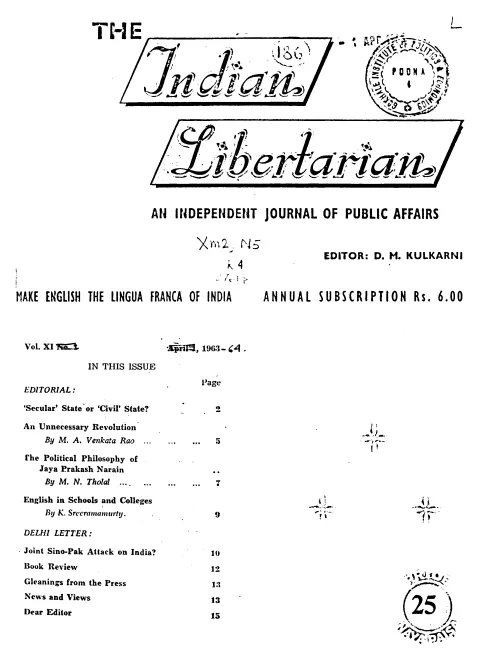
The Indian Libertarian
An Independent Journal of Public Affairs
By MA Venkata Rao, M. N. Tholal, K. Sreeramamurty
Libertarian Publishers Private Ltd., 26, Durgadevi Road, Bombay-4 · Bombay · 1963
16 pages
Summary
This issue of The Indian Libertarian (Vol. XI No. 1, April 1963) is the opening number of the journal’s eleventh volume and ranges across four of the most contested questions facing India in early 1963: the proper constitutional character of the Indian state (secular vs. civil), the futility of communist revolution as a developmental strategy, the political philosophy of Jayaprakash Narayan, the place of English in Indian education, and the looming strategic threat posed by a possible Sino-Pakistani joint military action. The editorial sets a polemical tone by arguing that Prime Minister Nehru misconceives the word ‘secular’ and that what India needs is not a state indifferent to religion but a ‘civil’ state defined by equality before law and freedom of conscience. The remaining feature essays engage M. A. Venkata Rao’s scepticism about communist revolution’s track record on welfare, M. N. Tholal’s critical analysis of Jayaprakash Narayan’s Gandhian non-violence as a foreign-policy guide, and K. Sreeramamurty’s defence of English as the medium of instruction in Indian higher education. The Delhi Letter section, a book review of Ralph Borsodi’s The Challenge of Asia, press gleanings, news items, and a letters column round out the issue. Together, the articles project a consistent classical-liberal and anti-socialist orientation — sceptical of state planning, concerned about civil liberties, and pragmatic on defence and language policy.
Key points
-
This opening number of Volume XI, dated April 1963, leads with an unsigned editorial, Secular State or Civil State?, arguing Nehru misapplies the term secular and that India instead needs a civil state defined by equality before law.
-
M. A. Venkata Rao’s An Unnecessary Revolution challenges the premise that communist revolution was historically necessary, citing Soviet and Chinese wage and living-standard data against Western capitalist democracies.
-
Venkata Rao closes with a six-point manifesto of what a free society and free economy require, contrasting each point explicitly with communist practice.
-
M. N. Tholal’s essay on Jayaprakash Narayan argues his political philosophy is incoherent, since his Gandhian commitment to non-violence could not be reconciled with his endorsement of India’s response to the 1962 Chinese aggression.
-
K. Sreeramamurty contributes a defence of English as the medium of instruction in Indian higher education, arguing it remains the practical language of administration and scholarship across a linguistically divided country.
-
The issue also carries a Delhi Letter, a book review of Ralph Borsodi’s The Challenge of Asia, press gleanings, news items and a letters column.
Essays
’Secular’ State or ‘Civil’ State?
This unsigned editorial challenges Prime Minister Nehru’s repeated use of the term ‘secular state’, arguing that the phrase is philosophically confused and politically loaded. The editor contends that India’s founders and many Congress leaders imported the word ‘secular’ from Western political traditions without grasping its original meaning — namely a state that does not establish or favour any religion — and have instead deployed it as a polemical weapon to silence religious minorities and democratic critics alike. The editorial proposes that the correct aspiration for India is a ‘civil’ state: one that guarantees equality before the law, freedom of conscience and worship, and the individual rights of every citizen regardless of faith. It further argues that describing India as a ‘Hindu State’ would be as incorrect as calling it a ‘secular state’, and that Nehru’s Government itself violates its own secular claims by granting special privileges to certain religious communities. The piece closes by insisting that civil liberties — not secularism as a slogan — are the true safeguard of Indian democracy.
- Nehru’s use of ‘secular state’ is treated as intellectually borrowed and misapplied — it does not correctly describe Indian constitutional practice.
- The editorial proposes replacing ‘secular state’ with ‘civil state’, meaning equal rights before the law for all citizens irrespective of religion.
- Calling India a Hindu State would be wrong; but calling it secular in the Western sense is equally inapt given active state involvement with religious institutions.
- The Government’s failure to apply uniform civil law across communities is cited as evidence that ‘secularism’ is a rhetorical shield rather than a governing principle.
- The editorial links civil liberties and rule of law as the authentic liberal alternative to both theocracy and the confusion it calls ‘pseudo-secularism’.
An Unnecessary Revolution
By MA Venkata Rao
M. A. Venkata Rao argues that communist revolution is an ‘unnecessary’ strategy for achieving economic equality and social welfare, given that the empirical record of the Soviet Union and China demonstrates no superior welfare outcomes compared with the capitalist democracies of the West. He reviews the claims made for the Russian and Chinese revolutions — that they were the only available routes to modernisation, land reform, and freedom from colonial exploitation — and finds each wanting. Drawing on data about wages, living standards, and freedom, he contends that the violence and authoritarian control exacted by revolutionary communism far exceeds any developmental gains, and that capitalist economies with welfare provisions have delivered higher wages, more widely available goods, and genuine individual freedom. He concludes with a six-point summary of what a free society and a free economy looks like, explicitly contrasting each point with communist practice.
- Venkata Rao challenges the empirical premise that communist revolution was historically necessary for economic development or welfare.
- The article cites Soviet and Chinese wage levels and living standards as evidence of communist failure relative to Western capitalist economies.
- Violence and loss of freedom are treated as costs that are never offset by communist developmental gains.
- The concluding six-point ‘free society’ manifesto covers economic organisation, individual rights, rule of law, religious freedom, and democratic self-governance.
- The argument is framed as directed at Indian readers tempted by Marxist developmental arguments in the aftermath of the 1962 Sino-Indian war.
The Political Philosophy of Jaya Prakash Narain
By M. N. Tholal
M. N. Tholal’s essay examines Jayaprakash Narayan’s political philosophy, focusing on the tension between Narayan’s Gandhian commitment to non-violence and his stated support for Indian resistance to the 1962 Chinese aggression. Tholal argues that Narayan’s philosophy is ultimately incoherent: having built his political identity around satyagraha, non-violent resistance, and a critique of the nation-state system, Narayan found himself unable to apply that philosophy to Chinese imperialism without contradiction. The essay notes that Narayan endorsed the Indian military response to China while simultaneously refusing to abandon his non-violent framework, and that he attempted to resolve this by distinguishing between ‘legitimate’ defence and ‘aggressive’ nationalism. Tholal contends that this distinction collapses under scrutiny and that Narayan’s philosophy, however admirable in the domestic sphere, provides no usable guide for Indian foreign policy when facing an adversary that rejects its premises. The essay also questions Narayan’s advocacy of Sino-Indian friendship and his apparent faith that China’s leaders could be persuaded by moral argument.
- Tholal identifies a fundamental contradiction in Jayaprakash Narayan’s political philosophy between his non-violence doctrine and his support for military resistance to China.
- Narayan’s belief that moral suasion could influence Chinese Communist leaders is treated as dangerously naive.
- The essay argues that Gandhian non-violence works only against adversaries who share some moral common ground, and China under Communist rule does not.
- Narayan’s neutralism and his advocacy of Sino-Indian friendship are criticised as having emboldened Chinese assertiveness.
- Tholal credits Narayan’s sincerity and democratic credentials while rejecting his policy prescriptions.
English in Schools and Colleges
By K. Sreeramamurty
K. Sreeramamurty defends the retention of English as the medium of instruction in Indian schools and universities, arguing against the Andhra Pradesh government’s move to introduce regional languages as the sole teaching medium. He contends that English is not merely a colonial legacy but has become an integral part of Indian intellectual and scientific culture, and that switching to regional languages at the higher education level would damage India’s ability to attract international scholars, produce internationally competitive research, and train professionals for a modern economy. The essay argues that the ‘nationalist’ case for replacing English is emotionally driven and economically reckless, and that no country has succeeded in replacing a widely used international language of scholarship without severe long-term intellectual costs. Sreeramamurty notes that even within India, using regional languages as university media would balkanise knowledge production and make inter-regional academic exchange impossible.
- Sreeramamurty argues that English at the university level is a pragmatic necessity, not a mark of colonial subservience.
- The Andhra Pradesh government’s proposal to shift university instruction to Telugu is the immediate target of the critique.
- The essay claims that no country has successfully replaced an established international language of scholarship without intellectual and scientific setbacks.
- Using regional languages in Indian universities would prevent inter-regional academic mobility and collaboration.
- The author invokes international scholars and the practical needs of professional training to defend English retention.
Joint Sino-Pak Attack on India?
The Delhi Letter section (unsigned, described as ‘From Our Correspondent’) analyses the strategic threat of a joint Sino-Pakistani military offensive against India in the aftermath of the 1962 Sino-Indian war. The piece reports on diplomatic signals from Washington and the debates among Indian political leaders about the appropriate response. It notes that the American Secretary of State Dean Rusk had visited Pakistan and India, and that both the Sino-Pakistan border agreement and Pakistan’s arms negotiations with China were deepening India’s security dilemma. The letter argues that India’s political class has been slow to grasp the depth of the Sino-Pakistani strategic convergence and urges a more alert posture. It also discusses Indo-Pak talks — noting US and UK pressure on India to make concessions on Kashmir as a condition for military assistance — and criticises the Government for appearing to treat the Kashmir question as negotiable under foreign pressure.
- The Delhi Letter identifies a Sino-Pakistani strategic alignment as a serious and immediate threat to Indian security following the 1962 war.
- US and UK pressure on India to negotiate on Kashmir in exchange for military aid is presented as a form of coercion India must resist.
- The article criticises Indian government complacency about the depth of China-Pakistan cooperation.
- Dean Rusk’s South Asia visit is the news peg; the article reads his statements as insufficiently reassuring to India.
- The letter argues India must build its own military capacity rather than depend on conditional Western assistance.
Book Review
This unsigned book review covers Ruth Benedict’s Patterns of Culture and a companion work, summarising their argument that human culture is shaped by distinct configurations of values, practices, and psychological orientations that differ radically across societies. The review explains Benedict’s famous contrast between ‘Apollonian’ and ‘Dionysian’ cultures and notes her argument that no culture’s configuration is inherently superior to another. The reviewer briefly relates Benedict’s framework to Indian civilisational questions, suggesting that an understanding of cultural pluralism is relevant to India’s own debates about national identity and social reform. The review is short (one page) and largely descriptive rather than critical.
- The review covers Ruth Benedict’s Patterns of Culture, explaining its central thesis about culture as configuration.
- The Apollonian/Dionysian distinction is the conceptual centrepiece of the summary.
- The reviewer draws a brief connection between Benedict’s cultural pluralism and Indian debates about identity.
- The review is descriptive rather than analytical and does not engage in sustained criticism of Benedict’s method.
Gleanings from the Press
The Gleanings from the Press section reprints and briefly contextualises press extracts on the Indian government’s language and educational policies, focusing on Gujarat’s parents’ movement demanding English instruction from the fifth standard, and criticism of the use of charkha (handspinning) as a compulsory school subject in Gujarat as an ‘anti-English’ cultural imposition.
- Reports on a mass movement in Gujarat demanding English instruction from the fifth standard.
- Criticises the mandatory teaching of charkha in Gujarat schools as ideologically driven and educationally counterproductive.
- Connects the language debate to the journal’s broader pro-English editorial stance.
News and Views
The News and Views section carries a series of short items: a report on the US $240 million interest-free loan to India for the Third Five-Year Plan signed by Ambassador John Kenneth Galbraith; a note on Nehru’s statements fearing conflict on the Hindi language issue; an item on the English movement in Gujarat demanding English from fifth standard; a report from New York quoting Aldous Huxley on the pessimistic prospects for underdeveloped nations; and a Poona item on former Defence Secretary H. M. Patel urging India to accept Western military aid. A further item reports Rajaji (C. Rajagopalachari) calling for India to lead the ‘Afro-Asian camp’ rather than outsource that leadership to Nkrumah or Nasser.
- US $240 million interest-free loan to India announced; Galbraith quoted on its unprecedented scale.
- Nehru expressed concern about Hindi/language conflicts at a Congress workers’ meeting in New Delhi.
- Aldous Huxley quoted forecasting extreme gloom for underdeveloped nations unless population growth is controlled and governance improved.
- H. M. Patel (former Defence Secretary) urges acceptance of Western military aid without hesitation.
- Rajaji advocates India taking leadership of the Afro-Asian bloc rather than ceding it to Nkrumah or Nasser.
Dear Editor
The Dear Editor letters column carries two items. The first, by P. Kuppi Rao from Madras, defends the right of individuals to hold and act on their views on prohibition, arguing that a man who privately believes prohibition is wrong should not be compelled to enforce it — a point about liberty of conscience in public service. The second item is a short quote attributed to ‘Insight’ criticising Nehru’s self-assurance about his infallibility, using a paraphrase of the Dickens Micawber formula to make the point that a leader who trusts no one but himself and refuses outside advice will lead a country to misery.
- P. Kuppi Rao argues for individual liberty of conscience, specifically that a person who opposes prohibition on principle should not be forced to administer it.
- The second letter uses satire to criticise Nehru’s alleged sense of political infallibility.
- Both items reflect the journal’s consistent concern with individual rights over state compulsion.
Metadata and summary are AI-extracted from the source PDF and reviewed for editorial accuracy. The original work is available via the Read PDF tab above (where present); paragraph-level citation inside the PDF is deferred to a future engagement.