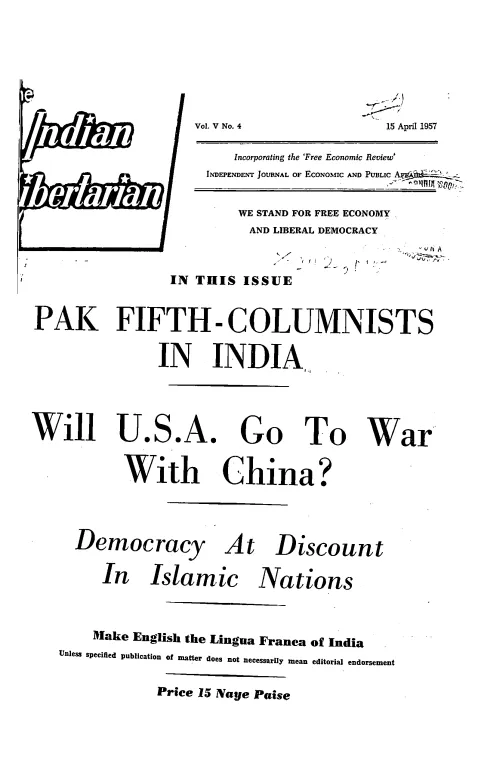
periodical issue
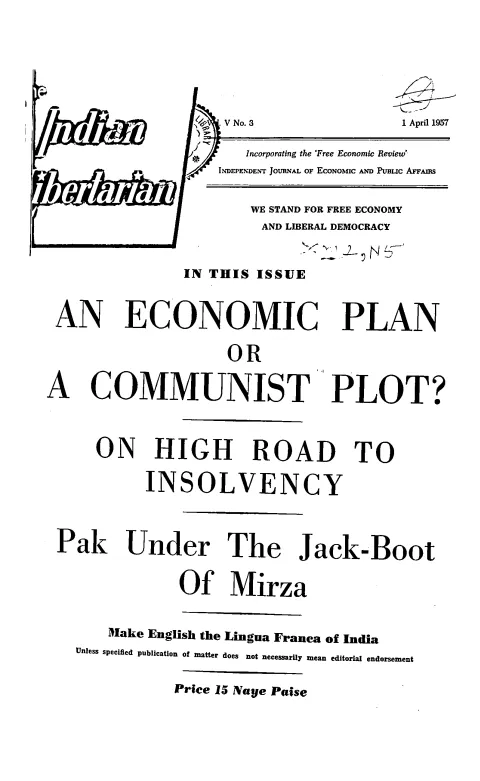
The Indian Libertarian
Independent Journal of Economic and Public Affairs
By MA Venkata Rao, M. G. Hallar, Salvador de Madariaga, KD Valicha
Libertarian Publishers (Private) Ltd., 36 Durgadevi Road, Bombay 4 · Bombay · 1957
20 pages
Summary
The Indian Libertarian, Vol. V No. 3 (1 April 1957), is a bi-monthly libertarian journal edited by Miss Kusum Lotwala and published by Libertarian Publishers (Private) Ltd., Bombay. This issue appeared immediately after India’s second general elections and takes them as its central occasion: the editorial interrogates whether Congress’s renewed mandate will deliver genuine democratic governance or deepen the slide toward a one-party monopoly underwritten by planning bureaucracy and press manipulation. The issue’s argumentative center is the incompatibility of India’s Second Five Year Plan with the liberal values the journal upholds — the Plan is variously characterised as crypto-communist, fiscally ruinous, and intellectually dishonest. Surrounding that core are articles on West Pakistan’s authoritarian deterioration under President Mirza, a sharp critique of the Eisenhower Doctrine by Salvador de Madariaga, a polemic against India’s foreign-policy establishment, a letters section on the role of press and government, domestic and world news digests, and book reviews promoting libertarian titles. The issue also advertises the Libertarian Social Institute’s certificate course and the R. L. Foundation’s Libertarian Quarterly, signalling a wider institutional ecosystem in 1950s Bombay.
Key points
-
The Indian Libertarian, Vol. V No. 3, dated 1 April 1957 and edited by Kusum Lotwala, appeared immediately after India’s second general elections, and its editorial questions whether Congress’s renewed mandate signals genuine democratic governance.
-
The editorial attributes Congress’s victory partly to its control of the press and propaganda machine, citing electoral defeats in Maharashtra and Gujarat as evidence the party has lost contact with voters.
-
M. A. Venkata Rao’s ‘An Economic Plan or… A Communist Plot?’ argues the Second Five Year Plan replicates Soviet central planning under democratic cover, singling out State ownership of new industrial capacity as the decisive element.
-
M. G. Hallar’s ‘Interim Budget / On High Road to Insolvency’ cites an overall deficit of Rs. 218 crore as evidence that deficit financing is being dressed up as developmental investment.
-
Hallar argues that foreign borrowing, presented as a badge of international confidence, is actually a symptom of domestic resource exhaustion, and that no effective opposition to the trend exists.
-
The pseudonymous ‘Vivek’ poses five rhetorical questions on the election result, including Bombay’s polling-day declaration as a Union Territory and Jayaprakash Narayan’s withdrawal from formal politics.
-
‘Vigilant’ traces President Iskander Mirza’s dismantling of parliamentary government in West Pakistan, his capture of the press, and his use of the Khan Sahib ministry to suppress the Muslim League.
-
Salvador de Madariaga critiques the Eisenhower Doctrine for misreading Arab nationalism as communism, while K. D. Valicha contributes a satirical column lampooning India’s foreign-policy commentariat.
Essays
Editorial: The Elections and After
The unsigned editorial, ‘The Elections and After,’ reads the Congress party’s large-scale victory in the second general elections as a failure to translate popular mandate into democratic accountability. It argues that Congress has lost contact with the population — citing defeats in Maharashtra and Gujarat — and that the party’s monopoly on the press and propaganda machine has shielded it from honest reckoning. The editorial warns that unless Congress sheds its monopoly culture and embraces genuine economic freedom, the election result will entrench authoritarian planning rather than liberal democracy. It calls on the party’s own ‘A’ team to recognise that Forum of Free Enterprise voices are not fringe critics but prophets of the fiscal and democratic dangers ahead.
- Congress’s victory is attributed partly to control of press and propaganda, not genuine popular approval of its economic programme.
- Electoral defeats in Maharashtra and Gujarat are cited as evidence of lost contact with voters.
- The editorial distinguishes between Congress’s organizational machinery and the actual will of the electorate.
- A call is issued for Congress to abandon its ‘monopoly capitalism’ mindset and open the economy to free enterprise.
- The piece warns that without reform, democratic institutions will be hollowed out by one-party dominance.
Interim Budget / On High Road to Insolvency
By M. G. Balier
M. G. Balier’s ‘Interim Budget / On High Road to Insolvency’ is a fiscal critique of the government’s Second Five Year Plan budget. Balier argues that India’s planners have systematically underestimated the true cost of the Plan, that deficit financing is being dressed up as developmental investment, and that the country is on a trajectory toward insolvency. He contends that the budget’s apparent optimism conceals a structural gap between projected revenues and committed expenditures, and that the political will to contain spending is absent because plan-targets have become ends in themselves irrespective of fiscal sustainability. The piece warns that foreign borrowing, presented as a badge of international confidence, is in fact a symptom of domestic resource exhaustion.
- The Second Plan’s budget involves deficit financing that the author characterises as fiscally dangerous.
- An overall deficit of Rs. 218 crore is cited as evidence that the government is spending beyond its means.
- The article contends that planners are indifferent to fiscal discipline because plan-fulfilment is treated as an ideological imperative.
- Reliance on foreign loans is presented as a sign of resource failure rather than international trust.
- The author argues that no effective political opposition to the fiscal trajectory exists inside or outside Congress.
An Economic Plan or… A Communist Plot?
By MA Venkata Rao
M. A. Venkata Rao’s ‘An Economic Plan or… A Communist Plot?’ is a polemical critique of India’s Second Five Year Plan, arguing that the plan’s intellectual and structural features are indistinguishable from Soviet-style central planning and amount to a covert implementation of communist economic doctrine. Venkata Rao contends that the Plan’s architects — whom he treats as fellow-travellers of Soviet ideology — have used the planning apparatus to begin the nationalisation of the commanding heights of the economy under the guise of development. He attacks the ‘indifference to criticism’ displayed by planners, catalogues the rising monopoly of public sector enterprise, and calls for mobilising private capital and individual initiative instead. The article is one of the journal’s signature pieces, framing the liberty-vs.-planning debate as a question of civilisational choice rather than mere economic technocracy.
- The Second Five Year Plan is characterised as replicating Soviet economic organisation under the cover of democratic planning rhetoric.
- The article singles out the Plan’s insistence on State ownership of all new industrial capacity above a threshold as the decisive communist-pattern element.
- Venkata Rao accuses planners of deliberate ‘indifference to criticism’ and of suppressing alternative economic analysis.
- He argues that monopoly tendencies built into the Plan will eventually destroy the private sector and the press.
- The piece calls on citizens and intellectuals to resist the Plan’s logic before the institutional damage becomes irreversible.
Five Questions on the Elections
By Vivek
‘Five Questions on the Elections’ by the pseudonymous ‘Vivek’ poses five rhetorical questions to assess what the 1957 election result actually means. The questions probe: whether polling-day declaration of Bombay as a Union Territory is democratic; whether Prime Minister Nehru’s intervention in state elections is appropriate; whether Krishnamurti’s alleged electoral connections are credible; whether Jayaprakash Narayan’s acknowledged political stature is being wasted outside formal politics; and whether Congress-industry (‘Congress and Big Business’) alignment explains the party’s performance. The piece is sardonic throughout, questioning whether Congress voters endorsed the Plan’s direction or merely voted out of inertia and organisational loyalty. It raises concerns about elections being manipulated by state machinery and suggests that a more honest verdict would have been adverse to Congress.
- The declaration of Bombay as a Union Territory on polling day is treated as politically manipulative.
- Nehru’s active campaigning in state elections is questioned as an inappropriate use of Prime Ministerial authority.
- The Congress-industry nexus is interrogated — the article asks whether large business funding of Congress explains party performance.
- Jayaprakash Narayan’s political talent is cited as a wasted resource outside the formal party system.
- The overall thrust is that the election result reflects organisational machinery rather than genuine popular endorsement of the Second Plan.
West Pakistan Under the Jack-Boot of Mirza
By Vigilant
‘West Pakistan Under the Jack-Boot of Mirza’ by the pseudonymous ‘Vigilant’ analyses the consolidation of authoritarian rule in West Pakistan under President Iskander Mirza. The article argues that Mirza has systematically dismantled parliamentary governance, silenced the press, and used the Khan Sahib ministry as a political vehicle to suppress the Muslim League and other opposition parties. ‘Vigilant’ traces the communal and political roots of anti-India sentiment being cultivated by the Mirza regime and argues that Pakistan’s government has essentially become a family enterprise managed through official patronage. The piece warns Indian readers that Pakistani arms raids and the alleged ‘Soviet Fiction’ — Moscow’s claim of attempted Soviet kidnapping — are instruments of political distraction. The article closes with a brief item on Pakistani armed forces’ activities near Tripura.
- President Iskander Mirza is depicted as having converted West Pakistan’s government into a one-man authoritarian regime.
- The article documents the dismantling of the Muslim League and other opposition parties through executive and administrative coercion.
- Anti-India propaganda is characterised as a domestic political tool used to distract from governance failure.
- The Khan Sahib ministry is described as Mirza’s vehicle for consolidating personal and family power.
- A brief ‘Soviet Fiction’ sidebar addresses Moscow’s reported claim of a Soviet kidnapping attempt, treating it as propaganda.
The Eisenhower Doctrine
By Salvador de Madariaga
Salvador de Madariaga’s ‘The Eisenhower Doctrine’ is a measured but critical analysis of the United States’ Middle East policy as articulated in the Eisenhower Doctrine of early 1957. Madariaga argues that the Doctrine, while understandable as a response to Soviet expansionism, suffers from a fundamental misreading of the political energies at work in the Arab world: it treats communism as the primary threat when the deeper force is Arab nationalism and anti-colonialism. He contends that the Budapest-Warsaw axis is strategically more important to the Soviets than the Middle East, and that American military commitments to Middle Eastern states will be counterproductive since those states are already caught between East and West and will not be grateful recipients of American patronage. Madariaga warns that offering arms and money as instruments of policy in the region legitimises the very pattern of great-power interference that produces instability.
- The Eisenhower Doctrine is critiqued for misidentifying communism as the primary threat in the Middle East when Arab nationalism is the deeper force.
- Madariaga argues that the Budapest-Warsaw axis matters more to Soviet strategy than the Middle East, making the Doctrine’s framing strategically mis-calibrated.
- American offers of military assistance are seen as counterproductive because Middle Eastern leaders will instrumentalise rather than honour them.
- The article warns that great-power military presence in the region undermines rather than stabilises it.
- Madariaga calls for a policy framework that respects Arab self-determination rather than embedding new dependencies.
Talking Through the Hat
By K. D. Valicha
‘Talking Through the Hat’ by K. D. Valicha is a satirical essay on the type of ill-informed Indian pundit who holds confident opinions on every global and domestic issue while lacking the knowledge or intellectual rigour to sustain them. Valicha directs particular fire at what he sees as India’s self-congratulatory foreign-policy commentariat — commentators who imagine India’s non-alignment represents deep wisdom when it is in fact a form of political vanity that allows the country to lecture others while contributing nothing. The piece also mocks pro-communist Indian opinion-formers who dismiss US institutions while ignoring Soviet repression, and praises American practical-mindedness and democratic federalism. The essay closes with a defence of press freedom and a swipe at those who regard state control of opinion as compatible with liberal values.
- The article lampoons the Indian intellectual who speaks with authority on foreign affairs without genuine knowledge.
- Non-alignment is satirised as political vanity rather than principled wisdom.
- Pro-Soviet Indian opinion is criticised for selective indignation — condemning the US while ignoring Soviet atrocities.
- American democratic institutions and federalism are defended against Indian intellectual condescension.
- Press freedom is affirmed as a precondition for sound public opinion.
Libertarian Calling (letters section)
The ‘Libertarian Calling’ letters section carries correspondence from several readers responding to previous issues. Topics include: the role of a Congress member of Parliament; how to select good Congress leaders; press manipulation and propaganda; the functions of the A.I.C.C.; what makes for the most pathetic public figure (with a reader naming Nehru); and who has been the finest Prime Minister. There are also short excerpts from ‘The Mind Of The Nation,’ a digest of press opinion, covering Congress’s handling of the Marathwada agitation, freedom of the press, and Congress’s attitude to its critics.
- Readers debate how to reform Congress leadership selection from within.
- Multiple correspondents address the state of press freedom and government propaganda.
- One reader nominates Nehru as ‘the most pathetic public figure.’
- The section includes a digest feature (‘The Mind Of The Nation’) drawing on Times of India editorials.
- Press freedom and the Congress publicity machinery are recurring concerns across the letters.
Indian News Parade
‘Indian News Parade’ is an unsigned digest of domestic news items. Items covered include: the controversy over India’s publicity services; Congress and freedom of the press, drawing on a Times of India editorial that criticises Congress’s attempt to suppress adverse election reporting; a call to Congress leadership to treat external criticism as legitimate; and an excerpt from a Chinaman publication on Congress and ‘socialists’ using elections to outbid each other with promises. The section presents these items as evidence of a systemic problem in Indian democratic culture: the governing party treats the press as an instrument of party communication rather than as an independent fourth estate.
- A Times of India editorial is cited as evidence that even mainstream press organs recognise Congress’s hostility to free reporting.
- The news digest documents specific instances of Congress attempts to manage election coverage.
- The section frames press freedom as inseparable from democratic health.
- Foreign press commentary on India’s ‘socialist’ bidding war in elections is included for comparative perspective.
World News
The ‘World News’ section is an unsigned digest of international events across two pages. Items covered include: Soviet policy toward satellite states in the wake of the Hungarian uprising; the Rapacki proposal for a nuclear-free zone in Central Europe; US State Department admissions about Waremburg; the British cut in military spending; Pakistani armed raid reports near Tripura; Pakistan’s claims about British troops on the Naga border; food crisis reporting from DACCA on Pakistan’s attitude toward Maulana Bhashani; alarming Soviet propaganda projections; and the Naga question in the context of India’s food crisis. The section also includes brief items on ‘Extreme Suppression in Pakistan’ and on Indian and Pakistani border incidents. The digest frames these events through a consistently anti-Soviet, pro-Western-liberal lens.
- Soviet conduct in Eastern Europe following Hungary is framed as evidence of the impossibility of peaceful co-existence.
- Pakistan’s internal repression and border provocations are covered in parallel with West Pakistan articles elsewhere in the issue.
- The Naga border question is flagged as an unresolved internal security issue with international dimensions.
- US foreign policy is treated with measured sympathy but also critically examined for inconsistencies.
- Soviet propaganda output is characterised as a systematic effort to destabilise non-aligned and Western-aligned states.
Book Reviews
The ‘Book Reviews’ section covers three publications. First, a notice welcoming The Indian Libertarian to Madras through a new stockist, Libertarian Book Shop, Sandhurst Road, Bombay. Second, a review of ‘LIBERTARIAN ANTHOLOGY: A Selection of Essays and Explorations,’ published by the R. L. Foundation and edited by B. S. Sanyal. The reviewer (unnamed) notes that the anthology contains essays on the purpose of the journal, the libertarian perspective by M. V. Balakrishna Rao, a piece on monopolies drawing on Benjamin Tucker, a piece on justice and freedom by K. D. Valicha, and a rationalist thought survey. Third, a review of ‘ECONOMIES OF LIBERTY’ by K. D. Valicha — described as a sustained argument that the collective welfare state must give way to individual liberty and market economics, critically engaging Robertson’s analysis and drawing on classical liberal philosophy. The section also contains an advertisement for ‘CHARWAK: An Ancient Rationalist’ and notes the availability of ‘Some Must Have A Population Problem’ and ‘Large-scale and Small Industries to Coexist.’
A separate short item labelled ‘NOT A LOOT CAUSE’ appears at page 19, attributed to K. D. Valicha, defending the proposition that the collection of market rents does not constitute exploitation and that the libertarian position on property is not a defence of looting the poor.
- The Libertarian Anthology Vol. I (R. L. Foundation) is presented as a foundational document of the Bombay libertarian circle.
- Benjamin Tucker is invoked in the anthology’s treatment of monopoly — a classical anarcho-individualist touchstone being cited approvingly in an Indian liberal context.
- K. D. Valicha’s ‘Economies of Liberty’ frames individual liberty and free markets as the only sustainable basis for collective welfare.
- The book review section doubles as a publication network advertisement, reinforcing the institutional ecosystem around the journal.
- The ‘Not a Loot Cause’ note defends market-rent collection as philosophically consistent with libertarian property theory.
Metadata and summary are AI-extracted from the source PDF and reviewed for editorial accuracy. The original work is available via the Read PDF tab above (where present); paragraph-level citation inside the PDF is deferred to a future engagement.