periodical issue
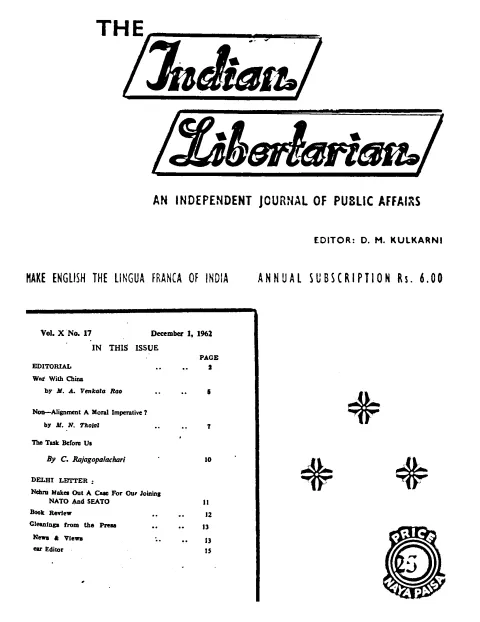
The Indian Libertarian
An Independent Journal of Economic and Public Affairs
By MA Venkata Rao, M. N. Tholal, V. Vijayatunga, Bernard Iddings Bell, A. D. Cohen
The Indian Libertarian, No. 25, Sandhurst Road, Bombay 4 · Bombay · 1960
24 pages
Summary
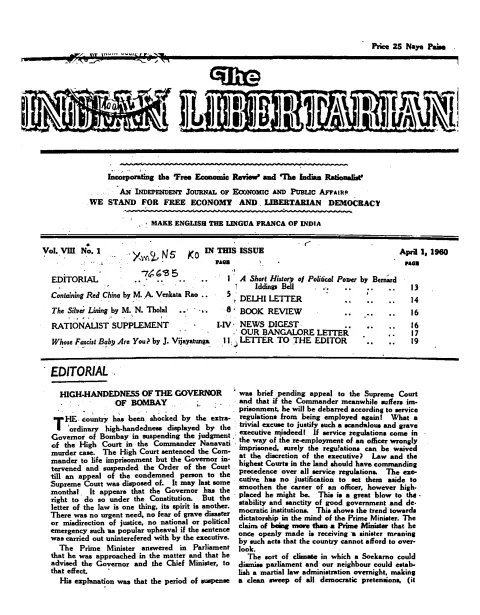
The Indian Libertarian (Vol. VIII No. 1, April 1, 1960) is a fortnightly periodical published from Bombay, incorporating the earlier ‘Free Economic Review’ and ‘The Indian Rationalist’. This issue is dominated by two urgent preoccupations: the Chinese military threat on India’s northern borders, and the erosion of democratic and constitutional norms within India itself. The editorial opens with a stinging attack on the Governor of Bombay’s high-handed intervention to stay the execution of the Commander Nanavati murder case sentence, framing it as executive overreach that corrodes the rule of law and encourages a drift toward authoritarian governance. Subsequent sections develop this theme through the lens of Nehru’s China policy—indicting his refusal to acknowledge Chinese aggression and his reliance on non-alignment bromides—and through a Rationalist Supplement that defends free expression and liberal rationalism against Congress domination of public life.
The issue also carries a pointed piece by V. Vijayatunga examining the survival of Brahmanical social authority in independent India under the label ‘fascism’, and a short philosophical essay by Bernard Iddings Bell tracing the historical cycle by which political power degenerates from aristocracy through plutocracy to mob rule. The Delhi Letter reports on the early fortunes of the Swatantra Party and urges mergers among liberal and opposition parties, while a brief but forthright essay by A. D. Cohen indicts the caste system as a form of perpetual servitude incompatible with democratic citizenship. A book review covers Volin’s history of Soviet collective farms. The News Digest and Bangalore Letter round out the issue with brief items on corruption, linguistic policy, and the Congress party’s growing dominance of state institutions.
Key points
-
The unsigned editorial, “High-Handedness of the Governor of Bombay”, condemns the Governor’s intervention to shield Commander Nanavati from service-regulation consequences after his murder conviction as executive overreach without constitutional warrant.
-
The editorial extends its attack to Nehru’s China policy, accusing him of dismissing warnings about Chinese aggression and of failing to build the military preparedness an honest appraisal would require.
-
M. A. Venkata Rao’s “Containing Red China” calls for abandoning non-alignment, joining SEATO and CENTO, recognising Tibetan independence, and inviting American military assistance to counter Chinese expansion.
-
Venkata Rao also urges investment in roads, supply lines and forward bases along the Himalayan frontier, and separately reviews Volin’s “The History of a Soviet Collective Farm” as a cautionary account of Stalinist collectivisation.
-
M. N. Tholal’s “The Silver Lining” reads the Chinese crisis as a salutary shock that should force India to shed its ‘Hindi-Chini bhai-bhai’ illusions and cultivate civic courage and military capacity.
-
Tholal calls for replacing Congress-controlled discourse with genuine pluralism and criticises the Congress habit of treating dissent from Nehru’s personal diplomacy as treachery.
-
V. Vijayatunga examines the survival of Brahmanical social authority in independent India under the label ‘fascism’, while Bernard Iddings Bell traces the historical cycle by which political power degenerates from aristocracy through plutocracy to mob rule.
-
A. D. Cohen indicts the caste system as a form of perpetual servitude incompatible with democratic citizenship, and the Delhi Letter reports on the Swatantra Party’s early fortunes while urging mergers among liberal and opposition parties.
-
The Rationalist Supplement records a Bombay seminar in which followers of M. N. Roy debate whether Rationalists should align with the Swatantra Party or remain non-partisan.
Essays
EDITORIAL
The editorial, titled ‘High-Handedness of the Governor of Bombay’, condemns the Governor’s intervention to protect Commander Nanavati from re-employment consequences following his murder conviction. The author argues that the Governor acted without constitutional warrant, treating the law’s letter and the law’s spirit as separable—an executive convenience that undermines the judiciary and promotes a culture of impunity. The editorial then broadens its attack to Nehru’s handling of the Chinese border crisis: it accuses him of dismissing Krishna Menon’s apologists for Beijing, of treating Chinese aggression as a matter of India’s own provocation, and of failing to build the military preparedness or diplomatic alliances that an honest appraisal of the threat would require. Pakistan’s territorial claims are also addressed, with the editorial urging that India’s Foreign Minister must stand firm on self-determination principles rather than yielding to Chinese or Pakistani pressure through ‘pipeline’ diplomacy.
- Governor of Bombay overstepped constitutional bounds by intervening to protect Nanavati from service-regulation consequences after the Supreme Court disposed of his appeal
- Editorial argues the executive has no justification to set aside service regulations to smooth the career of a convicted officer, calling it a blow to ‘stability and sanctity of good government’
- Chou En-lai’s visit is characterised as that of a ‘honoured guest’ whose hospitality reveals India’s supine foreign policy
- Krishna Menon is accused of publicly defending China and acting as Beijing’s advocate within the Indian Cabinet
- Nehru is criticised for advising the Governor and Chief Minister in the Nanavati matter rather than respecting judicial independence
Containing Red China
By MA Venkata Rao
M. A. Venkata Rao’s essay ‘Containing Red China’ argues that India’s China policy has been disastrously misconceived from the start. Venkata Rao contends that the Prime Minister’s attachment to non-alignment and his ideological sympathy for Communist China have led him to minimise the gravity of Chinese aggression, dismiss military preparedness, and isolate India from the Western alliances that alone could provide a credible counterweight to Chinese power. He calls for a complete recasting of India’s foreign policy: recognition of Tibet’s right to independence, alignment with SEATO and CENTO against Chinese expansion, and a willingness to invite American military assistance. The essay also argues that India should develop closer relations with countries sharing its democratic values—Japan, Malaya, Burma, Vietnam—rather than seeking solidarity with Communist states, and that a credible military deterrent on the Himalayan frontier requires immediate investment in roads, supply lines, and forward defence.
- Venkata Rao blames Nehru’s ideological pro-China bias for India’s failure to respond adequately to Chinese aggression on the northern border
- Argues India should abandon non-alignment and align with SEATO and CENTO as the only effective containment mechanism for Chinese expansion
- Calls for recognition of Tibet’s independence and solidarity with Tibetan resistance
- Urges development of military infrastructure—roads, supply lines, forward bases—along the Himalayan frontier
- Advocates closer alignment with democratic Asian nations (Japan, Malaya, South Vietnam) and American military assistance
The Silver Lining
By M. N. Tholal
M. N. Tholal’s ‘The Silver Lining’ offers a more measured but still critical appraisal of the Chinese crisis, framing it as an opportunity for India to shed its foreign-policy illusions and develop genuine national character. Tholal argues that China’s aggression has been salutary in exposing the hollowness of Nehru’s ‘Hindi-Chini bhai-bhai’ rhetoric and the danger of a policy built entirely on personal trust and ideological sympathy. He contends that India must cultivate civic courage, build military capacity, and—crucially—replace its Congress-controlled public discourse with a genuinely pluralistic one that allows frank criticism of the government’s China policy. He is sharply critical of the Congress party’s tendency to treat dissent as treachery and of Nehru’s attempts to silence critics by accusing them of being anti-national.
- Chinese aggression is reframed as a ‘silver lining’ that has forced India to confront the dangerous naivety of its non-alignment policy
- Tholal criticises Nehru’s conflation of personal diplomacy with national interest, arguing that genuine national security cannot rest on one man’s relationships
- Plain commonsense and willingness to acknowledge Chinese aggression are presented as the essential preconditions for any sound response
- Criticises Congress suppression of press criticism of government China policy as anti-democratic
RATIONALIST SUPPLEMENT
The Rationalist Supplement (inserted with separate roman-numeral pagination, I–IV) records a discussion held at ‘Current Politics’ seminar on 13th March in Bombay. Followers of M. N. Roy attended. S. Ramaseshan opened by arguing that Rationalists should not take part in party politics, and that no political party is the sole advocate of freedom—the Congress is not, despite its historic association with independence. The discussion that followed—featuring contributions from M. L. Willans, Mr. Govinda (Rationalist movement, Australia), Dr. T. Cornelius, Dr. Ranganathan and others—explored whether Rationalists should support the Congress, join the Swatantra Party, or maintain strict non-partisan advocacy. Multiple speakers challenged Nehru’s Chandigarh speech portrayal of Rationalism as anti-national. A separate short passage on S. K. G. Rajan dismisses Marx as an economist but credits him as a social thinker whose writings exposed the misuse of power by capitalists. References to South Indian Tamil literature tradition and the Aryan conquest are also noted.
- Rationalist seminar debated whether the movement should align with Swatantra Party, remain non-partisan, or actively oppose Congress domination of public life
- S. Ramaseshan argued Rationalists have a duty to uphold free expression and should not endorse any single party, including Congress
- Speakers criticised Nehru’s Chandigarh speech for labelling Rationalism as a form of anti-national activity
- Dr. Ranganathan and others argued for Swatantra Party support as the vehicle most aligned with Rationalist principles of individual freedom
- Discussion touched on Karl Marx’s legacy, distinguishing his social analysis from his economic theory
Whose Fascist Baby Are You?
By V. Vijayatunga
V. Vijayatunga’s ‘Whose Fascist Baby Are You?’ argues that the term ‘fascism’ is loosely applied in Indian political discourse, and that the real authoritarian danger comes not from any marginal party but from the entrenched social authority of Brahmanical tradition and its institutional heirs in independent India. Vijayatunga argues that ‘Brahmin authoritarianism’ has historically operated as an unofficial state within the state—controlling access to education, property, and public esteem—and that political independence has barely touched this structure. The essay draws on historical evidence of Brahmanical control over temples, literacy, and trade, and contends that genuine democratic freedom in India requires confronting this social authoritarianism as directly as it confronts the political kind.
- Vijayatunga challenges readers to locate the real source of authoritarian tendencies in Indian society: not in fringe political parties but in Brahmanical social tradition
- Argues that Brahmanical control over temples, learning, and commerce has historically constituted an ‘unofficial state’ operating beneath formal political structures
- Political independence has left the social authoritarianism of caste largely intact
- Draws contrast between ‘Upper Caste’ Aryan tradition and the more democratic spirit of the pre-Aryan south
A Short History of Political Power
By Bernard Iddings Bell
Bernard Iddings Bell’s ‘A Short History of Political Power’ (one page rendered) sketches a cyclical theory of political decline: aristocracy degenerates into plutocracy, plutocracy into mob rule, and mob rule into totalitarianism, from which a new aristocracy eventually arises. Bell argues that the mid-twentieth century democracies are caught in the mob-rule to totalitarianism transition and that the only escape is a recovery of genuine moral and intellectual authority, not merely electoral majorities. The piece is apparently a reprint of a text by an American author.
- Bell presents a cyclical theory of political degeneration from aristocracy through plutocracy to mob rule and then totalitarianism
- Argues that contemporary democracies are in the mob-rule stage, susceptible to demagogic capture
- Recovery requires reestablishment of genuine moral and intellectual authority, not just procedural democracy
DELHI LETTER
The Delhi Letter datelines from Kurukshetra and discusses the early performance of the Swatantra Party. The correspondent is broadly sympathetic but concerned: the Swatantra Party’s growth has been encouraging but it risks being a mere coalition of Congress defectors without a unifying ideology. The letter argues that Mr. Nehru’s personal authority is so powerful that Swatantra cannot succeed simply by opposing him—it must develop a positive programme grounded in liberal economics and democratic federalism. It also discusses the corruption case involving Mr. C. C. Deshmukh, and calls for merger between Swatantra, the Jan Sangh, and other opposition parties to form a viable electoral front.
- Swatantra Party’s early growth is noted with cautious optimism, but the party is warned against becoming a mere anti-Nehru vehicle without a constructive liberal programme
- Corruption involving C. C. Deshmukh’s appointments is discussed as emblematic of the Congress party’s entrenched patronage culture
- Calls for merger or coordination between Swatantra and other liberal/right-of-centre opposition parties
BOOK REVIEW
By MA Venkata Rao
The book review covers ‘The History of a Soviet Collective Farm’ by Volin, reviewed by A. Venkata Rao. The review is brief (approximately half a page) and characterises the book as a meticulous record of the failure of Stalinist collectivisation—the destruction of the peasant economy, the terror used to enforce collectivisation, and the eventual collapse of agricultural productivity. Venkata Rao uses the review to argue by implication that India’s own planning model and its romance with Soviet-style agricultural organisation is similarly doomed.
- Volin’s book is presented as a documentary account of the human cost and economic failure of Soviet collectivisation
- The review draws implicit parallels with India’s own planning debates and the Congress left’s sympathy for Soviet agricultural models
- Venkata Rao endorses Volin’s conclusion that collectivisation destroyed individual incentive and created chronic food insecurity
NEWS DIGEST
The News Digest carries brief items on: corruption going unchecked in the Nizam’s dominions; a brief reference to Captain Lim of the USA in the context of collective farming relief; and a note on Hyderabad reporting on agricultural productivity issues and the impact of land reform on farming incentives. The digest also contains a pointed item from the Calicut University notes on English-medium instruction, citing A. Ranganathan’s views on the importance of English as a vehicle for higher education and scientific literacy in India.
- Item on uncontrolled corruption in Nizam’s territory, presented as a failure of post-independence governance
- Note on Calicut University’s discussion of English-medium instruction and its importance for access to scientific and liberal education
- Brief agricultural item on declining farm productivity linked to collectivist land-reform policies
OUR BANGALORE LETTER
The Bangalore Letter discusses the Swatantra Party’s prospects in South India and comments on the Congress party’s increasing use of state patronage to suppress opposition. The correspondent notes that local Congress leaders are acting on instructions from above to intimidate Swatantra members and that several prominent businessmen who had been quietly supporting the Congress party are now beginning to look at Swatantra as a vehicle for liberal economic policy. The letter also comments briefly on the need for a free press and the danger of government advertising dependence making newspapers timid.
- Congress party apparatus in South India is described as using state patronage and intimidation against Swatantra Party members
- Business community beginning to explore Swatantra as an alternative vehicle for liberal economic policy
- Government advertising dependence is identified as a structural threat to press freedom in India
LETTER TO THE EDITOR
The Letter to the Editor section (page 19) contains a letter on the Pakistan border situation and the plebiscite question in Kashmir, arguing that India should not concede a plebiscite in Kashmir under Chinese or Pakistani pressure and that any plebiscite held under conditions of intimidation would be meaningless. The correspondent urges the Foreign Ministry to hold firm on the principle that self-determination is only valid when exercised freely, and argues that Pakistan’s claim to Kashmir cannot be advanced through external pressure from China.
- Argues against conceding a Kashmir plebiscite under current conditions of Pakistani and Chinese pressure
- Contends that self-determination is only meaningful when exercised without external intimidation or military threat
- Urges India’s Foreign Ministry to resist Chinese diplomatic support for Pakistan’s Kashmir claim
Metadata and summary are AI-extracted from the source PDF and reviewed for editorial accuracy. The original work is available via the Read PDF tab above (where present); paragraph-level citation inside the PDF is deferred to a future engagement.