periodical issue
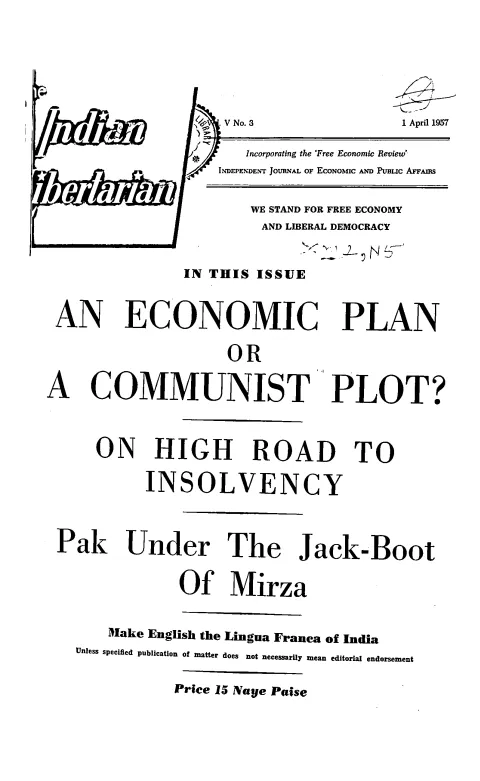
The Indian Libertarian
Independent Journal of Economic and Public Affairs
By MA Venkata Rao, J. K. Dhairyawan, Kishore Valicha
Miss Kusum Lotwala, Published on the 1st and 15th of each month · Bombay · 1958
28 pages
Summary
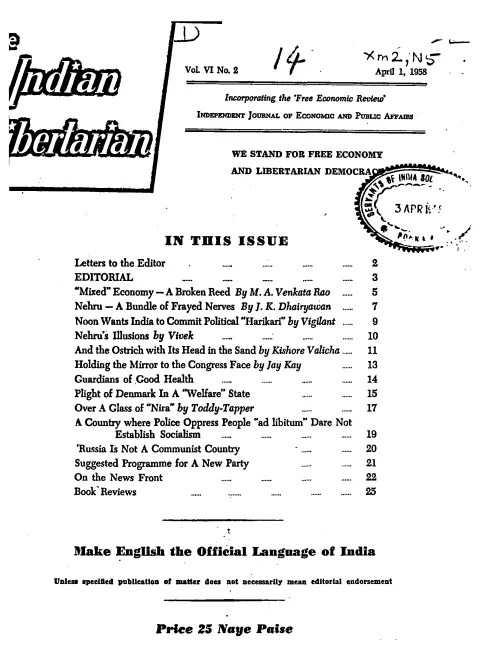
The Indian Libertarian, Vol. VI No. 2 (April 1, 1958) is a sixteen-article fortnightly journal published from Bombay under editor Miss Kusum Lotwala. Its masthead motto — ‘We Stand for Free Economy and Libertarian Democracy’ — encapsulates the editorial line sustained across every piece in the rendered pages: a sustained libertarian-classical-liberal critique of Nehru’s economic and foreign policies, the Congress Party’s internal culture, and the creeping socialism of Indian statecraft in the late 1950s. The journal incorporates the earlier ‘Free Economic Review’ and also campaigns editorially for English as India’s official language.
The issue opens with a letters column and a two-page editorial attacking the Arab Union, Indian foreign policy toward Pakistan, and the Congress Party’s failure to discipline itself. Subsequent articles by named and pseudonymous contributors dissect the ‘mixed economy’ doctrine as intellectually bankrupt, portray Nehru as psychologically unstable and politically erratic, expose Pakistan’s arms-spending and anti-India stance as reason to abandon sentimental friendship, and challenge the ostrich-like quality of pro-Pakistan sentiment in Indian political circles. Lighter features include a health column on vitamins, a satirical ‘True Tales’ strip on Helen Keller (by VERUS), a Toddy-Tapper column lampooning the Gandhi cap as political symbol, and a Danish welfare-state cautionary tale. Pages 19–20 reprint or adapt foreign material arguing that police oppression disqualifies India from socialism, and that Soviet Russia is not genuinely communist. Pages 21–28 (entries 14–16: ‘Suggested Programme For A New Party’, ‘On the News Front’, and ‘Book Reviews’) were not rendered in this chunk.
Key points
-
M. A. Venkata Rao’s lead essay “‘Mixed’ Economy — A Broken Reed” brands the mixed-economy doctrine an intellectual evasion and calls the nationalisation of the Life Insurance Corporation “legalised robbery.”
-
Venkata Rao argues the Constitution’s compensation clauses for expropriation are a facade because Parliament can amend them at will, citing a Supreme Court judgment as evidence.
-
J. K. Dhairyawan’s “Nehru — A Bundle of Frayed Nerves” reads Nehru’s dismissal of Chief Ministers and parliamentary irritability as personal insecurity, citing the prime minister’s own Ahmednagar Fort prison diary confessing a dictatorial temper.
-
The unsigned editorial calls Colonel Nasser a dictator exploiting pan-Arab sentiment rather than a genuine liberator, and urges India to abandon its romantic support for the Arab Union.
-
The editorial condemns the proposed Personal Income Tax law as discouraging enterprise and rewarding evasion, alongside a sidebar attacking the Muslim League’s communal electoral appeals.
-
“Vigilant’s” article “Noon Wants India to Commit Political Harikari” documents Pakistan’s tripled defence budget and threats from Prime Minister Feroz Khan Noon.
-
“Vivek’s” column “Nehru’s Illusions” criticises the prime minister’s stated views on Soviet satellite states, Sino-Indian friendship, and the economics behind the Planning Commission’s targets.
-
Kishore Valicha’s “And the Ostrich with Its Head in the Sand” challenges Indian advocates of Pakistan-friendship with evidence of Pakistani rearmament and its SEATO and CENTO alignment.
-
“Jay Kay’s” column “Holding the Mirror to the Congress Face” catalogues Congress Party scandals, including a forgery investigation, the case shielding Vijaya Lakshmi Pandit, and a Bombay election murder.
Essays
Letters to the Editor
A brief letters column occupying page 2. The visible letter is signed by F. Tandon and concerns the conduct of India’s official representatives abroad — criticising Mr. Nehru for failing to control diplomatic representatives and for making contradictory public statements. Tandon invokes the ‘Picture of U.P. in Figures’ statistical series and criticises the Forum of Free Enterprise’s annual data on production.
- Correspondent F. Tandon criticises Indian diplomatic representatives’ conduct abroad.
- Letter invokes ‘Picture of U.P. in Figures’ production data to make an economic argument.
- The letter signals reader engagement with statistical evidence as a tool of liberal critique.
EDITORIAL
The editorial ranges across three foreign-policy episodes: the Arab Union (United Arab Republic), the conspiracy in Saudi Arabia, and India’s Pakistan policy. On the Arab Union, the editor argues that Col. Nasser has revealed himself as a dictator rather than a pan-Arab liberator, and that India should stop its romantic support for him. The Saudi section covers an alleged conspiracy against the new Arab Republic. The bulk of the editorial — two columns on pages 3–4 — attacks India’s Pakistan policy as dangerously sentimental, noting that Pakistan’s defence budget has ballooned and its public rhetoric has become openly hostile. A separate squib condemns the ‘Muslim League game’ of making communal appeals. The editorial closes with attacks on the proposed Personal Income Tax law as a threat to incentive and a subsidy for administrative corruption.
- Nasser is described as a dictator exploiting pan-Arab sentiment rather than a genuine liberator.
- Pakistan’s military spending is rising sharply while it voices hostility to India — the editorial argues India must recognise this reality.
- India’s foreign policy toward Pakistan is characterised as sentimental and naive.
- The proposed Personal Income Tax is condemned as discouraging enterprise and rewarding evasion.
- A sidebar attacks the Muslim League’s communal rhetoric in Indian electoral politics.
”Mixed” Economy — A Broken Reed
By MA Venkata Rao
M. A. Venkata Rao argues that the ‘mixed economy’ doctrine is intellectually untenable and practically self-defeating. He contends that the term was invented as a device to sidestep the choice between capitalism and socialism, borrowing the worst features of both. The article criticises the First and Second Five Year Plans for sacrificing private enterprise to state monopoly, mocks the Planning Commission’s targets, and singles out the nationalisation of Life Insurance Corporation as an act of ‘legalised robbery.’ Venkata Rao insists the Constitution’s compensation clauses are a facade because Parliament can amend them at will, citing a Supreme Court judgment as evidence. The second page continues the argument against creeping state control of the press and private property.
- The ‘mixed economy’ label is a deliberate evasion: it combines state coercion with private enterprise to the detriment of both.
- Nationalisation of the Life Insurance Corporation is characterised as legalised robbery.
- The constitutional guarantee of compensation for expropriation is undermined because Parliament can alter the Constitution.
- The Planning Commission is criticised for setting unachievable targets and distorting price signals.
- The article argues that political interference in the economy cannot produce growth — only free markets can.
Nehru — A Bundle of Frayed Nerves
By J. K. Dhairyawan
J. K. Dhairyawan offers a psychological and political portrait of Nehru, arguing that the Prime Minister’s recent erratic behaviour — including his dismissal of Chief Ministers, his vacillation on policy, and his irritability in Parliament — reflects deep personal insecurity rather than strength of conviction. The article cites Nehru’s own diary entries from the Ahmednagar Fort imprisonment period, in which Nehru confessed to having a dictatorial temper. Dhairyawan argues that Nehru’s popularity is built on an irrational popular cult, and that his handling of the Rajasthan cabinet crisis demonstrated his willingness to manipulate constitutional machinery for partisan ends. A book advertised on page 8 — ‘The Assassins’ — is noted as sold through the Libertarian Book House.
- Nehru’s erratic public conduct is traced to a confessed dictatorial temperament documented in his own prison diary.
- The dismissal of the Rajasthan cabinet and interference in state Congress affairs illustrate unconstitutional centralisation.
- Popular adulation of Nehru is described as an irrational personality cult rather than genuine democratic endorsement.
- The article argues that Nehru’s policy inconsistency damages investor confidence and democratic norms.
Noon Wants India to Commit Political “Harikari”
By Vigilant
Writing as ‘Vigilant’, the author responds to statements by Pakistani Prime Minister Feroz Khan Noon that were widely reported as threatening India. The article documents the steep rise in Pakistan’s defence spending — defence expenditure has risen from Rs. 41 crores in 1947 to over Rs. 150 crores by the mid-1950s, with U.S. military aid on top — and argues that India’s continued policy of goodwill toward Pakistan is suicidal. The piece calls for India to re-examine the relationship and stop funding Pakistani military capacity through trade and diplomatic restraint.
- Pakistan’s defence spending has more than tripled since partition, funded partly by U.S. military aid.
- Noon’s public statements are characterised as a direct threat to India’s sovereignty.
- India’s continued ‘goodwill’ policy is described as enabling Pakistani rearmament.
- The article demands a fundamental policy rethink rather than continued forbearance.
Nehru’s Illusions
By Vivek
Writing as ‘Vivek’, the author attacks what he calls Nehru’s ‘illusions’ — particularly Nehru’s stated belief that satellite countries of the Soviet Union are gaining independence, and his persistent optimism about Sino-Indian friendship. Vivek argues that Nehru’s foreign policy is based on wishful thinking rather than hard geopolitical assessment, and that his willingness to lecture Western democracies while excusing Soviet repressions constitutes a double standard that damages India’s credibility. The piece also criticises Nehru’s domestic economic illusions, including his faith that the Planning Commission can deliver prosperity.
- Nehru’s belief that Soviet satellite states are drifting toward independence is dismissed as wishful thinking.
- Nehru’s simultaneous criticism of Western colonialism and silence on Soviet imperialism is characterised as a double standard.
- His optimism about Sino-Indian relations is described as a dangerous illusion given China’s regional ambitions.
- Domestic economic planning is presented as another illusion — the belief that state direction can substitute for market incentives.
And the Ostrich with Its Head in the Sand
By Kishore Valicha
Kishore Valicha’s article challenges Indian politicians and opinion-makers who continue to advocate friendship with Pakistan by ignoring the evidence of Pakistani hostility, rearmament, and pan-Islamic ideology. Valicha likens their posture to an ostrich burying its head in the sand. He argues that Pakistan’s military build-up and its alignment with SEATO and CENTO, combined with the statements of its leaders, constitute an unmistakable threat. The second page of the article (p. 12) carries the ‘Did You Know…’ feature by Scio, a miscellany of historical anecdotes.
- Pakistani leaders’ public statements and military build-up are presented as evidence of hostile intent that Indian politicians choose to ignore.
- Pakistan’s alignment with Western military pacts (SEATO, CENTO) while receiving U.S. arms is cited as a direct security threat to India.
- The ‘ostrich’ metaphor captures the author’s view that pro-Pakistan sentiment in Indian political circles is wilful blindness.
- Page 12 includes the ‘Did You Know…’ miscellany column by Scio.
Holding the Mirror to the Congress Face
By Jay Kay
Jay Kay’s article ‘Holding the Mirror to the Congress Face’ documents what the author presents as a series of concrete scandals implicating Congress politicians and officials: a medical man and Congress leader allegedly involved in forgery and fraud (the C.I.D. investigation is described); the case of Mrs. Vijayalaxmi Pandit’s alleged shielding of a British national from prosecution; and an election murder case in Bombay involving a Congress man. The article is polemical in tone, using official inquiry records to argue that Congress has developed a culture of impunity.
- A Congress leader and medical man in Bombay is alleged to have been involved in forgery and fraud; the C.I.D. report is described as suppressed.
- Mrs. Vijayalaxmi Pandit is accused of using diplomatic influence to shield a British national from Indian legal process.
- An election murder case in Bombay is attributed to Congress circles.
- The article argues these cases reflect systematic rather than incidental corruption within Congress.
Guardians of Good Health
An unsigned health column titled ‘Tiny Guardians of Good Health’ explains the biochemical roles of vitamins — particularly Vitamin C, the B-complex group, and B12 — in maintaining health. The article is written in accessible popular-science prose and recommends dietary sources: citrus fruits, grains, pulses, egg yolk, and leafy greens. The second half of the page carries the continuation of a ‘True Tales — Helen Keller’ illustrated feature by VERUS, depicting scenes from Keller’s education by Anne Sullivan, her college career, and the Braille system.
- Vitamin C and the B-complex vitamins are explained in accessible terms as essential for immunity, nerve function, and anti-anaemia.
- Dietary sources suitable for Indian readers (pulses, jaggary, leafy vegetables, egg yolk) are listed.
- The Helen Keller ‘True Tales’ feature illustrates themes of perseverance and self-education.
- The feature’s reference to Braille — invented by Louis Braille, a Frenchman, in 1829 — provides a cross-cultural reference point.
Plight of Denmark In A “Welfare” State
An unsigned article on the ‘Plight of Denmark In A Welfare State’ (spread across pages 15–16) draws on Danish economic data to argue that high taxation under the welfare state has suppressed savings, driven up consumer prices, and forced government to introduce price controls — which in turn create shortages. The article argues Denmark’s experience offers a preview of where India’s own nascent welfare-state ambitions are heading: a downward spiral of taxation, inflation, controls, and economic stagnation. The piece also includes a sidebar on income tax philosophy, invoking Karl Marx as the intellectual father of progressive income taxation and calling it the ‘Father of all Taxes’.
- Denmark’s welfare state has produced rising prices, suppressed savings, and a vicious cycle of tax-inflation-controls.
- Industrial exports have stagnated while welfare spending has outpaced national income growth.
- Progressive income tax is attributed to Marx’s Communist Manifesto and criticised as a tool of class warfare rather than equity.
- The Danish case is presented as a cautionary example for India’s own welfare-state trajectory.
Over A Glass of “Nira”
By Toddy-Tapper
Toddy-Tapper’s satirical column ‘Over A Glass of Nira’ on pages 17–18 uses the folk beverage of toddy/nira as a metaphor for honest, unpretentious thinking. The column’s main target is the Gandhi cap as a political status symbol: Toddy-Tapper observes that the cap has become the universal accessory of Indian politicians and petty officials who have nothing else to recommend them, and that wearing it has lost all connection to the idealism Mahatma Gandhi associated with it. The piece is written in a colloquial, humorous register and argues that surface symbols have displaced substance in Indian public life. The column continues on page 18 with remarks about Mrs. Vijayalaxmi Pandit’s diplomatic privileges.
- The Gandhi cap is satirised as a costume for political opportunists rather than a genuine symbol of Gandhian values.
- The column argues that Indian public life has become dominated by theatrical gestures emptied of ideological content.
- Mrs. Vijayalaxmi Pandit’s use of diplomatic immunity is used as a parallel example of privilege masquerading as principle.
- The nira/toddy motif frames the column as the voice of plain, populist common sense against elite pretension.
A Country where Police Oppress People “ad libitum” Dare Not Establish Socialism
Page 19 carries an unsigned article arguing that India’s record of police oppression disqualifies it from establishing socialism. The piece cites ongoing South Indian investigations into police atrocities and argues that any socialist state requires an honest and disciplined civil administration — which India demonstrably lacks. It draws on the Congress Party’s own admissions of police misconduct to make the point that socialism built on such a coercive foundation would be totalitarianism by another name.
- Police oppression and brutalisation of citizens are documented as evidence of a structurally corrupt civil administration.
- The argument is that socialism requires a high standard of state virtue — which India’s police record shows it cannot meet.
- The piece turns a standard socialist argument (the state as instrument of public good) against itself.
- Congress’s own inquiries are cited as the evidentiary basis, making the argument difficult to dismiss as anti-government bias.
‘Russia Is Not A Communist Country
Page 20 reprints or adapts a piece by Fred C. Clark and Richard Stanton Rimanoczy arguing that Soviet Russia is not genuinely communist. The argument is that Marxist communism promised a classless, stateless society but the USSR has produced a rigid class hierarchy with party elites at the top and ordinary workers at the bottom. Khrushchev’s admission of Stalinist crimes is cited as evidence of endemic state violence rather than aberration. The piece asks why, if Russia is not communist, pro-Soviet Indian intellectuals and politicians continue to defend it.
- The USSR has produced a new ruling class of party officials, contradicting Marxist promises of a classless society.
- Khrushchev’s own denunciations of Stalin are used to show the system’s brutality is structural, not incidental.
- The article asks why Indian pro-Soviet intellectuals defend a system that its own leaders condemn.
- The argument is that labelling Russia ‘communist’ is a propaganda success that obscures the reality of a new form of tyranny.
Metadata and summary are AI-extracted from the source PDF and reviewed for editorial accuracy. The original work is available via the Read PDF tab above (where present); paragraph-level citation inside the PDF is deferred to a future engagement.