speech
Inflation & Economic Growth
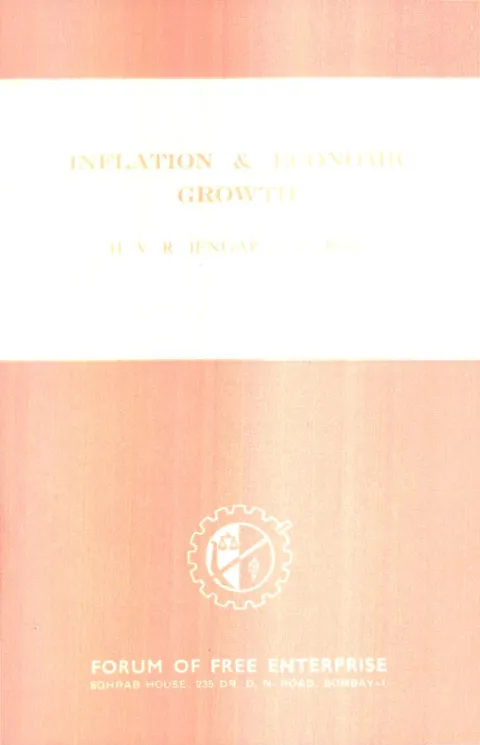
FORUM OF FREE ENTERPRISE, SOHRAB HOUSE, 235 DR. D. N. ROAD, BOMBAY-1 · Bombay · 1973
23 pages
Summary
H. V. R. Iengar, a former Governor of the Reserve Bank of India, delivered this inaugural address at a seminar on inflation organised by the Institute for Financial Management and Research in Madras on 14 December 1973. The Forum of Free Enterprise issued the talk as a pamphlet, prefaced with a Eugene Black epigraph that private enterprise must be accepted “not as a necessary evil but as an affirmative good.” Iengar accepts the orthodox diagnosis — that inflation is the joint product of an enormous expansion of the money supply and a shortfall of production — and uses his lecture to interrogate the political and administrative reasons why neither half of that equation is being corrected.
The first part of the address concentrates on the money side. Iengar argues that the Fifth Plan’s contemplated expansion of government outlay, financed in alarming proportions by Bank credit, is driving monetary expansion, and that ministerial pleas of “inescapability” for every budget head do not survive scrutiny; on his own estimate as much as 40 per cent of departmental expenditure simply “goes down the drain” through incompetence, corruption and pilferage. He couples this with a withering account of declining administrative discipline — unauthorised state-government overdrafts on the Reserve Bank dressed up at year-end, the perversion of election finance into a market for black money, and a politicised trade-union movement whose strikes hold the country to ransom. Through the discussion he keeps returning to Jayaprakash Narayan’s appeal for moral renewal and contrasts Indian sloppiness with the post-revolutionary discipline he observes in China.
The second half turns to production, especially agriculture, which Iengar reminds his audience supplies nearly half of national income. Citing a National Council of Applied Economic Research projection of food supply to 1980-81 and Dr. Koteswaran’s work on drought recurrence, he insists India must plan for repeated droughts and a competently run buffer stock and distribution system, rather than repeat the recently-collapsed wholesale wheat takeover. On industry he distinguishes between “monopoly houses” and merely “big houses,” accusing government of conflating the two on ideological grounds and so denying reputable firms the chance to expand and diversify. He closes by endorsing Sir Arthur Lewis’s view that the prime task is to eliminate the road-blocks to sustained growth, warning that without great moral leadership inflation will lead India “down the slippery path.”
An appendix reproduces an excerpt from an April/June 1973 IPA Review (Institute of Public Affairs, Australia) editorial on “Keynes & Inflation.” It argues that Keynes himself was a fierce opponent of inflation — citing his lines on how price changes “redistribute Fortune’s favours so as to frustrate design and disappoint expectation” — and that the Keynesian remedy for deflation must be inverted in present conditions: the way to cure chronic inflation is to reduce government spending and shrink “the impecuniosity of governments.” The rendered chunk ends mid-appendix in the discussion of Keynes’s “inflationary gap” concept.
Key points
-
Iengar diagnoses the 1973 inflation as a money-supply explosion meeting a production shortfall in both agriculture and industry, and insists the cure lies on both sides simultaneously.
-
He treats deficit financing of an expanding Fifth Plan budget through Bank credit as the principal monetary driver, and proposes a procedural rule requiring the central government to consult — and disclose disagreements with — the Reserve Bank before crossing ceilings.
-
Administrative decay is treated as an inflation problem in its own right: he estimates that up to 40 per cent of departmental expenditure is wasted, and points to unauthorised state overdrafts on the RBI that are quietly recycled each year-end.
-
Political corruption — driven by costly elections and a law that bars corporate donations — is identified as the chief generator of black money and a tax on the productive economy.
-
On agriculture, he draws on NCAER projections and Dr. Koteswaran’s drought-recurrence data to argue for a permanent, honestly run buffer stock and distribution system rather than ad hoc state takeovers of wholesale trade.
-
On industry, he distinguishes monopoly practices from mere bigness and accuses the post-Monopolies Commission legislation of penalising large reputable firms on ideological grounds.
-
Strikes and lock-outs in public-sector undertakings, he argues, show that nationalisation has not produced the disciplined workforce its philosophy assumed, and that political parties must let trade unions act as trade unions.
-
The appended IPA Review extract reads Keynes against the Keynesians, marshalling Keynes’s own writings on the distributive injustice of inflation to argue that in conditions of over-full employment the prescription should be reduced — not expanded — government spending.
Metadata and summary are AI-extracted from the source PDF and reviewed for editorial accuracy. The original work is available via the Read PDF tab above (where present); paragraph-level citation inside the PDF is deferred to a future engagement.