speech
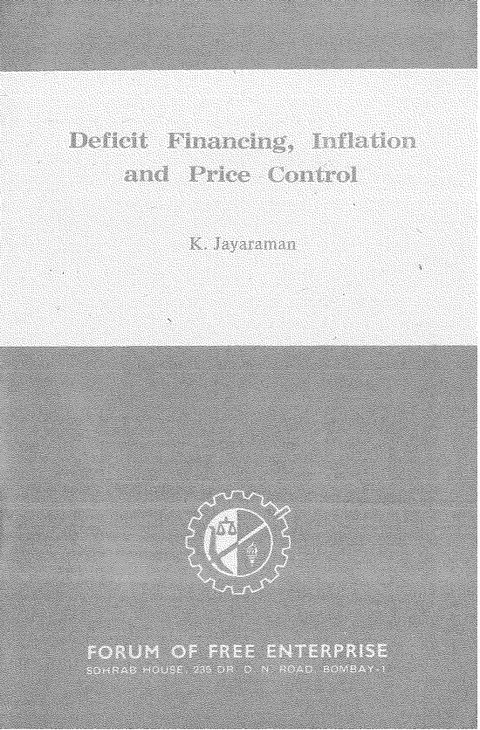
Deficit Financing, Inflation and Price Control
By K. Jayaraman
Published by M. R. PAI for the Forum of Free Enterprise, "Sohrab House", 235 Dr. Dadabhai Naoroji Road, Bombay-1. and printed by Michael Andrades at Bombay Chronicle Press Sayed Abdullah Brelvi Road, Fort, Bombay-1. · Bombay · 1973
9 pages
Summary
K. Jayaraman, a retired Indian Economic Service officer and former Director of Review and Research at the Tariff Commission, delivers this Forum of Free Enterprise lecture (Bombay, 25 July 1973; booklet dated 14 November 1973) as a diagnostic of the 1973 inflationary crisis. He opens with the headline fact that prices have risen by more than 22 per cent in a single year — the steepest in recent memory — with food articles accounting for over two-thirds of the rise and industrial raw materials up more than 30 per cent. The pamphlet treats inflation as “confiscation without compensation” and as “robbery on national scale,” arguing that anti-price-rise demonstrations have begun to deteriorate into lawlessness while government pricing policy itself adds fuel.
The central economic argument traces the rise of deficit financing from mild post-Independence levels through the 1964-65 acceleration, the 1966 rupee devaluation, the 1971-72 industrial slump, and the alarming jump in 1972-73 — culminating in deficit financing of Rs. 380 crores in the first three months of 1973-74 against a budgeted Rs. 75 crores for the whole year. Jayaraman acknowledges the Reserve Bank’s credit-squeeze and successive Bank Rate hikes but insists, citing Keynes, that interest-rate weapons are blunt in an oligopolistic, government-deficit-driven economy, and that real savings rather than passive deposit accumulation are what curb inflation.
On price control he is scathing. Indian prices, he argues, are set neither by competitive markets nor by any coherent long-term strategy but by ad hoc administrative responses to immediate pressures. He works through the distortions — vanaspati and groundnut oil, rubber tyres feeding off priority rubber prices, steel as a strategic product priced below world levels — and adopts the late Professor D. R. Gadgil’s verdict that cost-plus pricing is “the most costly way of enforcing price control,” rewarding inefficient producers and penalising the honest consumer. He quotes J. R. D. Tata’s 1972-73 Tata Iron and Steel annual report to argue that price-fixing authorities have evolved no norms or techniques of costing that would force producer and consumer alike to gain from cost cutting.
The closing pages invoke Professor B. R. Shenoy’s diagnosis of “perverse income shifts” and former RBI Governor L. K. Jha’s warning that deficit financing must be a supplement to, not a substitute for, resources mobilisation. Jayaraman dismisses wage-freeze proposals on the ground that wages form only one-fifth of total commodity cost and barely six per cent of GNP, and that the link between Indian wages and prices is weak and erratic. His prescription is to maximise production by linking wage rises to productivity, eliminate licence-permit red tape, restrain conspicuous consumption, unearth black money, and streamline distribution — closing with a citation from Great Britain’s The Accountant that “There is no golden rule to success in the battle against inflation.”
Key points
-
Prices have risen over 22 per cent in a single year; food articles account for more than two-thirds of the increase and industrial raw materials are up by over 30 per cent.
-
Deficit financing in the first three months of 1973-74 reached Rs. 380 crores — nearly 45 per cent of the whole of 1972-73 — against only Rs. 75 crores estimated in the Central Budget for the entire year.
-
Successive Bank Rate hikes and the May 1973 credit squeeze are necessary but insufficient; Keynes himself recognised the limits of re-discount rates as anti-inflation weapons in an oligopolistic economy.
-
Indian prices are determined by ad hoc administrative interventions, neither by a competitive market nor by a well-conceived long-term strategy, producing a price structure with no relationship to underlying economic conditions.
-
Cost-plus pricing — the dominant Indian method — entrenches inefficient marginal units, removes pressure for cost-cutting, and is described (after the late Professor D. R. Gadgil) as the most costly way of enforcing price control.
-
Half-controlled price structures produce supply distortions: controlling vanaspati while leaving groundnut oil free shifted output away from the controlled commodity; non-priority products like rubber tyres reap profits from priority-product price ceilings.
-
Wages form only one-fifth of total commodity cost and roughly six per cent of GNP; the wage-price link in India is weak and erratic, so wage freezes alone cannot arrest inflation.
-
The remedy lies in maximising production, linking wage rises to productivity, eliminating licence-permit red tape, restraining conspicuous consumption, unearthing black money, and streamlining the procurement and distribution of essential commodities.
Metadata and summary are AI-extracted from the source PDF and reviewed for editorial accuracy. The original work is available via the Read PDF tab above (where present); paragraph-level citation inside the PDF is deferred to a future engagement.