pamphlet
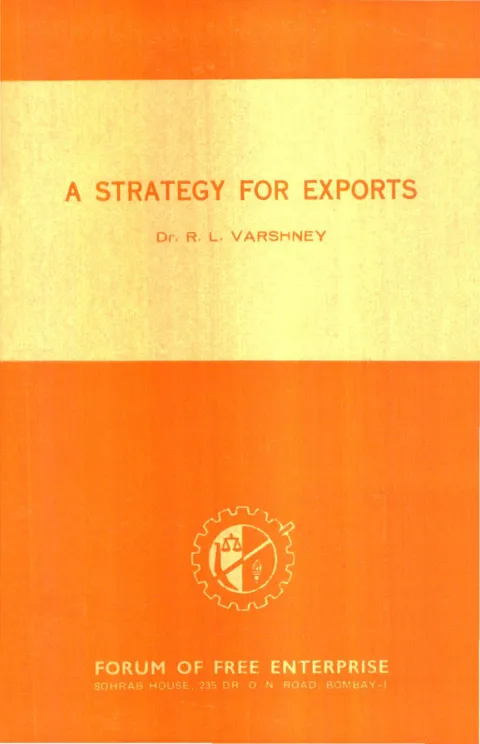
A Strategy for Exports
Published by M. R. PAI for the Forum of Free Enterprise, 235 Dr. Dadabhai Naoroji Road, Bombay-400 001, and printed by H. NARAYAN RAO at H. R. Mohan & Co., 9-B Cawasji Patel Street, Bombay-400 001. · Bombay · 1975
20 pages
Summary
In this 1975 Forum of Free Enterprise pamphlet, Dr. R. L. Varshney — then Jt. Director of the Indian Institute of Foreign Trade — assesses the dramatic jump in India’s exports during the closing years of the Fourth Plan and argues that the boom is largely a windfall rather than a tribute to Indian policy. He attributes the 22.6 per cent rise in 1972-73 and the 26 per cent rise in 1973-74 to four fortuitous factors: trade with Bangla Desh, the de facto devaluation of the rupee through its sterling link, the international price boom in primary products, and the energy crisis’s revival of natural fibres and leather. Once those tailwinds are stripped out, India’s structural position remains weak: its share of world trade has fallen continuously from 2.2 per cent in 1950 to 0.577 per cent in 1973, and exports as a share of GNP have collapsed from 6.3 per cent in 1950-51 to about 4.2 per cent in 1970-71.
The heart of the pamphlet is a strategy menu for converting the cyclical bounce into a sustained export drive. Varshney calls for identifying sectors of true comparative advantage (steel, aluminium, engineering goods, components and spare parts), increasing production rather than relying on “distress sales” forced out of a constrained domestic market, taming inflation through fiscal-monetary reform, and lowering costs through modernisation, full capacity utilisation, and linking wage growth to productivity. He challenges the regulatory architecture directly: he wants the export sector exempted from the MRTP “freeze” on large industrial houses, urges decanalisation and free competition between the STC and private exporters, and asks why India cannot welcome foreign capital and joint ventures of the kind the USSR has invited from West Germany, the U.S. and Japan.
Throughout, Varshney positions weak performance as a policy choice rather than fate. He criticises diffuse incentive bureaucracies, opaque drawback schemes, an export-obligation regime pegged at a punitive 60 per cent of new capacity, and the absence of any parliamentary follow-through on the 1970 Export Policy Resolution. Drawing repeatedly on the Japanese and West German examples, he insists that price stability, scale economies, professional market intelligence, and an industry-government “rapport” — not exhortation, compulsion, or state monopoly — are what turn export markets into durable foreign-exchange earners.
Key points
-
India’s 22.6% (1972-73) and 26% (1973-74) export surges produced a 12.8% Fourth Plan compound growth rate against a 7% target, but Varshney argues 85% of the rise was unit-value (price) gains, not real volume.
-
India’s share of world exports fell continuously from 2.2% in 1950 to 0.577% in 1973; exports/GNP collapsed from 6.3% in 1950-51 to 4.2% in 1970-71.
-
He attributes the recent boom to four fortuitous causes — Bangla Desh trade, the rupee-sterling devaluation, the 1972-73 primary-commodity price boom, and oil-crisis substitution toward natural fibres and leather — none of which is durable.
-
Capacity constraints (raw materials, power cuts, transport, labour, credit) and a profitable sheltered domestic market starve exports; banning or compelling exports has produced “distress sales” without expanding supply.
-
Strategy proposals: identify true comparative-advantage sectors (steel, aluminium, engineering goods, components), use foreign capital where needed, control inflation, and modernise plant to international scale.
-
Regulatory reform: exempt export-oriented industrial units from the MRTP freeze, allow private exporters to compete with the STC, decanalise inputs, and re-examine the 60% minimum export-obligation on new capacities.
-
Institutional reform: cut the diffuse exporter-assistance bureaucracy down to one or two agencies, introduce selectivity in licensing export houses, and set up an Export-Import Bank to finance turnkey and consultancy exports to Asian and African co-developing countries.
-
He repeatedly invokes the Japanese and West German models — price stability, scale, “filling the order”, and industry-government rapport — as the operative template, and notes that the 1970 Export Policy Resolution has gone largely unimplemented.
Metadata and summary are AI-extracted from the source PDF and reviewed for editorial accuracy. The original work is available via the Read PDF tab above (where present); paragraph-level citation inside the PDF is deferred to a future engagement.