pamphlet
INDIA NEEDS A FREE MARKET EXCHANGE RATE
Published by M. R. Pai for Forum of Free Enterprise, "Sohrab House", 235, Dr. Dadabhai Naoroji Road, Bombay 1, and printed by H. Narayan Rao at H. R. Mohan & Co., 9-B, Cawasjee Patel Street, Bombay 1. · Bombay · 1963
4 pages
Summary
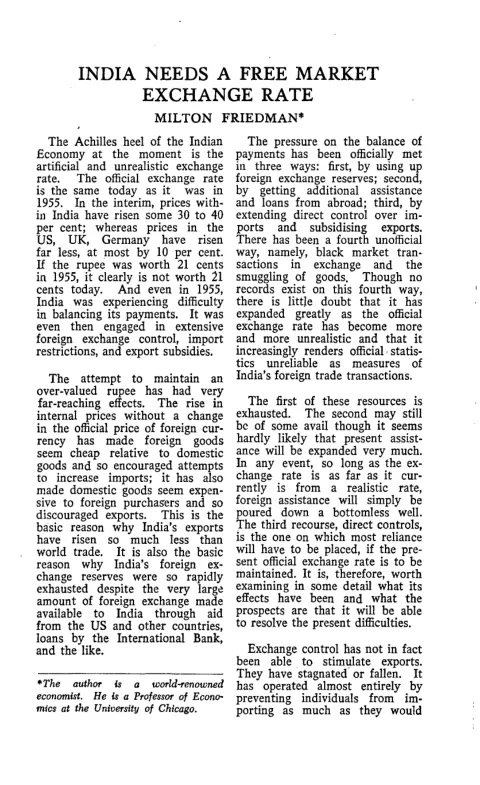
Milton Friedman, then Professor of Economics at the University of Chicago, argues in this Forum of Free Enterprise leaflet (reproduced from Swarajya of 30 March 1963) that India’s pegged, overvalued rupee is the single biggest weakness of its economy. He observes that while domestic prices have risen 30–40 per cent since 1955, prices in the US, UK and Germany have risen at most 10 per cent — yet the official exchange rate has not moved. The result is that imports look artificially cheap, exports look artificially expensive, and the government has been forced into four increasingly unsustainable strategies for filling the gap: drawing down foreign reserves, taking on foreign aid and loans, imposing direct controls on imports and exports, and tolerating a swelling black market.
Friedman dwells longest on the third recourse — direct controls — because it is the lever on which Indian policy has come to lean hardest. He argues that there is no satisfactory administrative criterion for deciding which imports are ‘essential’, that no central authority can know which domestic substitutes are worth producing or at what cost, and that quantitative licensing inevitably breeds corruption, windfall profits for licence-holders, and a corrosion of public trust in government. Exchange control has not stimulated exports either; they have stagnated or fallen because importing inputs through the official channel is uneconomic.
His prescription is to stop pegging the rupee and let it float in a free market, with day-to-day rates set by private transactions. A floating rate would supply an automatic adjustment mechanism, make exchange crises impossible, and allow the complete elimination of import quotas, tariffs, subsidies and other interference with international trade. Friedman closes with a Hayekian appeal to dispersed knowledge: a market rate would mobilise the specialised information of tens of millions of Indians, providing ‘a far more subtle and efficient adjustment than blunt measures of a few central planners’. A one-shot fixed devaluation, he concedes, would be an improvement, but a continuously market-clearing rate is what India actually needs.
Key points
-
Friedman identifies the artificial, overvalued rupee as the ‘Achilles heel’ of India’s economy, citing a 30–40 per cent rise in Indian prices since 1955 against at most 10 per cent in the US, UK and Germany.
-
He enumerates four ways India has met balance-of-payments pressure: running down reserves, taking foreign aid and loans, direct controls on imports and exports, and an expanding black market.
-
Direct controls, he argues, lack any rational criterion for deciding ‘essential’ imports and force planners to ration foreign exchange without the information needed to do so intelligently.
-
Import licensing breeds corruption, windfall profits, inequality of income and wealth, and erodes public trust in government.
-
Exchange control has failed even on its own terms — exports have stagnated or fallen because producers cannot import inputs economically at the official rate.
-
A one-off devaluation to a more realistic peg (he floats figures like 7 rupees to the dollar or 20 to the pound) would be a partial fix but invites renewed crisis as inflation continues.
-
The first-best policy is a freely floating rupee whose rate is set day-to-day by private transactions, supplying an automatic adjustment mechanism and rendering import quotas, tariffs and subsidies unnecessary.
-
A market rate would harness the dispersed specialised knowledge of millions of Indians — a Hayekian argument that planners, however able, cannot collectively match the aggregate knowledge of the population.
Metadata and summary are AI-extracted from the source PDF and reviewed for editorial accuracy. The original work is available via the Read PDF tab above (where present); paragraph-level citation inside the PDF is deferred to a future engagement.