
edited volume · anthology
The Economic Thinking of Prof. Milton Friedman
Published by M. R. PAI for the Forum of Free Enterprise, "Piramal Mansion", 235 Dr. Dadabhai Naoroji Road, Bombay-1, and printed by B. D. Nadirshaw at Bombay Chronicle Press, Sayed Abdulla Brelvi Road, Fort, Bombay-1. · Bombay · 1977
20 pages
Summary
Published by the Forum of Free Enterprise on 14 January 1977 to mark Milton Friedman’s Nobel Prize, this slim booklet pairs two complementary texts. The first is a reprint of a 1963 article by Friedman himself — ‘India Needs A Free Market Exchange Rate’ — which the Forum had originally issued as a leaflet in May 1963 and now reproduces with a note that ‘developments on India’s foreign exchange front have moved in the direction indicated by Prof. Friedman.’ The second is ‘Milton Friedman — Leader of Monetarist Revolution’, a critical appraisal by P. R. Brahmananda, Professor of Monetary Economics at Bombay University, originally published in Commerce on 23 October 1976. Together the two pieces position Friedman as both a practical policy critic of India’s exchange-control regime and as the synthesiser who restored the Quantity Theory of Money to the centre of macroeconomics. The Forum supplies a brief introduction and the customary disclaimer that the views are not necessarily its own, while the back matter carries the standard membership appeal and an A. D. Shroff epigraph.
Key points
-
Published on 14 January 1977 by the Forum of Free Enterprise to mark Milton Friedman’s Nobel Prize, the booklet reprints Friedman’s 1963 article ‘India Needs A Free Market Exchange Rate’ alongside P. R. Brahmananda’s appraisal from Commerce, 23 October 1976.
-
Friedman diagnoses the pegged, overvalued rupee as the ‘Achilles heel’ of the Indian economy, noting domestic prices rose 30 to 40 per cent between 1955 and 1963 against at most 10 per cent in the US, UK, and Germany.
-
Friedman catalogues four official responses to maintaining the peg: drawing down reserves, soliciting foreign aid and loans, tightening exchange and import controls, and an expanding unofficial black market channel.
-
Friedman argues that direct import licensing misallocates imports, breeds corruption around licence-granting, and generates windfall rents for the fortunate few without stimulating exports.
-
Friedman predicts an imminent devaluation but rejects any new fixed peg, advocating instead a floating exchange rate combined with the abolition of quotas and export subsidies.
-
Brahmananda frames Friedman as the ‘hedgehog’ who restored the Quantity Theory of Money to macroeconomics, laying out its modern form in ten propositions covering the money multiplier, velocity, and demand for money.
-
Brahmananda credits earlier economists, including Fisher, Hawtrey, Robertson, Simons, Patinkin, Hayek, Gurley, and Shaw, for individual propositions, locating Friedman’s originality in synthesis and empirical testing rather than invention.
-
Brahmananda criticises Friedman for partly surrendering to Keynesianism by conceding effective demand under short-run conditions, and for advocating full indexation, which he reads as abandoning the fight against inflation.
Essays
Introduction
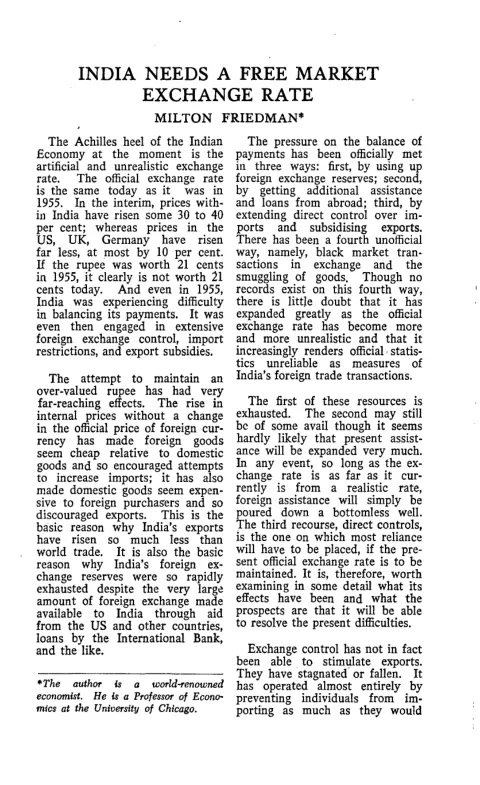
Friedman’s 1963 article diagnoses the overvalued, pegged rupee as the ‘Achilles heel’ of the Indian economy. Since 1955 internal Indian prices have risen 30–40 per cent while US, UK and German prices have risen at most 10 per cent, so at the unchanged official rate the rupee is worth far less than 21 cents in purchasing-power terms. Maintaining the peg, he argues, has forced the government down three increasingly damaging paths — drawing down reserves, soliciting more foreign aid and loans, and tightening direct exchange and import controls — while a fourth, unofficial channel of black-market transactions has expanded in step with the unreality of the official rate. Direct controls have failed to stimulate exports and instead misallocate imports, breed corruption around licence-granting, generate windfall rents for the lucky few, and corrode public trust in government.
Friedman predicts an inevitable devaluation ‘sometime within the next year or so’, perhaps to seven rupees to the dollar or twenty to the pound, but warns that a new fixed peg will only buy time. The clean solution is to stop pegging altogether: let the rate float, ideally alongside the abolition of import quotas, export subsidies and other trade interference; if quotas cannot be removed, at minimum replace them with tariffs under a floating rate. A market exchange rate, he concludes, would enlist ‘tens of millions of people in their everyday lives’ as decentralised allocators of foreign exchange — a knowledge advantage that no central planner can match.
- Diagnoses the overvalued pegged rupee as the central distortion in the Indian economy.
- Documents the divergence between Indian and Western price levels between 1955 and 1963 to argue the rupee is worth far less than 21 cents.
- Catalogues the three official responses to the peg — drawing down reserves, foreign aid and loans, direct controls — plus the black-market fourth channel.
- Argues that direct import licensing breeds corruption, rent-seeking and public distrust without stimulating exports.
- Predicts an imminent devaluation but rejects any new fixed peg as a stable solution.
- Advocates a floating exchange rate, ideally combined with the abolition of quotas and subsidies, as an automatic adjustment mechanism.
India Needs A Free Market Exchange Rate
By Prof. Milton Friedman
Brahmananda’s appraisal positions Friedman as the leader of the ‘Monetarist Revolution’ and the chief modern champion of the Quantity Theory of Money, alongside Piero Sraffa’s parallel revival of classical economics. He calls Friedman a ‘hedgehog’ in Isaiah Berlin’s sense — the thinker who knows one big thing — and lays out the modern Quantity Theory in ten propositions covering the money multiplier, the income-velocity function, the transmission mechanism, the stable demand for money, the case for a fixed money-supply growth rule, real-balance saving, the Fisher distinction between real and nominal interest, and the long-run neutrality of money for real output. For each proposition, Brahmananda generously distributes credit — to Irving Fisher, Ralph Hawtrey, D. H. Robertson, Henry Simons, Don Patinkin, Vera Lutz, Hayek, the Austrians, Gurley and Shaw — arguing that Friedman’s genuine originality lies less in the propositions themselves than in synthesising them and subjecting them to systematic empirical test.
The second half is more critical. Brahmananda holds that Friedman has ‘partly surrendered himself to Keynesianism’ by conceding the necessity of effective demand under Keynesian short-run conditions, and that his recent advocacy of 100 per cent indexation amounts to abandoning the fight against inflation in favour of preserving the status-quo ante. He contrasts Friedman with Hayek, who ‘cannot enter into any compromise … with the phenomenon of inflation’, and aligns himself with classical economists — Ricardo, Hume, J. S. Mill, Marshall, Robertson — who favoured a falling-price-level path as more conducive to social justice for workers and savers. The essay closes with the verdict that ‘Friedman’s victory is for Monetarism against Fiscalism’ but not for monetarist theory over the General Theory, and a call for Friedman to return to the older Quantity Theory tradition by recognising the rejection of Say’s Law as the root of the trouble.
- Frames Friedman as a ‘hedgehog’ who restored the Quantity Theory of Money to the centre of macroeconomics, on a par with Sraffa’s revival of classical economics.
- Lays out the modern Quantity Theory in ten propositions covering the money multiplier, velocity, transmission, demand for money, fixed-growth rule, indexation and long-run neutrality.
- Distributes credit for individual propositions to Fisher, Hawtrey, Robertson, Simons, Patinkin, Lutz, Hayek, Gurley and Shaw, locating Friedman’s originality in synthesis and empirical testing rather than novelty.
- Argues Friedman has ‘partly surrendered’ to Keynesianism by admitting effective demand as a necessary condition for full-employment real income.
- Criticises Friedman’s espousal of 100 per cent indexation as a ‘pain-killer preserving the status-quo ante’ rather than a remedy for inflation.
- Contrasts Hayek’s uncompromising anti-inflation stance with Friedman’s accommodation, aligning the author with classical economists like Ricardo, Hume, J. S. Mill and Marshall who preferred a falling-price-level path on grounds of social justice.
- Concludes that Friedman’s success is policy-level — ‘Monetarism against Fiscalism’ — and that the deeper task is to reject Say’s Law and the doctrine of effective demand ‘a la Keynes or a la Friedman’.
Metadata and summary are AI-extracted from the source PDF and reviewed for editorial accuracy. The original work is available via the Read PDF tab above (where present); paragraph-level citation inside the PDF is deferred to a future engagement.
People in this work
Related across the archive
 Primary workINDIA NEEDS A FREE MARKET EXCHANGE RATE
 Primary workInflation in Brazil—the Principles of Monetary Correction
 Primary workINFLATION IN INDIA
 ThePrintDemonetisation is a wild hit at the bull’s eye. It will not hurt the guilty: BP Adarkar
 ExcerptEconomic Reforms In India: Where Are We And Where Do We Go?