speech · memorial lecture
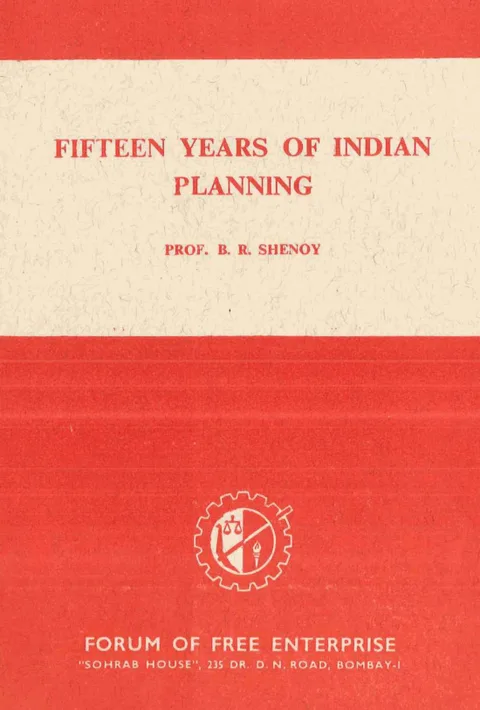
FIFTEEN YEARS OF INDIAN PLANNING
By B. R. Shenoy
Published by M. R. PAI for the Forum of Free Enterprise, "Sohrab House", 235, Dr. Dadabhai Naoroji Road, Bombay 1, and printed by S. B. Phansikar at Parmanand Co-operative Printing & Publishing Society Ltd., Ambekar Road, Wadala, Bombay 31. · Bombay · 1966
19 pages
Summary
Delivered as the Walchand Memorial Lecture in Bombay on 7 April 1966 and issued in pamphlet form by the Forum of Free Enterprise that August, B. R. Shenoy’s address is a forensic indictment of the first fifteen years of Indian central planning. Shenoy, then Director of the School of Social Sciences at Gujarat University, opens by insisting that economic progress must be measured by mass well-being — chiefly by the per capita availability of food and cloth — and then marshals official statistics to show that on this test the post-1951 record is at best semi-stagnant and on some measures (cereal availability per capita, cotton cloth consumption) worse than the late inter-war years. He argues that the planning regime has produced a structural divorce between production and consumer needs, channelling roughly 70 per cent of Third Plan investment into Public Sector “infrastructure” and heavy industry while the basic-goods sectors (agriculture, cotton textiles) atrophy.
The second half of the lecture builds a causal chain from this misallocation to India’s compounding crises: deficit-financed budgets that have doubled money supply over the decade and pushed prices up 70 per cent; recurring foreign-exchange droughts; mounting food shortages requiring 10 million tonnes of imports in 1966; the collapse of the capital market; and a perverse income redistribution from consumers to traders, intermediaries and Public Sector contractors that he calls a social injustice. Shenoy then prescribes fifteen reform points — denationalisation of Public Sector projects “capable of being worked on sound commercial principles”, a floating rupee, freezing or replacing P.L. 480 counterpart funds, removal of import-exchange controls, price decontrol, and a drastic scaling-down of Public Sector activity to under ten per cent of national income.
Throughout he draws on Milton Friedman’s contrast between centrally planned societies and the free-pricing systems of West Germany, Italy, Japan, Malaya, Singapore, Hong Kong and Formosa, and rests his case on the Rule of Law and the consumer’s sovereignty at “the shopping referendum”. The pamphlet closes with a fourteen-point summary of conclusions and a table of production indices for 1954-55 to 1964-65, framing the work as both a diagnosis of planning failure and a manifesto for restoring market coordination and a limited state.
Key points
-
Defines economic progress as a continued rise in the standard of living of the masses, measured first by per capita food and cloth availability, and tests Indian planning by that yardstick.
-
Documents that per capita cereal availability fell from 15.3 oz/day (1937-38 average) to 13.7 oz in 1964 and cotton cloth from 14.7 m in 1956 to 15.11 m only after 34.4 million tonnes of net wartime/post-war imports — concluding that the masses are “more hungry today than before the war”.
-
Attributes stagnation to a planning-induced divorce between production and consumer needs, with about 70 per cent of Third Plan investment going to Public Sector “infrastructure” and heavy industry rather than agriculture, cotton textiles and basic consumer goods.
-
Traces inflation, the foreign-exchange crisis, and the capital-market malaise to chronic budget deficits, exchange controls, import licensing premia of 500-700 per cent, and the diversion of P.L. 480 counterpart funds into deficit financing.
-
Quotes Milton Friedman to argue that no centrally planned society has produced sustained mass improvement, while citing West Germany, Italy, Japan, Malaya, Singapore, Hong Kong and Formosa as free-market success cases.
-
Calls for denationalisation of viable Public Sector projects, a floating rupee, repeal of import and price controls, freezing of P.L. 480 funds, and confinement of state activity to the Rule of Law, defence, monetary stability and rural extension services.
-
Concludes with a 14-point reform programme and TABLE II (Pattern of Production 1954-55 to 1964-65) showing Public Sector investment indexed at 438.3 against industrial production at 210.8 and agricultural production at 134.7.
Metadata and summary are AI-extracted from the source PDF and reviewed for editorial accuracy. The original work is available via the Read PDF tab above (where present); paragraph-level citation inside the PDF is deferred to a future engagement.