speech
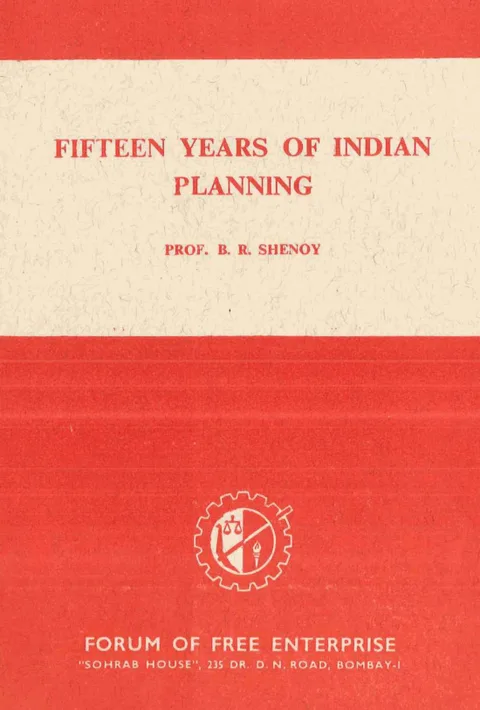
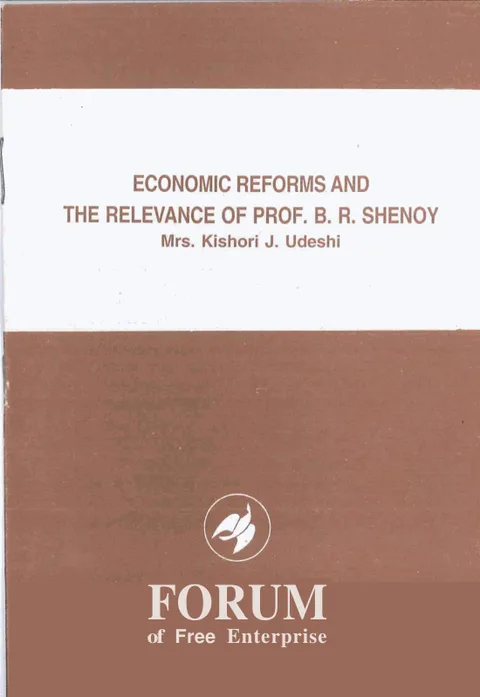
Economic Reforms and the Relevance of Prof. B. R. Shenoy
Published by S. S. Bhandare for the Forum of Free Enterprise, Peninsula House, 2nd Floor, 235, Dr. D. N. Road, Mumbai 400001, and Printed by S. V. Limaye at India Printing Works, India Printing House, 42 G. D. Ambekar Marg, Wadala, Mumbai 400 031 · Mumbai · 2007
13 pages
Summary
Delivered on 4 June 2007 as the Prof. B. R. Shenoy Birth Centenary Memorial Lecture under the joint auspices of the Economics Research Centre, Mumbai, the Indian Liberal Group and the Forum of Free Enterprise, Kishori Udeshi’s address reads as both a tribute and a vindication. Speaking as a former Deputy Governor of the Reserve Bank of India, she juxtaposes Shenoy’s heterodox prescriptions of the 1950s–1970s against the post-1991 reform agenda and argues that almost every major liberalisation step—reining in deficit financing, channeling resources into agriculture, dismantling industrial licensing, scaling back the public sector, adopting a fully floating rupee, and rebalancing taxation and expenditure—was anticipated in Shenoy’s writings. She treats him as ‘the real founding father of the reforms of the past 15 years.’
The lecture moves through a sequence of policy domains. On deficit financing and the foreign-exchange crisis she anchors the discussion in Shenoy’s Note of Dissent on the Second Five Year Plan, quoting at length his warning that forcing growth beyond available real resources guarantees uncontrolled inflation; she traces the 1957–58 and 1991 crises and the eventual passage of the Fiscal Responsibility and Budget Management Act, 2004, as belated acknowledgements. On monetary policy she imagines a ‘monetary hawk’ Shenoy as an inflation targeter for the post-1991 era of capital inflows. On industrial policy and the external sector she revisits his attack on indiscriminate import substitution and his early call for devaluation and a floating exchange rate.
Udeshi devotes substantial attention to two issues where she finds Shenoy still ahead of policy: the gold trade—where his 1963 and 1992 proposals for a Gold Exchange Bank remain only partially implemented—and agriculture, where his critique of price support, procurement and the misallocation of plan outlay is offered as a diagnosis of present-day farmer distress, with allusions to recent farmer suicides and to the Mexican Chiapas crisis. She closes by likening Shenoy to Hayek—both ‘hounded out of the corridors where economic counsel was sought,’ but only Hayek belatedly honoured—and quotes Milton Friedman’s tribute. The booklet, edited by S. S. Bhandare, also reproduces an editor’s note framing Shenoy as a ‘great thinker and visionary’ who stood almost alone against Nehruvian planning.
Key points
-
Frames B. R. Shenoy as ‘the real founding father’ of India’s post-1991 liberalisation, treating his 1950s–1970s heterodoxy as prophecy now vindicated.
-
Reconstructs Shenoy’s Note of Dissent on the Second Five Year Plan as the locus classicus on deficit financing, linking it to the 1957–58 and 1991 foreign-exchange crises and the FRBM Act, 2004.
-
Argues that in a liberalised, capital-inflow-heavy environment Shenoy would have been an ‘inflation targeter’ and monetary hawk, advocating sterilisation and aggressive intervention.
-
Reviews Shenoy’s seven-point reform agenda—ending inflation, agricultural investment, dismantling licensing, public-sector scale-down, a floating rupee, lower taxation—as a template the 1991 reforms substantially fulfilled.
-
Singles out gold policy as unfinished business, recalling Shenoy’s 1963 and 1992 proposals for a Gold Exchange Bank and noting that the 1997 liberalisation of gold imports still falls short.
-
Highlights agriculture as the domain where Shenoy’s warnings about price support, procurement and misallocated plan outlay best diagnose current distress, with reference to farmer suicides and the Mexican Chiapas precedent.
-
Likens Shenoy to Friedrich Hayek—both ostracised from official economic counsel—and laments that Shenoy, unlike Hayek, never lived to see his ideas adopted nor received comparable recognition.
-
Marshals testimony from Rakesh Mohan, Parth Shah and Milton Friedman to underline how little official acknowledgement Shenoy still receives even in the post-reform consensus.
Notable passages
"She treats him as 'the real founding father of the reforms of the past 15 years.'"
"Likens Shenoy to Friedrich Hayek—both ostracised from official economic counsel—and laments that Shenoy, unlike Hayek, never lived to see his ideas adopted nor received comparable recognition."
"framing Shenoy as a 'great thinker and visionary' who stood almost alone against Nehruvian planning"
"Marshals testimony from Rakesh Mohan, Parth Shah and Milton Friedman to underline how little official acknowledgement Shenoy still receives even in the post-reform consensus."
Metadata and summary are AI-extracted from the source PDF and reviewed for editorial accuracy. The original work is available via the Read PDF tab above (where present); paragraph-level citation inside the PDF is deferred to a future engagement.