speech
Prune the Plan
By B. R. Shenoy
Forum of Free Enterprise, 235, DR. DADABHAI NAOROJI ROAD, BOMBAY 1. · Bombay · 1957
10 pages

Prune the Plan
By B. R. Shenoy
Summary
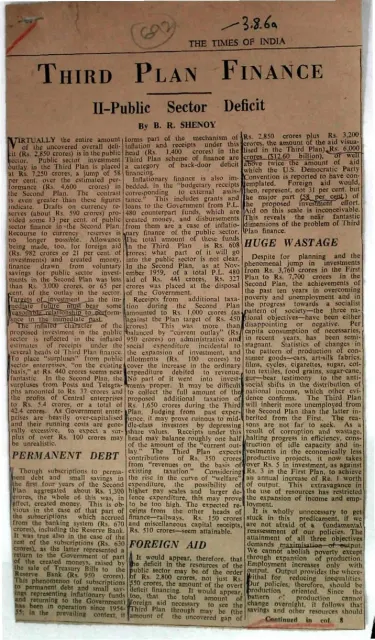
Prune the Plan is the full text of an address by Professor B. R. Shenoy, delivered in Bombay on June 17, 1957, on the Union Budget and the Second Five-Year Plan. Shenoy opens with the arithmetic of the Plan: the first two years’ outlay of about Rs. 1,600 crores is roughly 75% of the contemplated expenditure, the Government insists it will stick to the Plan whatever the difficulties, yet the resources to do so simply do not exist either at home or from abroad. The whole of the Plan’s overall resource gap of Rs. 2,500 crores, he argues, sits inside the Public Sector, while the Private Sector’s own target of Rs. 2,400 crores is already fully committed — so any attempt to close the gap by tapping private savings amounts to confiscation rather than democratic finance.
The core argument is austerely classical: economic development is a function of invested savings, and a poor country with per-capita income of Rs. 23.42 a month against America’s Rs. 775 cannot will into existence resources it does not have. Shenoy walks through the heads of finance — taxation, market loans, small savings, self-financing by industry, credit creation by commercial banks, deficit financing — and shows that each is either tapped out, already counted, or inflationary. Heavy current-year taxation has hit share values and dividends and contracted private investment; subscriptions to Government loans have exceeded expectations only because inflationary funds are circulating back as ‘voluntary’ savings; deficit financing has already pushed wholesale prices up 27% in twenty months.
From this diagnosis flow concrete consequences he is unsparing about: an acute foreign-exchange scarcity caused by over-investment, a yawning gap between internal and external gold prices (Rs. 62.50 per tola official, around Rs. 105 in Bombay) that the Sea Customs Act and an inverted burden of proof on gold-holders cannot close, and the spectacle of a Government ‘clipping the civil liberties of the individual’ in the manner of medieval monarchs clipping coins. Shenoy’s prescription is in the title: prune the Plan to the resources actually available, devalue the rupee to its real value, restore a balanced budget, and accept that inflation, once tolerated as a tool of development, will deliver less growth than the permissible maximum, not more. The pamphlet closes with the publisher’s standing invitation to join the Forum of Free Enterprise.
Key points
-
Frames the Second Five-Year Plan’s Rs. 2,500-crore overall resource gap as wholly located in the Public Sector, with the Private Sector’s Rs. 2,400-crore target already fully committed.
-
Insists on the classical proposition that economic development is a function of invested savings, and that a society cannot invest resources it does not possess.
-
Contrasts U.S. per-capita income of Rs. 775 per month with India’s Rs. 23.42 per month to argue that whatever ‘socialistic pattern of society’ is to be built must be built within that constraint.
-
Argues that heavy taxation in the current year has depressed share values and dividends and has therefore reduced rather than augmented investment.
-
Treats apparent successes of public subscription to Government loans as artefacts of inflationary money flowing back through the State, not as genuine voluntary saving.
-
Documents a 27% rise in prices in 20 months from deficit financing and warns that further deficit finance will deliver development below — not above — the permissible maximum.
-
Identifies an acute foreign-exchange scarcity as the direct consequence of over-investment, with imports rising from index 106 to 135 even as exports fell from 112 to 106.
-
Reads the Sea Customs Act’s reversal of the burden of proof on seized gold as a ‘case of clipping the civil liberties of the individual’, analogous to medieval coin-clipping.
-
Prescribes pruning the Plan to available resources, devaluing the rupee to its real value, and restoring non-inflationary budget financing.
Generated by the v1.5 extraction pipeline. Awaiting editorial review.
Metadata and summary are AI-extracted from the source PDF and reviewed for editorial accuracy. The original work is available via the Read PDF tab above (where present); paragraph-level citation inside the PDF is deferred to a future engagement.