speech
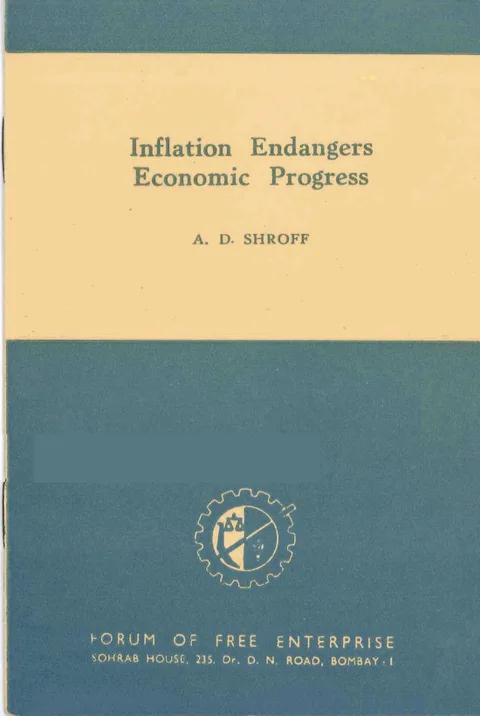
Inflation Endangers Economic Progress
By A. D. Shroff
Forum of Free Enterprise, Sohrab House, 235, Dr. D. N. Road, Bombay-1. Published by M. R. Pai, for Forum of Free Enterprise, "Sohrab House," 235, Dr. Dadabhai Naoroji Road, Bombay 1, and printed by S. Krishnamoorthy at Western Printers & Publishers (Prop. K. S. Mistry), 15/23, Hamam Street, Bombay 1. · Bombay · 1961
11 pages
Summary
This Forum of Free Enterprise pamphlet, based on a lecture A. D. Shroff delivered in Bombay on 8 March 1961, presents a sustained critical reading of the Union Budget for 1961-62. Shroff opens by faulting the year’s Economic Survey for departing from the dispassionate tone of its 1959-60 predecessor — it is, in his words, “heavily loaded with a certain bias and ideology” — and uses the Budget as a “photographic presentation” through which to test whether the closing Second Five-Year Plan has actually paid for the price rises and balance-of-payments strain it has caused.
The bulk of the pamphlet works through the Finance Minister’s proposals item by item. Shroff documents a revenue deficit of about Rs. 60 crores to be covered through Rs. 57 crores of new customs and excise duties and Rs. 3 crores of direct taxes, with public expenditure climbing from Rs. 998 crores in 1951-52 to Rs. 2,557 crores in 1960-61. He cites a then-recent National Council of Applied Economic Research study led by Dr. P. S. Lokanathan to argue that direct taxation has reached a ceiling: rates so high that large-income earners have nothing left to invest, joint-stock company savings are falling, and the government is forced back onto indirect taxes. The result is excises on 14 new commodities and rate increases on 18 more — kerosene, sugar, matches, vegetable products, radios, tobacco, paper, cement, fuel oils, motor vehicles — which Shroff says will be passed straight to consumers and choke the very industries meant to absorb agricultural labour.
Shroff’s central charge is that the budget institutionalises inflation. Deficit financing of Rs. 1,200 crores under the Second Plan has driven a 25 per cent rise in wholesale prices and a 43 per cent rise in the working-class cost-of-living index since 1949. The depreciation of the rupee, he warns, is now visible to outsiders: 100 Hong Kong dollars cost Rs. 116 instead of Rs. 83, and the pound sterling trades at Rs. 18 on the unofficial Bombay market against a par value of Rs. 13.34. With the Third Plan demanding a capital outlay of Rs. 12,000 crores (including Rs. 2,600 crores of foreign exchange) at a moment when India must repay Rs. 600 crores of foreign loans by 1966 and foreign balances have collapsed from Rs. 746 crores to Rs. 157 crores, Shroff closes with a plea for organised public opinion as the “only saving feature” left for stabilising the economy.
Key points
-
Opens by accusing the Economic Survey 1960-61 of ideological bias compared with the more dispassionate 1959-60 Survey.
-
Budget 1961-62 proposes Rs. 57 crores of new customs/excise duties and Rs. 3 crores of direct taxes to cover an estimated Rs. 60 crores revenue deficit.
-
Total public expenditure has risen from Rs. 998 crores in 1951-52 to Rs. 2,557 crores in 1960-61; Second Plan deficit financing reached Rs. 1,200 crores.
-
Cites NCAER study led by Dr. P. S. Lokanathan to argue direct taxation has hit a ceiling — corporate savings are falling and the net investment rate is in decline.
-
Excise duty extended to 14 new commodities and raised on 18 existing ones, including kerosene, sugar, matches, radios, tobacco, paper, cement and motor vehicles.
-
Wholesale prices rose 25 per cent across the Second Plan; the all-India working-class cost-of-living index is at its highest since 1949.
-
Internal rupee depreciation now visible abroad: 100 Hong Kong dollars cost Rs. 116 versus Rs. 83 a year earlier; pound sterling trades at Rs. 18 unofficially against the par value of Rs. 13.34.
-
Third Plan needs Rs. 12,000 crores capital outlay (Rs. 2,600 crores in forex) while India must repay Rs. 600 crores of foreign loans by 1966 and foreign balances have fallen from Rs. 746 crores to Rs. 157 crores.
-
Closes by arguing organised public opinion is the only remaining instrument for stabilising the economy.
Metadata and summary are AI-extracted from the source PDF and reviewed for editorial accuracy. The original work is available via the Read PDF tab above (where present); paragraph-level citation inside the PDF is deferred to a future engagement.