speech
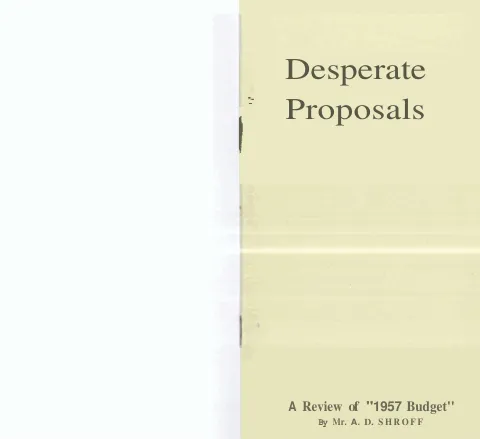
Desperate Proposals
A Review of "1957 Budget"
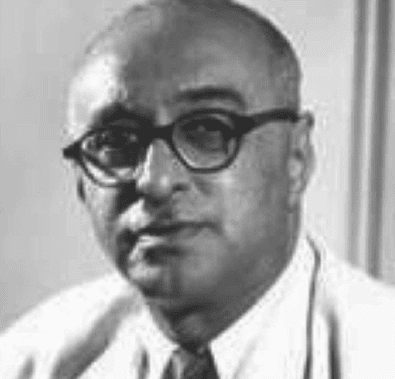
By A. D. Shroff
Forum of Free Enterprise, 235, Dr. Dadabhai Naoroji Road, Bombay 1. · Bombay · 1957
13 pages
Summary
A. D. Shroff’s address to the Commerce Graduates’ Association in Bombay on 22 May 1957 is a sharp, line-by-line attack on the Union Budget of 1957–58, which he treats as the financial expression of a Second Five-Year Plan that has lost contact with India’s productive capacity. Shroff concedes that some deficit financing under planned development is unavoidable, but argues that taxes to cover the Rs. 33-crore current-account deficit could have been raised without the revolutionary new burdens the Finance Minister proposes. The actual package — fresh excises on tea, cloth, matches, sugar, cement and steel ingots, a sharply lowered minimum income-tax slab, a heavier super-tax and bonus tax, a new wealth tax and an unprecedented expenditure tax — is, in his telling, dictated only by the need to extract as much revenue as possible from a population already living at bare subsistence.
The critique moves outward from prices to politics. Shroff documents how government control of cement and steel has produced shortage, illegitimate State Trading Corporation profits and what he calls open profiteering by the State, even as the private sector is denounced for the same conduct. He reads the wealth tax and expenditure tax as administratively impossible without a ‘Police Raj’, certain to invite evasion, corruption and double taxation of company shareholders. The wider charge is that the Plan has become ‘the Government’s Plan’ rather than a People’s Plan, that it is being pushed through at a cost the country cannot bear, and that foreign-exchange reserves have been squandered through indiscriminate import licences, leaving India with a sterling balance of only Rs. 400 crores and dependent on IMF drawings.
The speech closes on a procedural demand: an independent committee, on the model of the post-First-World-War Inchcape Committee, to scrutinise the runaway growth of public expenditure that the Finance Minister’s speech, in Shroff’s view, refuses to examine. Throughout, the polemical frame is that of the title — a ‘gamble in planning’ whose budget is the ‘last throw of a desperate gambler’ — and the pamphlet is issued by the Forum of Free Enterprise as part of its campaign for a recognised, secure role for private enterprise in Indian development.
Key points
-
Shroff frames the 1957–58 Union Budget as ‘a gamble in planning’ whose revolutionary new taxes flow from the attempt to force through the Second Five-Year Plan rather than from sound fiscal logic.
-
He estimates the new tax incidence at about Rs. 93 crores (of which excise duties account for over Rs. 63 crores) and argues these levies fall hardest on consumers already at bare subsistence, citing a village where only 58 of around 900 children attend school because the rest ‘had no clothes to put on’.
-
On controlled commodities like cement and steel, he charges the State Trading Corporation with ‘an illegitimate profit of Rs. 12 per ton’ and accuses the Government of ‘a daylight robbery of Rs. 12/- per ton’ — profiteering of the kind for which private business is condemned.
-
He attacks the new wealth tax and expenditure tax as administratively unworkable, doubly taxing company shareholders and capable of effective enforcement only under what he calls ‘a Police Raj’.
-
Shroff retracts an earlier welcome of the Prime Minister’s assurance that the private sector has ‘an assured and respected place’, concluding that the proposals ‘can only have a limited life of its own’.
-
He warns that wholesale prices have risen 13 per cent in the last year, that food and high prices are spreading despite fair price shops, and that talk of controlling inflation through fresh excises is ‘a phantasmagoric hallucination’.
-
Indiscriminate import licensing in 1956 has, in his account, drawn down India’s sterling balance from about Rs. 710 crores to roughly Rs. 300 crores and forced reliance on $127 million already drawn from the IMF out of a $200 million entitlement.
-
He demands an independent committee, on the model of the post-First-World-War Inchcape Committee, to carry out a ‘thorough and all-sided scrutiny of public expense’, noting that the Finance Minister’s speech contains ‘no word’ about expenditure restraint.
Metadata and summary are AI-extracted from the source PDF and reviewed for editorial accuracy. The original work is available via the Read PDF tab above (where present); paragraph-level citation inside the PDF is deferred to a future engagement.