speech
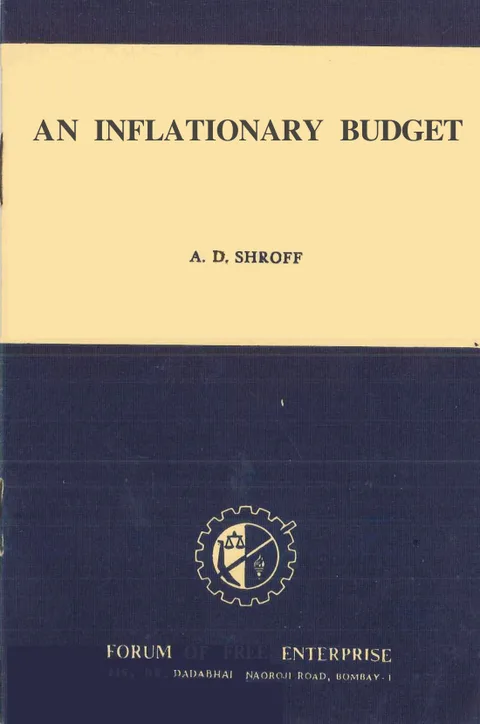
An Inflationary Budget
By A. D. Shroff
Published by M. R. Pai, for Forum of Free Enterprise, 235 Dr. Dadabhai Naoroji Road, Bombay-1, and printed by S. Krishnamoorthy, at Western Printers & Publishers, 15/23 Hamam Street, Bombay-1. · Bombay · 1959
13 pages
Summary
Delivered as a speech on 11 March 1959 under the joint auspices of the Democratic Group and the Progressive Group in Bombay, and published by the Forum of Free Enterprise, A. D. Shroff’s address dissects the Union Budget for 1959-60 presented by Finance Minister Morarji Desai. Shroff opens by chiding the Lok Sabha for the casual treatment given to a document that shapes the livelihood of millions, then walks his audience through the budget’s revenue and expenditure sides before issuing his central warning: the budget is fundamentally inflationary, and the inflationary trajectory of the Second Five-Year Plan has now reached a point where ‘runaway inflation’ is a live risk.
On revenue, Shroff highlights how excise duties have leapt from Rs. 156 crores in 1956-57 to Rs. 325 crores in 1959-60, becoming the single largest individual head, while the gap between estimates and Plan demand is closed by deficit financing that compels the Reserve Bank to print fresh notes at the Nasik Security Printing Press. Defence expenditure, although reduced to Rs. 243 crores, still exceeds the Rs. 200-crore ceiling he urges for a country that professes Gandhian non-violence. The Plan has come to dominate the entire budget: during the first three years of the Second Plan only about 36% of expenditure was met from domestic borrowings while 63% came from foreign borrowings and deficit financing. Sterling balances are essentially exhausted, the price level has risen by some 15%, and the Government’s earlier assumption that Rs. 1,200 crores of deficit financing would not be inflationary has been falsified by events.
The bulk of the address scrutinises taxation. Shroff judges the much-advertised ‘simplification’ of corporate tax — abolition of the excess-dividend tax and a re-grossing of dividends in shareholders’ hands — to be in practice a form of double taxation that raises the effective burden on joint-stock companies to roughly 51.5%, while Section 23-A, restored as the ‘most obnoxious’ provision in the Income-Tax Act, will throttle small and medium enterprises. The new wealth tax (introduced earlier by T. T. Krishnamachari), the expenditure tax, the gift tax and the capital-gains tax are dismissed as variously unworkable, perverse or counter-productive; estate duty has produced only Rs. 1.20 crores because, in one of his most memorable lines, ‘rich people are not obliging the Government by dying too soon.’
Throughout, Shroff frames the budget as further evidence of a deliberate diversion of resources from the private to the public sector — a drift, he insists, that contradicts the Congress Party’s own Nagpur resolution affirming that national income rises with rapidity only when private-sector-led capital formation is sustained. He concedes one welcome reform: Morarji R. Desai’s formal abolition of the compulsory deposit scheme that the Forum had earlier denounced. The pamphlet closes with the signature Shroff epigram — ‘Free Enterprise was born with man and shall survive as long as man survives.‘
Key points
-
Speech delivered 11 March 1959 in Bombay under joint auspices of the Democratic Group and Progressive Group; issued as a Forum of Free Enterprise pamphlet analysing the Union Budget for 1959-60.
-
Excise duties have risen from Rs. 156 crores in 1956-57 to Rs. 325 crores in 1959-60, becoming the single largest individual head of revenue; corporation tax expected to yield Rs. 58.75 crores against Rs. 56 crores.
-
About 63% of Plan financing in the first three years of the Second Plan came from foreign borrowings and deficit financing, against only ~36% in the First Plan — sterling balances are nearly exhausted.
-
Cost of living has risen by roughly 15%; with imports falling under exchange restrictions the cushioning effect on prices is gone and inflationary pressure is set to intensify.
-
Defence outlay at Rs. 243 crores still exceeds Shroff’s recommended Rs. 200-crore ceiling for a country committed to Gandhian non-violence.
-
Corporate-tax ‘simplification’ raises the effective burden on joint-stock companies to roughly 51.5% by re-grossing dividends and reintroducing what amounts to double taxation; Section 23-A is revived as the most obnoxious provision in the Income-Tax Act.
-
Wealth tax (introduced earlier by T. T. Krishnamachari), capital-gains tax, expenditure tax, gift tax and revived Section 23-A together suppress private capital formation; estate duty yields only Rs. 1.20 crores against earlier projections of Rs. 12-15 crores.
-
The budget’s pattern continues a deliberate diversion of resources from the private to the public sector, contradicting the Congress Party’s own Nagpur resolution on private-led capital formation.
-
One welcome reform: Morarji R. Desai’s formal abolition of the compulsory deposit scheme, previously denounced by the Forum.
Metadata and summary are AI-extracted from the source PDF and reviewed for editorial accuracy. The original work is available via the Read PDF tab above (where present); paragraph-level citation inside the PDF is deferred to a future engagement.