pamphlet
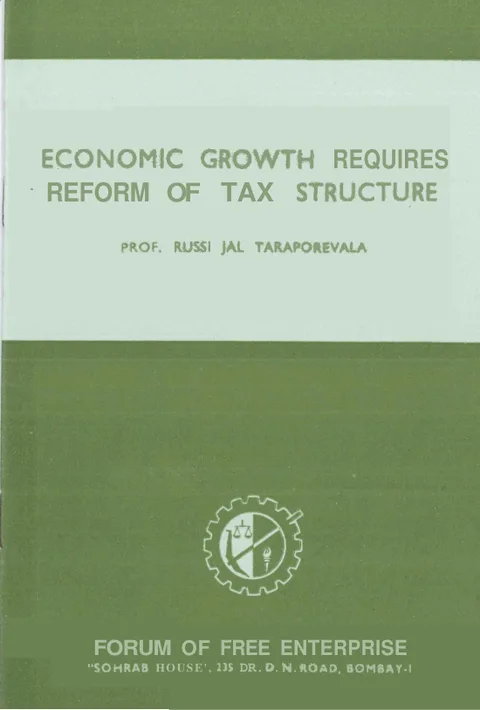
Economic Growth Requires Reform of Tax Structure
Published by M. R. Pai, for Forum of Free Enterprise, "Sohrab House", 235, Dr. Dadabhai Naoroji Road, Bombay 1, and printed by J. V. Patel at New Onlooker Printing Press Pvt. Ltd., Sassoon Dock, Colaba, Bombay-5. · Bombay · 1962
15 pages
Summary
This Forum of Free Enterprise pamphlet — reprinted from Capital Annual 1961 and issued in February 1962 — argues that the tax structure assembled during India’s Second Five-Year Plan has actively retarded the savings, investment, and entrepreneurial activity on which the Third Plan’s six-per-cent growth target depends. Prof. Russi Jal Taraporevala opens with the principle that tax policy must serve multiple, often conflicting, objectives, and that in an under-developed mixed economy where the private sector still does most of the saving and investing, the dominant purpose of taxation must be to provide conditions which stimulate savings and promote risk-bearing enterprise. Citing National Council of Applied Economic Research figures, he shows that the Government’s net savings rose from Rs. 208.9 crores (1951-52) to Rs. 1411.8 crores (1957-58) while Government investment grew from Rs. 221.1 crores to Rs. 794.8 crores — a pattern that, on his reading, left the private sector squeezed by rapid-succession Budgets which ‘created a state of chronic instability in the tax structure.’
Taraporevala then catalogues what he treats as the wreckage of the Second Plan’s fiscal experimentation: six different direct taxes on individuals (income, wealth, expenditure, gift, capital-gains, estate); a wealth tax that has yielded only between Rs. 4.50 and Rs. 7.50 crores a year while deterring foreign technical talent; an expenditure tax introduced on Nicholas Kaldor’s advice that has produced trivial revenue (Rs. 9 lakhs in its first year, an estimated Rs. 90 lakhs for 1961-62) while generating disproportionate administrative cost; and a corporate-tax regime — the 1959 grossing-of-dividends scheme, the repeated tampering with bonus shares and the capitalisation of reserves, and Section 23A’s penalty on small companies — that he says has almost crippled the entrepreneurship and risk-bearing of the business and industrial classes. He uses falling retained-earnings figures (Rs. 41.73 crores in 1955-56 down to Rs. 12.06 crores in 1957-58 for private corporations) to argue that the Second Plan’s corporate tax burden has eaten into the internal financing on which industrial expansion in India depends.
The reform programme follows directly from the critique. Taraporevala calls for abolishing the expenditure tax outright, reappraising and reducing personal income and wealth tax rates, capping the combined direct-tax bite at 80 per cent of an individual’s annual income (with a 5 per cent exemption for those subscribing to new industrial enterprises), simplifying company taxation, abolishing the bonus tax, and amending Section 23A so it does not penalise small companies. He pleads for stability in indirect taxation — changes in excise duties should as a rule be confined to the annual Budget, with mid-year revisions reserved for national emergencies. Finally, in the search for revenue, he urges the Government to confront the politically inconvenient areas it has so far avoided: a salt tax, partial abolition or substantial relaxation of Prohibition, and serious reform of land-revenue taxation, all of which he estimates could yield hundreds of crores during the Third Plan with minimum economic sacrifice. The pamphlet closes with the standard Forum disclaimer and an A. D. Shroff epigraph on free enterprise.
Key points
-
Argues that tax policy in an under-developed mixed economy must above all promote private savings and investment, since the private sector still bears the main burden of capital formation and entrepreneurship.
-
Documents that during the Second Plan, net savings of the Government Sector rose from Rs. 208.9 crores (1951-52) to Rs. 1411.8 crores (1957-58) while net investment in the Public Sector through Government grew from Rs. 221.1 crores to Rs. 794.8 crores — a pattern Taraporevala says crowded out private capital formation.
-
Counts six different direct taxes on individuals (income, wealth, expenditure, gift, capital-gains, estate duty) imposed during the Second Plan and treats their cumulative weight as a factor retarding India’s economic development.
-
Singles out the expenditure tax — introduced on Nicholas Kaldor’s advice by then Finance Minister T. T. Krishnamachari — as a clear failure: trivial revenue (Rs. 1 crore actual against Rs. 9 crores originally estimated for its first year), and disproportionately costly to administer.
-
Argues that the 1959 grossing-of-dividends scheme, Section 23A of the old Indian Income Tax Act, and the cumulative bonus-share and capital-reserves taxes have suppressed retained corporate earnings — the dominant funding source for industrial expansion in India.
-
Proposes that the combined direct-tax burden on an individual not exceed 80 per cent of annual income, with a 5 per cent exemption for those acquiring shares in declared new industrial enterprises.
-
Calls for abolishing the expenditure tax and the bonus tax, simplifying corporate taxation, and amending Section 23A so it does not retard the growth of small and medium companies.
-
Urges politically difficult revenue reforms — a salt tax, partial abolition or substantial relaxation of Prohibition, and overdue reform of land-revenue taxation — projected to yield hundreds of crores with minimal economic harm.
Metadata and summary are AI-extracted from the source PDF and reviewed for editorial accuracy. The original work is available via the Read PDF tab above (where present); paragraph-level citation inside the PDF is deferred to a future engagement.