pamphlet
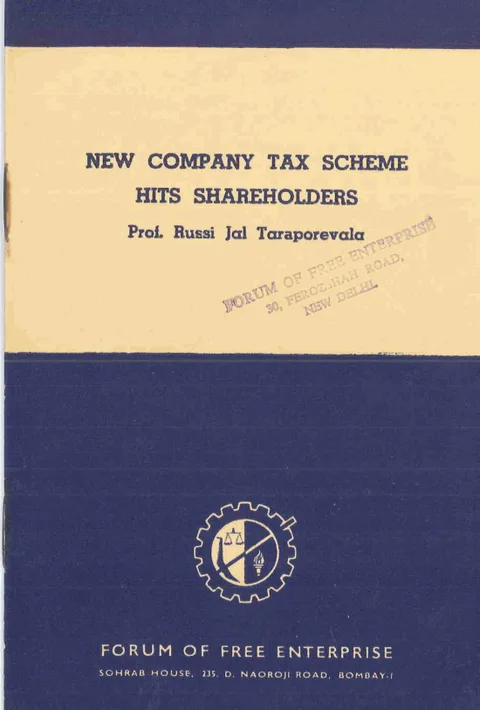
NEW COMPANY TAX SCHEME HITS SHAREHOLDERS
Published by M. R. Pai, for Forum of Free Enterprise, "Sohrab House", 235 Dr. Dadabhai Naoroji Road, Bombay 1, and printed by P. A. Raman at Inland Printers, Victoria Mills Building, 55, Gamdevi Road, Bombay 7. · Bombay · 1960
11 pages
Summary
Prof. Russi Jal Taraporevala’s pamphlet, issued by the Forum of Free Enterprise on 8 February 1960 and reproduced from the Capital Annual of 1959, is a technical assessment of the radical streamlining of Indian company taxation introduced by the Finance Act, 1959. Taraporevala opens by contrasting the old regime — under which companies were subject to seven different direct taxes (income tax with surcharge, corporation tax, excess dividends tax, wealth tax, capital gains tax, the Section 23A penal super-tax, and the bonus issue tax) and where ‘grossing’ of dividends produced a cumbersome and unpredictable effective rate — with the new scheme that consolidates direct taxation into income tax at 20 percent and corporation tax at 25 percent of assessed profits, and abolishes the excess dividends tax, the wealth tax on companies and the practice of grossing up dividends.
The author welcomes the reform ‘in principle’ as a long overdue rationalisation, but devotes most of the booklet to a granular analysis of who actually gains and who loses. Drawing on a statistical comparison (the table on page 8) of total taxes, net dividends and gross dividends under the old and new schemes, he shows that companies distributing all their after-tax profits as dividends will see total tax burdens rise between roughly 9 and 22 percent, with net cash dividends falling between 11 and 21 percent. Ordinary shareholders — particularly of companies with large past reserves grossed up at the full rate — lose the credit they would previously have received in their personal assessments; preference shareholders and inter-corporate investors are hit hardest, with gross dividend income on intra-group holdings covered by Section 56A falling by as much as 32 to 35 percent.
Taraporevala is sharply critical of Section 23A, which he says still impedes industrial growth by discouraging companies from ploughing back profits, and of the bonus issue tax, which the Finance Act 1959 has actually widened by withdrawing the exemption for bonus shares issued from share-premium accounts. He treats this retention as the ‘most deplorable step’ in the reform, citing Nicholas Kaldor, the Indian Taxation Enquiry Commission, the British Royal Commission on the Taxation of Profits and Income, and the NCAER as authorities who have condemned the levy in principle. He closes by recommending that the total rate of income tax and corporation tax be fixed between 35 and 40 percent of gross profits, that ad hoc relief be granted for dividends paid out of past taxed profits, that Section 23A and the bonus issue tax be abolished, and that ultimately a single non-refundable flat tax on gross corporate profits replace the entire structure — a goal he hopes Finance Minister Morarji Desai will continue to pursue.
Key points
-
The Finance Act, 1959 radically simplifies Indian company taxation by replacing seven overlapping direct taxes with income tax at 20 percent and corporation tax at 25 percent of assessed annual profits.
-
The cumbersome ‘grossing’ of dividends, which made the effective rate of tax on shareholders depend on the composition of company income and delayed assessments throughout the system, is abolished for accounting years ending after 31 March 1959.
-
Although the excess dividends tax and the wealth tax on companies are eliminated, ordinary shareholders lose the credit previously received for grossing up dividends paid out of past taxed profits or reserves.
-
A statistical comparison (page 8) shows total tax burdens rising between 8.8 and 19.4 percent, and gross dividends falling between 2.1 and 22.3 percent, depending on a company’s historical tax profile.
-
Inter-corporate investments are hit hardest: individual shareholders may suffer a 30-35 percent loss of gross dividend income on holdings in companies covered by Section 56A of the Indian Income Tax Act.
-
Section 23A’s penal super-tax on closely held companies, though marginally relaxed, still penalises ploughing back of profits and impedes industrial growth.
-
The retention and widening of the bonus issue tax — now extended to bonus shares issued from share premium accounts — is condemned as economically unjustified and contrary to the recommendations of Kaldor, the Indian Taxation Enquiry Commission and the Royal Commission on the Taxation of Profits and Income of Britain.
-
Taraporevala recommends a single flat non-refundable tax on gross corporate profits between 35 and 40 percent, ad hoc relief for dividends paid from past reserves, and abolition of Section 23A and the bonus issue tax.
Metadata and summary are AI-extracted from the source PDF and reviewed for editorial accuracy. The original work is available via the Read PDF tab above (where present); paragraph-level citation inside the PDF is deferred to a future engagement.