pamphlet
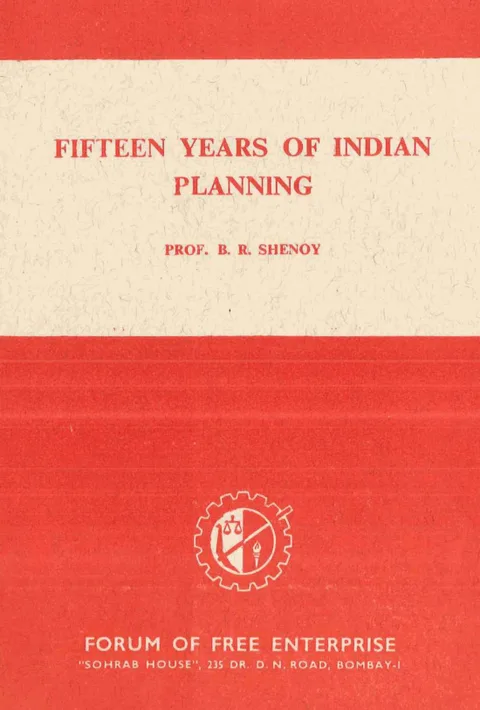
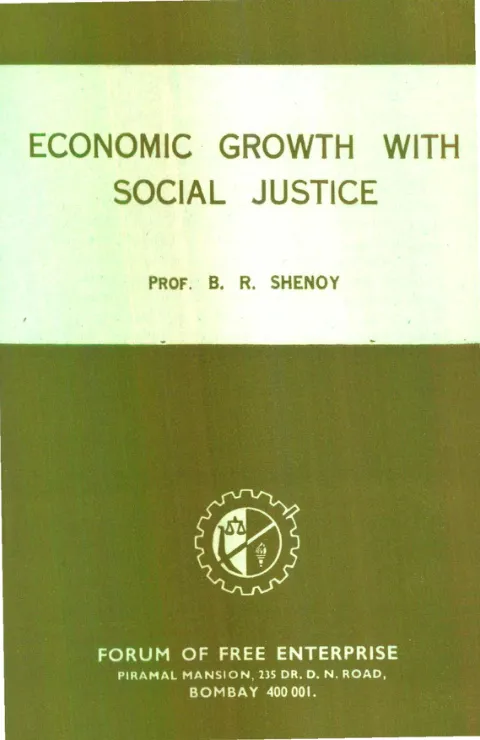
Economic Growth with Social Justice
By B. R. Shenoy
Published by M. R. Pai for the Forum of Free Enterprise, 235 Dr. Dadabhai Naoroji Road, Bombay-400 001. and Printed by H. Narayan Rao at H. R. Mohan & Co., 9-B Cawasji Patel Street, Bombay-400 001. · Bombay · 1980
16 pages
Summary
Economic Growth with Social Justice is a short policy pamphlet by B. R. Shenoy, written in August 1977 a few months before his death and issued by the Forum of Free Enterprise in Bombay. Shenoy sets out a compact theoretical case for consumer sovereignty: a free society is defined by citizens who function in the economic sphere under the doctrine of pragmatism, in which sovereign consumers — not a planning commission — direct production through a price-regulated market mechanism that includes trade, capital markets, and forward markets. He pairs this with the requirement of private property in the means of production (citing Ludwig von Mises and using the Soviet collective-farm experience as evidence that ownership matters), the four economic freedoms of the individual (use of income, choice of consumption, choice of savings, choice of occupation), and four resulting desiderata — cost-and-quality competition, employment expansion, the elimination of monopoly-bred social injustice, and a narrowing of income contrasts as the wage share of GDP rises.
The second half of the pamphlet is a diagnosis of three decades of Indian socialism. Shenoy argues that the working of exchange control, import-export restrictions, the 1956 Industrial Policy Resolution, the Planning Commission, nationalisation, state trading, the Reserve Bank’s credit controls and the licence-permit machinery has produced four sectors: a priority-fed public sector, a policy-favoured industrial sector, a harassed and neglected agricultural sector, and a corrupt sector that lives off the other three. He marshals figures — public-sector firms absorbing roughly 55% of investment but yielding only 17% of NNP in 1975-76; per-capita agricultural income falling from Rs. 219.20 in 1960-61 to Rs. 155.90 in 1976-77; the population below the poverty line moving from 39% to 45% — to argue that agriculture, on which 72% of the population lives, is being starved of capital while industry and the urban elite are pampered.
The remedy Shenoy prescribes is a nine-point “right-about turn” toward what he calls the Gandhian concept of the state’s role: divert resources into agriculture, remove internal and external trade barriers, revise the 1956 industrial policy, abolish licensing and subsidies, scale down public-sector outlays (even withdrawing existing investments), confine the state to its natural duties, remove exchange control and adopt a fully floating Rupee, cut taxation and balance the budget at a much lower level, and review all economic legislation for abandonment or restructuring. He cites West Germany under Ludwig Erhard, Spain, Japan and the “mini-Japans” of Asia as success cases, and India, Burma, Sri Lanka, Pakistan and Bangladesh as classic socialist failures. The pamphlet closes on the aphorism that consumer sovereignty and voter sovereignty are two aspects of the same free citizen.
Key points
-
Defines a free society as a “pragmatic society” of consumer sovereignty operating through a price-regulated market mechanism that includes trade, capital markets and forward markets.
-
Treats private property in the means of production as foundational, citing von Mises and arguing the Soviet 3% of land under private plots produced 1/3 of USSR’s gross farm output and 1/2 of its livestock.
-
Lists four economic freedoms of the individual: distribution of income between consumption and saving, choice of consumption, choice of savings allocation, and choice of occupation.
-
Identifies four sectors produced by Indian socialism — a pampered public sector, a policy-favoured industrial sector, a harassed agricultural sector, and a corrupt sector fed by licensing, exchange control and subsidies.
-
Quantifies failure: public sector absorbs ~55% of investment but contributes 17% of NNP (1975-76); per-capita agricultural income falls Rs. 219.20 (1960-61) to Rs. 155.90 (1976-77); population below the poverty line moves from 39% to 45%.
-
Contrasts the wage-and-salary share of GDP: Japan 41.3%→50.8% (1960-1974), West Germany 46.9→54.7, vs Socialist India fluctuating around 28-30%.
-
Proposes a nine-point U-turn including abolition of industrial licensing and subsidies, scaling down of public-sector outlays, a fully floating Rupee, lower taxation with a balanced budget, and a review of all economic legislation for repeal or restructuring.
-
Frames consumer sovereignty and voter sovereignty as two faces of the same free citizen, and praises West Germany under Erhard, Spain, Japan and Asia’s “mini-Japans” as exemplars.
Metadata and summary are AI-extracted from the source PDF and reviewed for editorial accuracy. The original work is available via the Read PDF tab above (where present); paragraph-level citation inside the PDF is deferred to a future engagement.