pamphlet · collected works
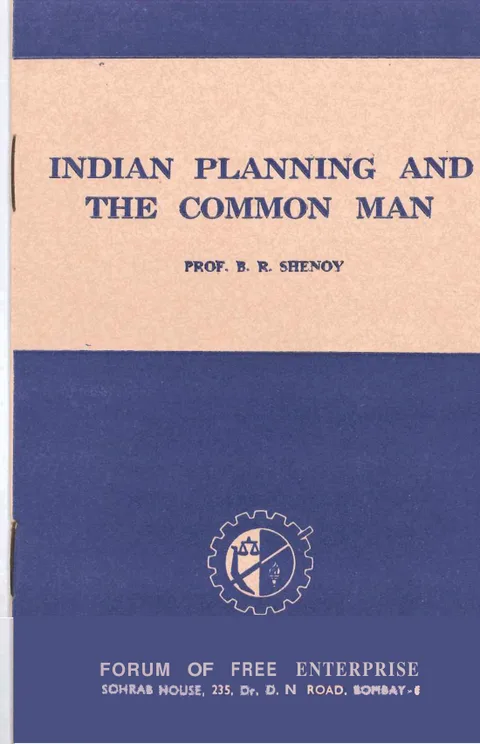
Indian Planning and the Common Man
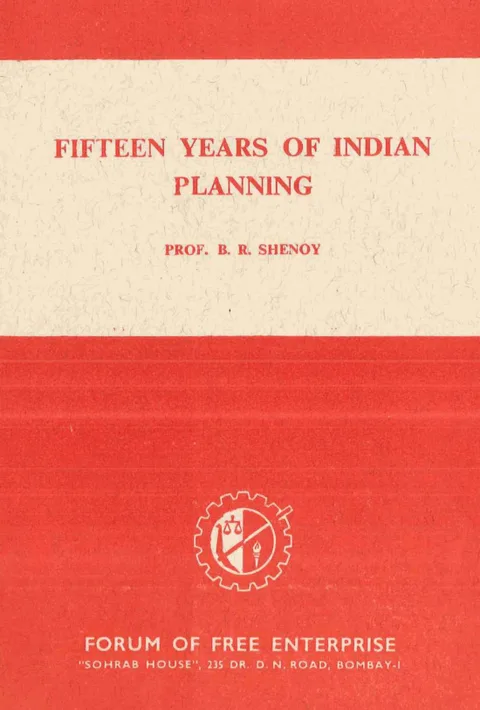
By B. R. Shenoy
FORUM OF FREE ENTERPRISE, SOHRAB HOUSE, 235, Dr. D. N. ROAD, BOMBAY-1 · Bombay · 1962
14 pages
Summary
Prof. B. R. Shenoy’s 1962 Forum of Free Enterprise pamphlet bundles three of his newspaper essays — two from the Indian Express (28 October 1961) and one from the Times of India (23 October 1961) — into a sustained attack on the development model defended by Prime Minister Nehru at the Third Plan debate in the Lok Sabha. Shenoy concedes the headline statistics (national income up 42 per cent in a decade, life expectancy from 24 to 47.5 years, industrial output up 94 per cent) but argues they are a “misleading bunch of statistics”: the composition of the national product, not its aggregate volume, is the real test of welfare, and on that test India has failed. The output of cotton cloth in common use rose only 1.4 times in a decade while electric lamps rose 2.9 times, radios 5.9 times and sewing machines 9.6 times; per capita foodgrain availability has steadily declined. “Planning has produced a ‘good life’ not for the masses but for a thin layer of the parasitical minority of its beneficiaries.”
The second essay, “Planning & Social Justice,” reframes the objective of planning as the production of mass-consumption goods commanded by consumer sovereignty rather than the heavy-industries-plus-statism bias of the official plans. Shenoy connects the regimentation of investment to the concentration of economic power in “State functionaries — with arbitrary rights of disposal, directly or indirectly, over the employment, livelihood and well-being of virtually the entire nation” — calling this “a potential source of ruthless social injustice — ruthless, among other reasons, because arbitrariness is backed by police powers.” Real social justice, he insists, cannot be ensured better than “through policies of economic freedom on the pattern of the E. E. C. countries and Japan, where state planning is confined to its natural sphere.”
The third essay, “Planning & Inflation,” attacks the Economic Survey 1960-61’s claim that price rises are “the very condition of economic advance.” Shenoy marshals comparative data — West German national income rising 12 per cent annually 1953-59 with prices up only 1 per cent a year; Japanese national income rising 12.3 per cent annually with prices up 2 per cent over the whole period; France and Italy posting strong growth while prices actually fell — to argue that rapid growth and monetary stability normally go hand in hand. India’s inflation, he concludes, is the avoidable by-product of public-sector over-investment financed by deficit financing (Rs. 450 crores 1959-60), bank-credit expansion, and P. L. 480 counterpart funds; foreign aid has “illegitimately” masked the symptoms but cannot defer the crash indefinitely. The pamphlet closes with an appendix listing twenty-one recommended works — Hayek, Mises, Robbins, Roepke, Erhard, Bauer, Hazlitt and others — that constitute Shenoy’s classical-liberal canon.
Key points
-
Shenoy frames the pamphlet as a rebuttal to the Prime Minister’s January 1962 Lok Sabha defence of the Third Plan, arguing that aggregate income gains conceal a composition that has neglected mass-consumption goods.
-
Per capita foodgrain availability fell from 15.5 oz/day in 1955 to 15.3 oz in 1959-60 to 15.4 oz in 1960 despite 17.8 million tons of imports, while cotton cloth in common use rose only 1.4 times against electric lamps 2.9x, radios 5.9x and sewing machines 9.6x.
-
He attributes the consumer-goods shortfall to a heavy-industries plan-bias, statist controls and the displacement of consumer sovereignty by “statist slogans” of public good.
-
Section II reframes statism as a structural source of social injustice because arbitrary state allocation is “backed by police powers,” and points to the E.E.C. countries and Japan as evidence that growth and social justice come through economic freedom, not state planning.
-
Section III refutes the Economic Survey 1960-61 thesis that inflation is the inevitable price of growth, citing West Germany (12% growth, 1% inflation), Japan (12.3% growth, 2% inflation) and France/Italy as counter-examples.
-
Shenoy diagnoses Indian inflation as a consequence of deficit financing (Rs. 450 crores in 1959-60), commercial-bank credit creation, and P. L. 480 counterpart funds — with foreign aid acting as a misleading cushion that may “defer the crash for a while, but not for an indefinite period.”
-
The appendix’s 21-item reading list — Hayek (multiple), Mises, Robbins, Roepke, Erhard, Colin Clark, P. T. Bauer, Henry Hazlitt — anchors the polemic in the Mont Pelerin/classical-liberal tradition.
Metadata and summary are AI-extracted from the source PDF and reviewed for editorial accuracy. The original work is available via the Read PDF tab above (where present); paragraph-level citation inside the PDF is deferred to a future engagement.