speech
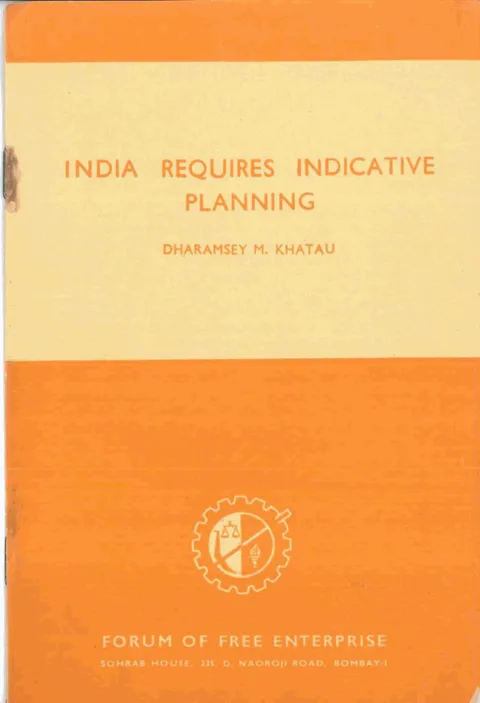
INDIA REQUIRES INDICATIVE PLANNING
Published by M. R. Pai for the Forum of Free Enterprise, 235, Dr. Dadabhai Naoroji Road, Bombay 1 · Bombay · 1967
7 pages
Summary
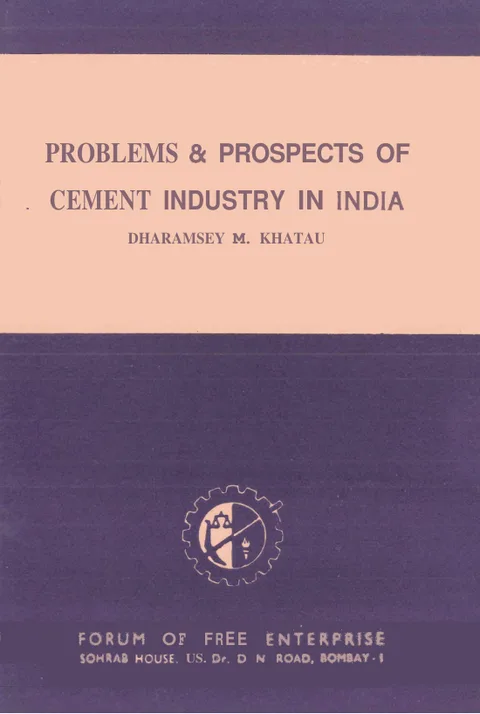
Drawn from his inaugural address to the 59th Annual General Meeting of the Indian Merchants’ Chamber on 10 February 1967, Dharamsey M. Khatau’s pamphlet argues that India’s drift toward ‘state capitalism and Statism’ has produced costly, wasteful, and politically dangerous results. Reviewing the first three Plans, he notes that targets were missed, unemployment rose across educated, agricultural, and non-agricultural classes, and the strategy’s capital-intensive, heavy-industry bias starved agriculture and rural development. The Fourth Plan, on inadequate data, projects only 9 to 10 million additional jobs against a backlog of 15 to 18 million disguised unemployed and an incremental labour force of 23 to 25 million — a shortfall he treats as a fundamental indictment of comprehensive planning.
Khatau ties planning failure to the concentration of economic power in political and bureaucratic hands, citing the Planning Commission’s own review that the Public Sector earned only 1.5% on Rs. 2,037 crores invested across 34 undertakings, and quoting Dr. Radhakrishnan’s Republic Day broadcast on ‘widespread incompetence and gross mismanagement’. He clarifies that he opposes neither planning nor a mixed economy; he opposes lop-sided, ideologically pre-conceived planning. Pointing to France’s success with ‘indicative planning’ — coordinative, market-respecting, free of doctrinaire rigidity — he urges India to adopt a similar pragmatic system that uses fiscal and monetary tools rather than administrative fiats, relies on cooperative planning with industry and trade unions, and frees the Private Sector from discriminatory restrictions.
The closing section is a defence of private enterprise as ‘an affirmative goad’ (echoing Eugene Black) and a call to industry to abandon sheltered-market complacency, raise productivity, and trust that advanced techniques and modern machinery can expand rather than shrink employment. Khatau’s frame throughout is Gandhian as well as liberal: he invokes Gandhi’s warning that doctrinaire schemes which minimise exploitation can also ‘destroy individuality, which lies at the root of all progress’, and ends with confidence that the Private Sector, given the opportunity, ‘will deliver the goods’.
Key points
-
Diagnoses post-devaluation drift toward ‘state capitalism and Statism’ as costly and wasteful, and calls for pragmatic reorientation of basic planning assumptions.
-
Treats employment as the decisive test of planning: capital-intensive heavy-industry bias has failed to dent unemployment, with the former Minister for Planning conceding that the agricultural population’s share could shrink only from 70% to 60% over fifteen years.
-
Cites Fourth Plan arithmetic — 9 to 10 million new jobs against 15 to 18 million disguised unemployed plus 23 to 25 million incremental labour — to argue that current strategy cannot absorb the backlog.
-
Attacks Public Sector performance using the Planning Commission’s own figures: a 1.5% return on Rs. 2,037 crores across 34 undertakings, bureaucratic mismanagement, and a doctrinaire ‘commanding heights’ approach that has crowded out private effort.
-
Quotes Gandhi on the danger of suppressing individuality ‘at the root of all progress’ and Dr. Radhakrishnan’s Republic Day rebuke of incompetence and mismanagement of national resources.
-
Distinguishes ‘indicative’ (French-style, cooperative, market-respecting) planning from India’s ‘comprehensive’ planning, advocating annual and mid-term plan appraisal, fiscal-monetary tools, and joint formulation with industry and trade unions.
-
Calls on the Private Sector to shed sheltered-market complacency, lift productivity, and treat automation and modern machinery as employment-expanding rather than labour-displacing.
-
Frames private enterprise positively — ‘not as a necessary evil, but as an affirmative goad’ — and closes with confidence that given the opportunity it ‘will deliver the goods’.
Metadata and summary are AI-extracted from the source PDF and reviewed for editorial accuracy. The original work is available via the Read PDF tab above (where present); paragraph-level citation inside the PDF is deferred to a future engagement.