edited volume · anthology
Approach to the Fourth Five-Year Plan
By Dr. R. C. Cooper, S. M. Dahanukar
FORUM OF FREE ENTERPRISE, SOHRAB HOUSE, 235 DR. D. N. ROAD, BOMBAY-1 · Bombay · 1968
24 pages
Summary
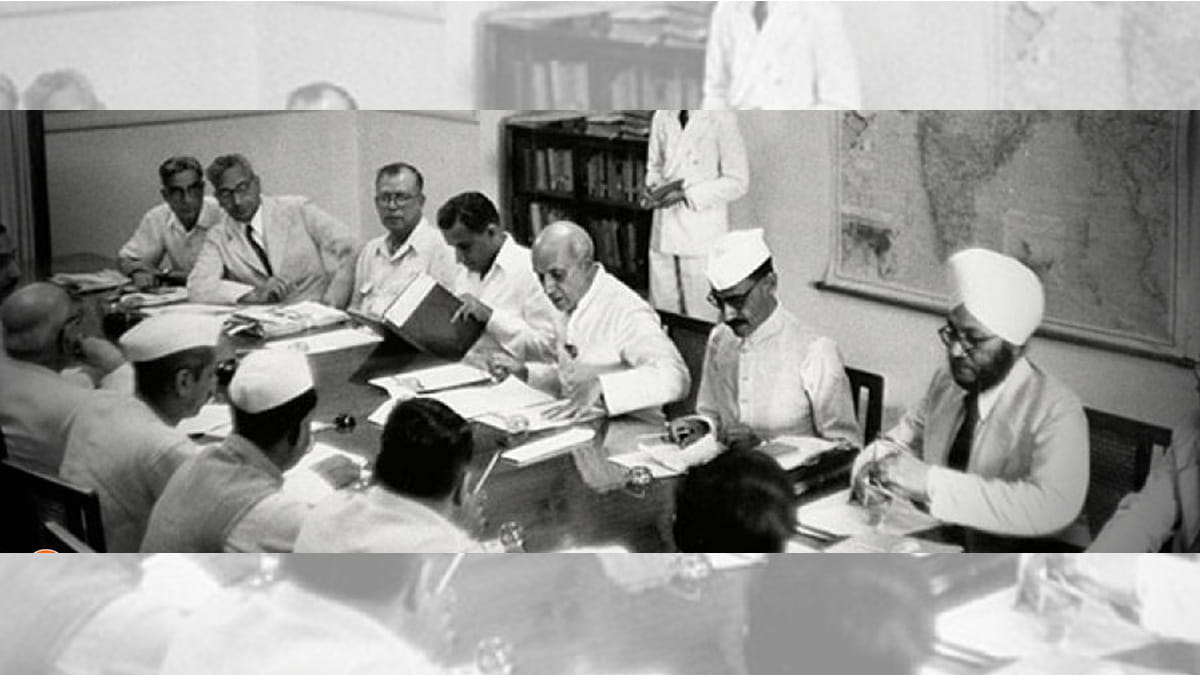
Published by the Forum of Free Enterprise on 10 November 1968 to coincide with the Planning Commission’s circulation of its ‘Approach to the Fourth Five-Year Plan’ note, this pamphlet collects three addresses by Dr. Rustom C. Cooper, Y. A. Fazalbhoy and S. M. Dahanukar — a chartered accountant and Indian Merchants’ Chamber past president, the head of the All-India Manufacturers’ Organisation, and the president of the Maharashtra Chamber of Commerce. The FFE introduction frames the volume as a continuation of its post-1956 campaign against Soviet-style centralised planning, citing inflation, foreign exchange crises, food shortages and industrial recession as vindication of warnings earlier issued by A. D. Shroff, Murarji J. Vaidya, N. A. Palkhivala, Prof. P. T. Bauer and Prof. B. R. Shenoy.
The three contributors converge on a single argumentative centre: fifteen years of plans have produced a ‘marginal’ economy by Asian standards, the Planning Commission has been doctrinaire, over-ambitious and overly bureaucratic, and the Fourth Plan can only succeed if it is resource-based rather than need-based, gives the private sector greater latitude, conditions further public-sector investment on a 10 per cent rate of return, and replaces licensing with a more permissive industrial policy.
Key points
-
Dr. Rustom C. Cooper, a past president of the Institute of Chartered Accountants of India, argues Indian planning has reached a crossroads after three Plans and an enforced plan holiday, forcing a choice between balanced and imbalanced growth strategies.
-
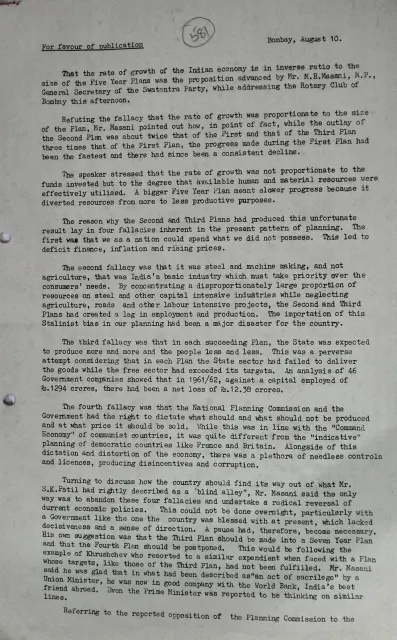
Cooper’s audit finds average growth of 3.3 per cent against 6 to 8 per cent in Japan, Thailand, China and Korea, with per capita national income rising only 1.2 per cent between 1951 and 1966.
-
Cooper identifies seven planning errors, including doctrinaire and over-ambitious targets, resource over-estimation and Centre-State discord, and proposes ten remedies including performance budgeting and a 10 per cent minimum return on public-sector capital.
-
Y. A. Fazalbhoy, president of the All-India Manufacturers’ Organisation, endorses the Planning Commission’s “Growth with Stability” language but argues it still hesitates to extend industrial delicensing to its full effect on production.
-
Fazalbhoy defends delicensing against fears of monopoly and small-firm displacement by citing American legislation such as the Small Business Act and Justice Learned Hand’s warning against confusing restraint of monopoly with loss of common freedom.
-
A further plank in his argument urges a more liberal policy on importing foreign technical know-how, noting that royalty payments rose only from Rs. 16 crores in 1957-58 to Rs. 32 crores in 1967-68.
-
S. M. Dahanukar, president of the Maharashtra Chamber of Commerce, joins Cooper and Fazalbhoy in arguing that the Fourth Plan should be resource-based rather than need-based and grant private enterprise greater latitude.
-
The Forum of Free Enterprise’s introduction frames the volume as continuing its post-1956 campaign against Soviet-style centralised planning, citing inflation, foreign-exchange crises and food shortages as vindication of earlier warnings by A. D. Shroff and B. R. Shenoy.
Essays
Approach to the Fourth Plan — Indian Planning at Crossroads
By Dr. Rustom C. Cooper
Dr. Rustom C. Cooper, then a Past President of the Institute of Chartered Accountants of India and of the Indian Merchants’ Chamber, argues that ‘Indian planning has reached the crossroads’ after three Plans and an enforced plan holiday. He compares the doctrines of Balanced and Imbalanced Growth, then audits the record: an average growth rate of 3.3 per cent against 6–8 per cent in Japan, Thailand, China and Korea; per capita national income growth of only 1.2 per cent between 1951 and 1966; Third Plan inflation of 32 per cent; unemployment backlog rising from 5.3 to 10 million; indirect taxes producing 75 per cent of total revenue; and Public Sector returns of 1.8 per cent on capital with losses in seven of eleven years between 1960-61 and 1964-65.
From this audit Cooper enumerates seven errors — doctrinaire planning, unrealistic planning, over-ambition, over-planning, resource over-estimation, bureaucratic implementation, Centre-State discord and neglect of population control — and proposes ten remedies for the Fourth Plan period, including performance budgeting for both public and private sectors, conditioning further Public Sector investment on rates of return, price stabilisation, lower dependence on external aid, export priority, and reducing reliance on government agencies. He warns that mobilising the additional Rs. 200–300 crores demanded by the ‘Approach’ should be ‘thoroughly re-examined’ if existing Public Sector concerns of over Rs. 3,000 crores were forced to yield a reasonable 10 per cent return.
- Indian planning is at a crossroads after three Plans and an enforced plan holiday; this is the moment to choose between Balanced and Imbalanced Growth and to decide whether ‘regimented’ planning suits a democracy.
- The economy has grown at only 3.3 per cent per annum; per capita growth between 1951 and 1966 was just 1.2 per cent, and India’s rate is marginal compared with 6 per cent in Japan, 7 per cent in Thailand and 8 per cent in Nationalist China.
- Seven errors of past planning — doctrinaire, unrealistic, over-ambitious, over-planned, resource over-estimating, bureaucratic, and Centre-State discordant — must be acknowledged before any Fourth Plan strategy can succeed.
- Public Sector undertakings have earned a return of only 1.8 per cent on invested capital and made losses in seven of the last eleven years; further investment must be conditional on the rate of return on existing assets.
- The Fourth Plan should be self-reliant, prioritise exports, restore harmony in industrial relations, and demand at least a 10 per cent return on the existing Rs. 3,000 crores of Public Sector industrial investment before any new resource mobilisation.
A Judicious Industrial Licensing Policy is Essential
By Y. A. Fazalbhoy
Y. A. Fazalbhoy, President of the All-India Manufacturers’ Organisation, endorses the ‘Approach’ note’s call for ‘Growth with Stability’ and welcomes signs that the Planning Commission is moving toward delicensing and decontrol, but argues that the Commission still hesitates to extend free scope for industrial licensing to its full impact on production and productivity. He defends de-licensing against the standard objections — fear that small-scale units will be wiped out, that planning targets cannot be achieved without licences, that licensing is needed to ration scarce capital, and that delicensing will produce monopolies — by pointing to American practice (where the Small Business Act and Small Investment Corporation Act protect smaller firms within a competitive economy) and to Justice Learned Hand’s warning against confusing restraint of monopoly with the loss of common freedom.
Fazalbhoy also urges a more liberal approach to the import of foreign know-how. Annual royalty payments have risen only from Rs. 16 crores in 1957-58 to Rs. 32 crores in 1967-68, and cost of know-how is generally less than 7½ per cent of overall cost; the Government, he argues, should not follow any ‘hard and fast rule’ but consider each case on merit, permitting purchase or royalty agreements where they serve the national interest, rather than restricting know-how imports because of foreign-exchange anxiety.
- ‘Growth with Stability’ is the right banner for the Fourth Plan, but agricultural prices must be stabilised first if industrial stability is to follow.
- Decontrol and delicensing should go further; objections from small-scale-industry advocates and monopoly-fearers can be met with American-style legislation (Small Business Act, Small Investment Corporation Act) and indicative targets backed by tax concessions rather than by licensing.
- Capital is scarce, so investment in existing units that yields more output per rupee is preferable to creating new units; service-sector expansion will eventually absorb most of the working population, as in developed economies.
- Foreign know-how imports should not be rationed by a single rule; the cost is less than 7½ per cent of total cost, and confining manufacturers to one technology would ‘throttle initiative’ and weaken competitiveness.
Fourth Plan should be Based on Available Resources
By S. M. Dahanukar
S. M. Dahanukar, President of the Maharashtra Chamber of Commerce, opens his commentary on the ‘Approach’ note by praising its thoughtful drafting and its move to reorient planning onto a ‘practical basis’. He welcomes its insistence that Public Sector investment must yield profits before fresh resources are committed, its proposal to give the Private Sector greater latitude through reduced controls, its emphasis on financial assistance to agriculturists through co-operative and commercial bank credit, and its attention to small rain-fed cultivators. On price stabilisation he supports the note’s proposal that the Government build buffer stocks of foodgrains and expand distribution through fair-price shops and consumer co-operatives.
In the rendered pages, Dahanukar pivots to a critique of the old planning method: targets were fixed first, programmes built around them, and then the Planning Commission scrambled to find resources, leaving an ‘unbridged gap’ filled by deficit financing and foreign aid. He calls for this approach to be abandoned in favour of a different one — the substantive proposal is cut off where the rendered chunk ends on printed page 18.
- The ‘Approach’ note correctly insists that fresh Public Sector investment wait until existing units become profitable, and that the Private Sector be given greater latitude through reduced controls.
- Agricultural credit through co-operative and commercial banks, plus targeted aid for small rain-dependent cultivators, is rightly emphasised in the note.
- Buffer stocks of foodgrains operated by Government, plus expanded fair-price shops and consumer co-operatives, are the right instruments for stabilising prices across other commodities.
- Past plans wrongly fixed targets first and then chased resources, producing deficit financing, dependence on foreign aid and an ‘unbridged gap’ — the rendered chunk ends just as Dahanukar begins to propose a replacement method.
Metadata and summary are AI-extracted from the source PDF and reviewed for editorial accuracy. The original work is available via the Read PDF tab above (where present); paragraph-level citation inside the PDF is deferred to a future engagement.