edited volume · proceedings
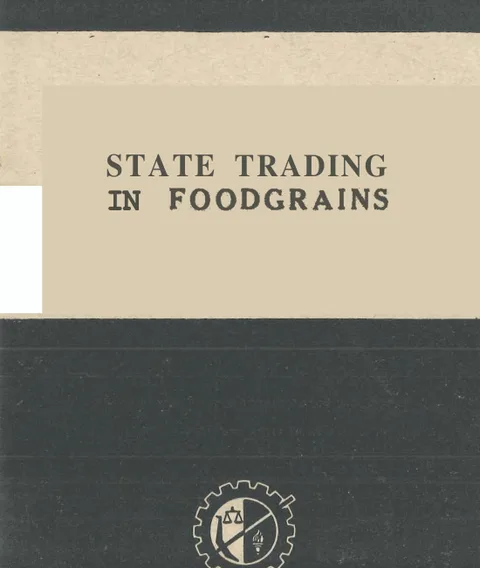
STATE TRADING IN FOODGRAINS
By A. D. Shroff
Published by M. R. Pai for the Forum of Free Enterprise, 235, Dr. Dadabhai Naoroji Road, Bombay 1, and Printed by Michael Andrades at the Bombay Chronicle Press, Horniman Circle, Bombay-1. · Bombay · 1959
19 pages
STATE TRADING IN FOODGRAINS
Summary
This 1959 booklet from the Forum of Free Enterprise gathers the presidential remarks and four addresses delivered at a Bombay Convention on State Trading in Foodgrains held on 13 March 1959, called in response to the National Development Council’s November 1958 decision to take wholesale foodgrain distribution into State hands. A. D. Shroff presides; he is joined by Devji Rattansey (Vice-President of the Bombay Foodgrains Dealers’ Association), Ranchhoddas Jethabhai (President of the Bombay Rice Merchants’ Association), M. H. Hasham Premji (President of the All-India Foodgrains Dealers’ Association) and Prof. R. K. Amin of the Vallabh Vidya Nagar Commerce College, Anand. The contributors agree that the foodgrains crisis is fundamentally a problem of production rather than distribution, that the existing private trade is more efficient than the State machinery proposes to replace it, and that the policy is being pushed to deflect attention from the Government’s deficit-financing failures.
The volume’s argumentative centre is twofold: a moral and constitutional warning that the Indian liberty experiment is being eroded by an expanding bureaucratic State whose appetite for control runs from ‘pins to motor cars’, and an applied economic case that procurement, price-fixing and the elimination of three lakh foodgrain merchants will impoverish cultivators, swell unemployment, and worsen the very price-rise it claims to cure. Speakers repeatedly invoke the failures of wartime rationing under Rafi Ahmed Kidwai’s decontrol, cite the Asoka Mehta and Food Inquiry Committee reports, and call instead for improved production incentives, the removal of food zones, an all-India advisory board of merchants, and licensed (not state-monopolised) trade.
Key points
-
A. D. Shroff’s presidential address, “A Danger to Democratic Way of Life”, contrasts moral condemnation of private merchant profit with public praise for the State Trading Corporation’s Rs. 53-crore surplus on cement.
-
Shroff argues that forcing roughly 300,000 foodgrain merchants to surrender their trade to the State Trading Corporation violates the constitutional freedom to choose one’s own avocation.
-
Devji Rattansey, vice-president of the Bombay Foodgrains Dealers’ Association, argues the National Development Council’s November 1958 decision was a hasty response to a 5 to 8 per cent price rise caused by an inaccurate rabi harvest forecast, not trader misconduct.
-
Rattansey notes that the Asoka Mehta Committee’s structural remedies, including a Price Structure Board and wealth taxes, were quietly dropped while only its state-trading recommendation survived.
-
Rattansey shows bank advances against foodgrain stocks had barely grown, rebutting the charge that traders were hoarding for profit, and proposes removing food zones in favour of an all-India advisory council of merchants.
-
Ranchhoddas Jethabhai, president of the Bombay Rice Merchants’ Association, contributes an address titled “A Novel Idea”, though only its opening page survives in the rendered text.
-
M. H. Hasham Premji, president of the All-India Foodgrains Dealers’ Association, and Prof. R. K. Amin of Vallabh Vidya Nagar Commerce College also address the convention alongside Shroff and Rattansey.
-
The convention was convened on 13 March 1959 in Bombay after the National Development Council resolved in November 1958 to move wholesale foodgrain distribution into state hands.
Essays
A DANGER TO DEMOCRATIC WAY OF LIFE
By A. D. Shroff
Shroff’s presidential address frames the proposed State trading in foodgrains as a ‘danger to the democratic way of life’ rather than a technical adjustment. He attacks the moral double-standard by which private merchants are vilified for profit-seeking while the State Trading Corporation’s Rs. 53-crore surplus on cement is praised as a national virtue, and warns that the Prime Minister’s habit of denouncing ‘vested interests’ is in fact aimed at the only constituency capable of resisting the concentration of political and economic power in the bureaucracy. He cites the All-India Manufacturers’ Organisation address of 11 March 1959 to argue that the Government’s real grievance is independent thought, not concentration.
The argument closes with a constitutional point: the freedom to choose one’s avocation under the Constitution is violated if 300,000 merchants are forced to surrender their trade to the State Trading Corporation. Shroff exhorts the mercantile community—‘the fullest backing’ of which secured political independence—to mobilise public opinion, agitate for the removal of bad laws from the Statute Book, and remind the rulers that ill-conceived state trading will neither halt inflation nor solve the food problem, and will one day be regretted.
- Treats State trading as a question of democratic principle, not merely of economic efficiency.
- Highlights moral inconsistency: private profit is condemned while State Trading Corporation surpluses (Rs. 53 crores on cement) are celebrated.
- Reads attacks on ‘vested interests’ as a campaign against the independent mercantile community that bankrolled the freedom struggle.
- Argues the policy violates the constitutional right to choose one’s profession and concentrates power dangerously in bureaucrats.
- Locates the real food problem in deficit financing and inadequate production, not in middlemen’s behaviour.
AN ALTERNATIVE TO STATE TRADING
By Devji Rattansey, M.L.C. (Bombay State), Vice-President, Bombay Foodgrains Dealers’ Assn.
Devji Rattansey, Vice-President of the Bombay Foodgrains Dealers’ Association, argues that the National Development Council’s November 1958 decision was a hasty response to a 5–8% price rise in 1958 caused by an inaccurate rabi forecast, not by trader misconduct. He notes that the Asoka Mehta Committee’s recommended remedies—a Price Structure Board, wealth and expenditure taxes, a 45% maximum income-tax ceiling—were quietly dropped while only its ‘doctrinaire’ suggestion of state trading was retained, and points out that no Food Minister has actually been able to explain what state trading in foodgrains means in practice.
Rattansey rebuts the charge that traders are profiteers by showing that bank advances against foodgrain stocks have hardly grown, and that the Government’s own conduct (levying export duties one day, banning exports the next, promoting them on the third) destroys the certainty that trade requires. He calls for the removal of food zones, the appointment of an all-India advisory council of honest merchants, and limited licensed trading by the State only for imports—closing by quoting Gandhi on ministerial humility and warning that handing the trade to a few lakh inexperienced civil servants will produce a mess.
- The 1958 price rise was a forecast failure, not a hoarding conspiracy, and bumper 1957–58 crops had previously held prices steady.
- The Asoka Mehta Committee’s structural remedies were dropped; only its state-trading proposal survived.
- Even the Food Minister cannot define what ‘state trading in foodgrains’ actually means.
- Government conduct—shifting export duties and bans daily—destroys the certainty that any trade requires.
- Proposes removing food zones, a national advisory council of merchants, and licensed (not monopolised) trade.
A NOVEL IDEA
By Ranchhoddas Jethabhai, President, Bombay Rice Merchants’ Association
Only the opening page of Ranchhoddas Jethabhai’s address (President of the Bombay Rice Merchants’ Association) is in the rendered set; the rest of his text is missing from the supplied PDF. On the page seen he argues that the ‘novel idea’ of state trading was hailed at the Nagpur Congress in early 1959 and rushed into implementation by the Government, with traders cast as a ‘scapegoat’ for steep price rises that were really driven by other forces. He recalls that earlier wartime state trading in foodgrains during the rationing period had brought hardship to producers and consumers and caused heavy losses, and cites the Food Inquiry Committee Report’s estimate that government handling cost roughly Rs. 46.4 crores a year while serving less than 15% of the population.
- The proposal was hailed at the early-1959 Nagpur Congress session and rushed through soon after.
- Middlemen were scapegoated for a price rise the speaker attributes to other factors.
- Recalls heavy losses and hardship to producers and consumers under wartime state trading and rationing.
- Cites the Food Inquiry Committee’s figure of Rs. 46.4 crores per year wasted serving under 15% of the population.
THE FOOD SITUATION IN ITS PROPER PERSPECTIVE
By M. H. Hasham Premji, President, All-India Foodgrains Dealers’ Association
M. H. Hasham Premji, President of the All-India Foodgrains Dealers’ Association, sets out to clear away ‘emotional’ confusion and restore the factual foundations of the food debate. He reviews seventeen years of swings between rationing and free trade, treating the late Rafi Ahmed Kidwai’s decontrol as one of the wisest steps independent India ever took. He shows that foodgrain output has risen from 32 million tons in 1939–40 to a projected 71 million in 1958–59 (a 40-million-ton increase), that population pressure (1.5% growth) and the propensity to consume of a poor people account for most of the persisting shortage, and that the irrigation potential created by multi-purpose projects has not been put to use—so the right strategy is to expand production and warehousing rather than nationalise trade.
The second half is a defence of the foodgrain trade itself: a network of primary and secondary mandis, lakhs of small firms, and 350–400 thousand wholesale rice traders in Bombay city alone, earning barely 2% gross (1% nett) profit. He calls the claim that the trade is concentrated in ‘a few hands’ a ‘blatant lie’, warns that nearly Rs. 1,000 crores of deficit financing and an additional Rs. 250 crores planned for the year ahead will keep food prices high regardless of who controls distribution, and proposes that the Government concentrate on production-side measures—cheap rural electricity, cattle wealth, cowdung as fuel, warehousing—rather than ‘grand schemes like State Trading in food or from pins to motor cars’.
- Treats Rafi Ahmed Kidwai’s decontrol of foodgrains as one of independent India’s wisest decisions.
- Output has risen from 32 million tons (1939–40) to a projected 71 million (1958–59); the problem is production, not distribution.
- Population growth of 1.5% per annum and rising consumption account for most persistent pressure on prices.
- Rejects the ‘concentration’ charge: lakhs of small firms and hundreds of thousands of wholesalers populate the trade at 1–2% margins.
- Identifies deficit financing (nearly Rs. 1,000 crores already, with Rs. 250 crores more proposed) as the real driver of food inflation.
- Recommends rural electrification, fodder/cowdung utilisation, irrigation and warehousing over State distribution.
AN ECONOMIST’S APPROACH TO THE FOOD PROBLEM
By Prof. R. K. Amin, Principal, Commerce College, Vallabh Vidya Nagar, Anand
Prof. R. K. Amin (Principal, Commerce College, Vallabh Vidya Nagar, Anand) supplies the academic complement to the merchant speakers. He examines the three principal arguments adduced for state trading—exploitation by middlemen, the need to dampen price fluctuations during the Second Five-Year Plan, and the need to raise marketable surplus and tax revenue from the rural sector for industrialisation—and finds none of them sufficient. Middlemen exploitation, where it exists, can be limited by warehouses and Rural Credit Survey reforms; price fluctuations are driven by deficit financing and the inelasticity of the agricultural supply curve, not by traders, and are better controlled by licensing and stock disclosure than by state monopoly.
On the structural argument, Amin agrees that India’s industrialisation needs a larger marketable surplus and more rural tax revenue, but argues that on a backward-sloping rural supply curve, taking grain away from low-income farmers without giving them low-priced industrial goods in exchange is ‘tantamount to taking away a piece of bread from the hungry mouth’. He concludes that the proper approach is a production-oriented agricultural policy, full implementation of the Rural Credit Survey recommendations, and a Community Development Scheme that raises voluntary rural contributions—reserving state trading only for the case where democracy itself is to be sacrificed to total economic control.
- Frames and refutes three standard arguments for state trading: middlemen exploitation, price stabilisation and surplus extraction for industrialisation.
- Argues price instability comes from deficit financing and inelastic agricultural supply, not from trader behaviour.
- Uses the backward-sloping supply curve to show that procurement at low prices in a poor rural economy will depress output, not raise marketable surplus.
- Treats taxation of agriculture as defensible in principle but inequitable when farmers cannot exchange the cash for industrial goods.
- Endorses production-oriented agricultural policy, Rural Credit Survey reforms, and voluntary labour through Community Development.
Generated by the v1.5 extraction pipeline. Awaiting editorial review.
Metadata and summary are AI-extracted from the source PDF and reviewed for editorial accuracy. The original work is available via the Read PDF tab above (where present); paragraph-level citation inside the PDF is deferred to a future engagement.
People in this work
- A. D. Shroffauthor
- Devji Rattansey, M.L.C. (Bombay State), Vice-President, Bombay Foodgrains Dealers' Assn.
- Ranchhoddas Jethabhai, President, Bombay Rice Merchants' Association
- M. H. Hasham Premji, President, All-India Foodgrains Dealers' Association
- Prof. R. K. Amin, Principal, Commerce College, Vallabh Vidya Nagar, Anand