edited volume · proceedings
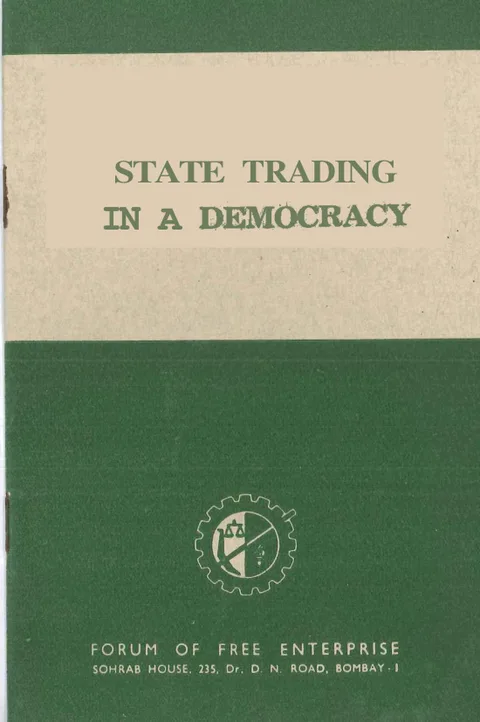
STATE TRADING IN A DEMOCRACY
By s-g-panandikar, k-a-hamied-b-sc-m-a-ph-d-berlin-f-r-i-c-m-l-c-j-p, m-h-hasham-premji, b-m-choksi, r-v-murthy
Published by M. R. Pai for the Forum of Free Enterprise, 235, Dr. Dadabhai Naoroji Road, Bombay 1, and Printed by Michael Andrades at the Bombay Chronicle Press, Horniman Circle, Bombay-1. · Bombay · 1960
18 pages
STATE TRADING IN A DEMOCRACY
Summary
State Trading in a Democracy gathers the speeches delivered at a Forum of Free Enterprise symposium held in Bombay on 6 May 1960, presided over by Dr. S. G. Panandikar. The booklet was published in August 1960 in the wake of a Parliamentary Estimates Committee report on the State Trading Corporation (STC) and amid a countrywide controversy over the STC’s rapidly expanding scope. Five speakers — Dr. S. G. Panandikar, Dr. K. A. Hamied, M. H. Hasham Premji (President of the Federation of All-India Foodgrains Dealers’ Associations), B. M. Choksi (President of the Paper Traders’ Association, Bombay), and R. V. Murthy — converge on a common indictment: that the STC’s monopoly status, its drift from regulator to operator, its bureaucratic incompetence in commodity-specific cases (cement, manganese, paper, foodgrains), and its political utility as a patronage and vote-gathering machine threaten both Indian democracy and the productive trading community.
The contributors place their critique in the tradition of liberal political economy: Hamied invokes Lincoln’s definition of democracy and Ludwig Erhard’s umpire-versus-player analogy, Premji warns that state trading in foodgrains will end in compulsory procurement and rationing, while Murthy documents specific operational failures in cement and manganese exports. The volume’s argumentative center is that competition — not state monopoly — is the safeguard against the joint exploitation of producer and consumer, and that the State’s proper role lies in education, public health, infrastructure and a fair playing field rather than in usurping commercial functions traders have performed for generations.
Key points
-
Dr. S. G. Panandikar, presiding over the symposium, argues that the State Trading Corporation’s harm flows specifically from its monopoly character, since acting as monopoly buyer and seller squeezes producer and consumer alike.
-
Panandikar concludes the STC should be dispensed with altogether, trusting private traders to perform the essential function of trading at minimum social cost.
-
Dr. K. A. Hamied invokes Lincoln’s definition of democracy and Ludwig Erhard’s umpire-versus-player analogy to argue that a democratic State should referee the economic game rather than trade in it directly.
-
Hamied contrasts the Canadian Commercial Corporation’s fifty-one-person staff with the STC’s 1,540 employees handling lower turnover, and cites zonal wheat-price gaps between Delhi, Ghaziabad, and Bombay as evidence of state-created distortion.
-
M. H. Hasham Premji, President of the Federation of All-India Foodgrains Dealers’ Associations, warns that extending state trading into foodgrains is a political project that will end in compulsory rationing.
-
B. M. Choksi, President of the Bombay Paper Traders’ Association, adds the paper trade’s case to the symposium’s shared indictment of the STC’s bureaucratic incompetence and expanding monopoly scope.
-
R. V. Murthy documents specific operational failures in the STC’s cement and manganese export dealings as evidence of bureaucratic mismanagement.
-
The volume’s shared argument holds that competition rather than state monopoly protects producer and consumer, with the State’s proper role confined to education, health, and infrastructure.
Essays
MONOPOLY PRACTICES OF STATE TRADING CORPORATION HURT NATIONAL ECONOMY
By DR. S. G. PANANDIKAR
Dr. S. G. Panandikar, presiding over the symposium, argues that the harm of the State Trading Corporation flows specifically from its monopoly character rather than from state trading per se. Because the STC is simultaneously the monopoly buyer and the monopoly seller, both producer and consumer are squeezed; the cure, if state trading must continue at all, is to reduce the STC to one trader among many that competes on fair terms with the private trade.
He further contends that the STC cannot be run effectively by officers without commercial experience and personal market knowledge, and that even continued operation requires the active guidance of experienced businessmen. His preferred solution is to dispense with the STC altogether and trust private traders to perform the essential function of trading efficiently and at minimum social cost.
- The monopoly character of the STC — not state trading in the abstract — is what damages the national economy.
- Combining monopoly buyer and monopoly seller in one entity injures producer and consumer simultaneously.
- If state trading must exist, the STC should be one competing trader, not a monopolist.
- Officers without business experience and market knowledge cannot run a trading enterprise; experienced traders must at minimum advise the STC.
- Dispensing with the STC entirely is the most desirable course because private trade can perform trading functions efficiently and at minimum cost to society.
STATE TRADING IN INDIA
By Dr. K. A. HAMIED, B.Sc., M.A., Ph.D. (Berlin). F.R.I.C., M.L.C., J.P.
Dr. K. A. Hamied frames state trading as a constitutional and philosophical question: a democratic State exists to look after public affairs and the basic well-being of the people, not to invade their day-to-day economic lives. Drawing on Lincoln’s definition of democracy and Ludwig Erhard’s famous analogy of the State as the football umpire rather than a player, he argues that direct trading by the State violates the fundamental principle of democracy by becoming an instrument of oppression over the ruling people themselves.
Hamied then audits the STC’s four declared objectives — expanding trade with Communist countries, maintaining price equilibrium, bridging supply-demand gaps, and supplementing private trade — and finds that the organisation has either failed or quietly substituted profit-making and the supplanting of private trade for its stated aims. He cites the Bombay oil refineries, foodgrain price levels, and inter-zonal wheat barriers as evidence; offers a striking comparison between the Canadian Commercial Corporation’s lean 51-person staff and the STC’s 1,540 employees handling lower turnover; and insists that the path to national greatness lies through education, public health, housing, schools and infrastructure rather than through state shops in milk powder, cement and handloom cloth.
- A democratic State’s duty is to look after public affairs, not to trade in goods of daily requirement.
- Erhard’s umpire analogy: the State should referee the economic game, not start playing football itself.
- The STC’s four declared objectives have been displaced by an undeclared one — profit-making for the State.
- Comparison with the Canadian Commercial Corporation (51 staff, $95M turnover vs. STC’s 1,540 staff on lower turnover) demonstrates the STC’s bureaucratic bloat.
- Zonal barriers in wheat trade prevent prices in Delhi (Rs. 18) and Ghaziabad (Rs. 19) from being equalised with Bombay (Rs. 27); the State itself creates artificial price differentials.
- National greatness depends on education, social reform and infrastructure — not on the State selling milk powder, cement and handloom cloth.
STATE TRADING IN FOODGRAINS WILL LEAD TO RATIONING
By M. H. HASHAM PREMJI, President, Federation of All-India Foodgrains Dealers’ Associations
M. H. Hasham Premji, speaking as President of the Federation of All-India Foodgrains Dealers’ Associations, warns that state trading in foodgrains is a political project that will end in rationing. He recounts a Bombay meeting with the Managing Director of the STC at which extension of the STC’s foodgrains role was floated, places the current push in the context of the PL 480 agreement for 17 million tons of US wheat secured by Food Minister S. K. Patil, and argues that India’s recurrent food crises stem from inadequate production and storage rather than from trader malpractice.
He ridicules the bureaucratic hope of overcoming a 33% production shortfall by inserting officials between producer and consumer, citing John Matthai’s and Eugene Black’s warnings against state enterprise overreach, and concludes that compulsory grain procurement plus consumer rationing is the inevitable endpoint of the present path. With characteristic moral framing — Mahatma Gandhi’s warning against false gods and Moses’s first commandment — Premji defends the 300,000 small foodgrains traders as the only existing machinery capable of moving the country’s grain.
- State trading in foodgrains is a political instrument designed to entrench government machinery and secure votes — not a solution to the food problem.
- The PL 480 deal for 17 million tons of US wheat is a temporary palliative; the real problem is a 33% production shortfall and inadequate buffer-storage capacity.
- Government inspection of 140-150 godowns showed only one or two cases of hoarding, refuting the case for sweeping state intervention.
- John Matthai and Eugene Black are invoked as authorities counselling restraint in state economic enterprise.
- Persisting in state trading will force complete controls, compulsory procurement and rationing — destroying the small-trader machinery the country actually depends on.
BUREAUCRATIC HANDLING OF TRADE IS NOT SUITED TO ECONOMIC GROWTH
By B. M. CHOKSI, President, Paper Traders’ Association, Bombay
B. M. Choksi, President of the Paper Traders’ Association, Bombay, brings the perspective of a working trader who initially gave the STC the benefit of the doubt. Recounting how the STC moved from foreign trade with Communist countries into newsprint, tissue paper and other domestic distribution roles, he describes the alarmed response of established paper traders who found themselves forced into ‘Associate’ arrangements with the corporation in order to keep doing business.
Drawing on the parallel experience of cement, shipping and export traders, Choksi argues that the STC’s expansion reflects a new ‘religion of socialism’ that misunderstands the role of trade in national development. He concludes that the path of increased state trading leads to State Capitalism, a bureaucracy hostile to both individual freedom and democracy, and the ruin of the economy.
- Initial openness to the STC turned to alarm as the corporation entered newsprint, tissue paper, cement and shipping arrangements.
- STC’s ‘Associate’ scheme forces established traders to participate on its terms in order to remain in their own line of trade.
- Expansion is driven by a political-ideological ‘religion of socialism’ rather than by economic necessity or efficiency.
- Politicians’ abstract theories are detached from market realities and the prosperity of the trading community.
- Increased state trading leads to State Capitalism, a bureaucracy that destroys individual freedom and democracy, and economic ruin.
STATE TRADING — AN UNMITIGATED TALE OF BUNGLING & INEFFICIENCY
By R. V. MURTHY
R. V. Murthy takes the symposium’s argument to its case-study extreme, treating the STC’s record in two commodities — cement (internal distribution) and manganese ore (export) — as a forensic indictment. In cement, he shows the STC has been pocketing the maximum conceivable profit margin without handling a single bag, exploiting a gap between an Rs. 58-10 ex-works price reported by the Estimates Committee and an Rs. 15.50 figure cited by the Economy Minister. In manganese, he documents the Visakhapatnam loading farce and links the resulting Indian export decline (24% against a 4% world drop, with steel-mill destocking in America compounding the damage) to the STC’s mishandling.
Murthy then turns to barter deals, ferro-manganese, and the broader pattern of the STC displacing experienced exporters from long-standing networks. He warns of the dangers of bilateral barter with Communist countries — once trade is funnelled politically, those customers can switch off without notice — and ends with the symposium’s most quoted line: once the tiger tastes human blood, it never gives up the habit. The STC’s entry into trade, he concludes, is the most unfortunate event in recent Indian economic history.
- STC’s cement operations yield massive unearned profit margins precisely because it never handles a bag; the Estimates Committee’s Rs. 58-10 ex-works price and the Economy Minister’s Rs. 15.50 figure cannot both be true.
- Manganese exports illustrate operational failure: ships sent to load at Visakhapatnam found no ore, were diverted to Bombay, and faced fabricated berth-delay explanations to mask losses.
- India’s manganese exports declined 24% even as the global decline was only 4%; the STC is the proximate cause.
- STC’s barter deals with Communist countries entail strategic risk: bilateral political customers can terminate trade without warning, leaving exporters stranded.
- Bureaucratic ignorance is amplified by Parkinson-style staff growth; the STC’s personnel expansion compared to Canadian counterparts illustrates the disparity.
- The STC’s entry into trade is the most unfortunate event in recent Indian economic history and demands a clear policy declaration in light of the Estimates Committee Report.
Generated by the v1.5 extraction pipeline. Awaiting editorial review.
Metadata and summary are AI-extracted from the source PDF and reviewed for editorial accuracy. The original work is available via the Read PDF tab above (where present); paragraph-level citation inside the PDF is deferred to a future engagement.