edited volume · proceedings
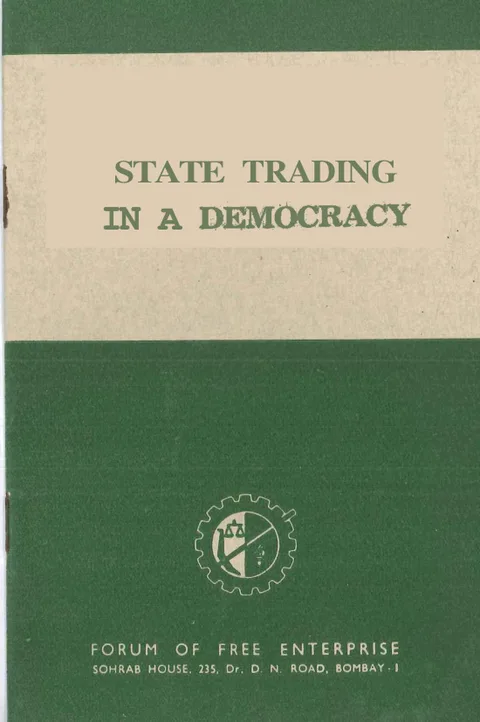
State Trading
By A. D. Shroff
FORUM OF FREE ENTERPRISE, 235, DR. DADABHAI NAOROJI ROAD, BOMBAY-1 · Bombay · 1958
23 pages
State Trading
Summary
This booklet, issued by the Forum of Free Enterprise in Bombay, gathers the addresses delivered at the Forum’s Convention on State Trading held in Bombay on April 28, 1958. A. D. Shroff, President of the Forum, presides; the other speakers are N. Dandeker, I.C.S. (Retd.), S. C. Bose of the Utkal Mining and Industrial Association in Calcutta, Murarji J. Vaidya, former President of the Indian Merchants’ Chamber, and D. B. Futnani, President of the Iron, Steel and Hardware Merchants’ Chamber of India. The introduction frames the volume with a sidebar epigraph from Eugene Black, President of the World Bank, that private enterprise must be accepted not as a necessary evil but as an affirmative good.
The five speakers converge on a single argument: that the expansion of the State Trading Corporation (S.T.C.) under India’s planned-economy doctrine of a ‘socialistic pattern of society’ is the most sinister encroachment on free enterprise and the democratic way of life since independence. Shroff calls it a ‘Twentieth Century East India Company’; Dandeker mounts a constitutional argument that any new State activity must be ‘demonstrably necessary’ in the public interest and that the absence of autonomy invites backdoor political abuse; Bose documents the wreckage of the mineral and ore trade — manganese, iron ore, mica — under STC monopoly pricing; Vaidya argues that centralised barter deals with Communist countries are simultaneously corrupting export discipline and breeding a clientele dependent on the ruling party; Futnani details the fiscal and procurement disasters in steel imports, where amateur State purchasing has driven up costs by roughly forty per cent. The unifying thesis is that State Trading concentrates favour, finance and discretionary patronage in the hands of bureaucrats and the ruling party, hollowing out parliamentary democracy from within.
Key points
-
A. D. Shroff, presiding as Forum President, brands the State Trading Corporation “the Twentieth Century East India Company” and calls the nationalisation of life insurance and creation of the STC the Government’s two most indefensible acts.
-
Shroff argues the STC has demoralised the merchant class, ruining hundreds of merchants and reducing others to silent fear, and warns it is now extending into petrol and newsprint distribution.
-
N. Dandeker mounts a constitutional argument that any new State economic activity must be “demonstrably necessary in the public interests,” proposing a two-pronged test of whether objectives are achievable by ordinary citizens or by regulated private enterprise.
-
Dandeker contends the State Trading Corporation has never been forced to meet this test in advance, with its results instead rationalised after the fact, and that its unlimited finance makes it a de facto monopoly no private trader can rival.
-
S. C. Bose of the Utkal Mining and Industrial Association documents damage to the manganese, iron ore and mica trade under STC monopoly pricing.
-
Murarji J. Vaidya, former President of the Indian Merchants’ Chamber, argues that centralised barter deals with Communist countries corrupt export discipline and breed a clientele dependent on the ruling party.
-
D. B. Futnani, President of the Iron, Steel and Hardware Merchants’ Chamber of India, details fiscal and procurement failures in steel imports, where amateur State purchasing raised costs by roughly forty per cent.
-
The volume’s introduction cites an epigraph from World Bank President Eugene Black insisting private enterprise be accepted “not as a necessary evil but as an affirmative good.”
Essays
INTRODUCTION
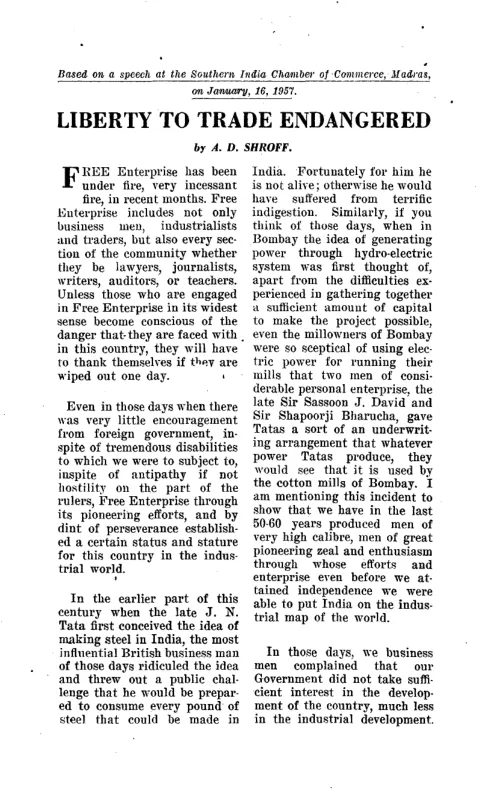
By A. D. Shroff
Shroff opens by complaining that the Government has so politicised business that businessmen cannot avoid politics, citing a Gujarati proverb — ‘when the ruler takes to trading, the subjects must go a-begging’ — to frame his attack. He singles out the nationalisation of life insurance and the founding of the State Trading Corporation as the Government’s two most indefensible acts, arguing that the STC has so widely extended Government patronage that it has demoralised the merchant class outright: hundreds of merchants ruined, others reduced to silent fear of speaking out.
He warns that the STC is now extending its tentacles to petrol and newsprint, and recounts a personal encounter with Nagpur manganese ore traders whose stocks are mounting and whose businesses are about to be shut down by STC’s intrusion. He closes with the polemical comparison: the State Trading Corporation ‘can be described as the Twentieth Century East India Company’, and its existence is further proof that the Government is attempting to destroy the precious democratic inheritance of independent India.
- The Union Finance Minister Morarji Desai’s advice to businessmen to stay out of politics is unworkable because the Government has injected politics into every layer of business.
- Nationalisation of life insurance and the creation of the State Trading Corporation are the Government’s ‘two most indefensible actions’.
- The STC has demoralised the merchant class — hundreds of merchants ruined, others afraid to speak.
- STC is poised to take over petrol and newsprint distribution next, and is already destroying the Nagpur manganese trade.
- Shroff brands the STC ‘the Twentieth Century East India Company’ and frames it as an attempt to destroy democracy.
STATE TRADING AND ITS IMPLICATIONS
By A. D. Shroff
Dandeker mounts the most legalistic case against State Trading, arguing that India’s democratic Constitution rests on fundamental rights and personal liberty, that the State is bound by those limits in every activity it undertakes, and that any new State activity in the economic field must be ‘demonstrably necessary in the public interests’. He develops a two-pronged test: a State activity is permissible only where (a) the desired public objectives cannot be achieved by ordinary citizens and corporations, and (b) those objectives cannot be achieved equally well through regulated private enterprise. He argues that the STC has never been forced to meet either test ex ante, and that its results are routinely justified ex post facto by whichever rationale fits the day.
He then turns to the limitations on State activity once it is permissible. Even within Iron Curtain countries, he says, State Trading suffers from a near-total absence of autonomy: control over imports, exports, licences and transport priorities can all be manipulated to favour the State Trading Corporation, creating not merely a commodity monopoly but a monopoly over the procedures by which trade succeeds. The unlimited finance and discretionary patronage placed at STC’s disposal make it ‘almost a de facto financial monopoly’ that no private enterprise can compete against, and these distortions, he insists, must be rigidly circumscribed if State Trading is not to escape control entirely.
- India’s democratic Constitution requires that any new State activity be ‘demonstrably necessary in the public interests’ before encroaching on individual rights and liberties.
- A two-prong test: (i) objectives unachievable by ordinary citizens/corporations, (ii) unachievable through regulated private enterprise.
- The STC has never been forced to meet this test ex ante; its results are rationalised ex post facto.
- Even within Iron Curtain countries, State Trading suffers from ‘almost complete absence of autonomy’ that breeds backdoor political abuse.
- Unlimited public finance gives the STC a ‘de facto financial monopoly’ against which no private trader can compete.
LIMITS & LIMITATIONS OF STATE TRADING
By N. Dandeker
Bose, speaking from the mineral and ore industry, opens with the categorical claim that there are no constitutional or economic grounds for the operation of the STC in India, that the idea is borrowed from the U.S.S.R. and cannot fit a country whose productive organisation lies in the private sector. He recounts that he had urged the STC at its founding to confine itself to shipping, banking and insurance services rather than commodity trade, and warns that an organisation with no clear-cut boundaries — straddling international trade, the Iron Curtain trade, internal trade, vessel chartering and Steel/Hydro-electric projects — is the most dangerous form of State activity.
He then catalogues the wreckage in the mineral trade. The STC’s inexperience and price-making behaviour has annoyed foreign buyers; iron ore production has dropped from 58% Fe quality previously exported to 35% of mines closed in India; STC has dishonoured 40% of manganese contracts; mines in Andhra and Orissa are shutting; unemployment of fifty thousand workers looms. His central image: ‘the S.T.C. has killed the goose laying the golden eggs.’ He demands the STC withdraw and the existing private trading mechanism be restored, warning that even three years will not undo one year of damage. Pages 18 and 19 of his address are missing from the rendered chunk.
- There are no constitutional or economic grounds for STC operation; the idea is borrowed from the U.S.S.R. and ill-fitted to India’s private-sector economy.
- STC’s lack of clear boundaries and its operation across services, internal trade, mining and steel makes it the most dangerous form of State activity.
- Iron ore production has collapsed from 58% Fe exportable quality to 35% of mines closed; manganese ore is in acute slump.
- STC has dishonoured 40% of manganese contracts, restraining the private sector’s foreign markets.
- Aphorism: the STC ‘has killed the goose laying the golden eggs’; three years will not repair one year of damage.
STATE TRADING IN MINERAL, ORES
By S. C. Bose
Vaidya frames his address around the question of how State Trading impacts India’s democratic way of life. He asks why the Government of India set up the STC at all — to promote exports? to develop the mining industry? to help the trader? — and answers that, at the time of its formation, the rationale offered was the difficulty of dealing with the centralised state apparatus of Communist trading partners. Yet, he argues, all STC deals with Communist countries have been on a barter basis, while applications by Indian private traders for similar barter arrangements have been denied on the ground that the Government of India opposes such deals as a matter of policy — a flagrant contradiction.
His deeper argument is constitutional: in a democracy, the State must treat every citizen as equal before the law, but the STC system is the opposite — registration with the STC is the gateway to favours, and unregistered traders are squeezed out. Centralisation in a single trading body places every importer and exporter at the mercy of the STC and threatens the very fundamentals of freedom, individual liberty and democracy. He warns that when a large body of citizens come to depend on the State Trading Corporation for their livelihood, they will never vote against the ruling party — destroying both opposition politics and parliamentary democracy. Vaidya closes by noting that the Forum of Free Enterprise itself was founded precisely to call a halt to the ‘expanding activities and tentacles of the octopus of government control’.
- STC was set up ostensibly to deal with centralised Communist trading bureaucracies, but all such trade is in fact on a barter basis available to private traders.
- Government denies private traders the same barter arrangements it concludes through the STC — a flagrant contradiction.
- Registration with the STC has become a regime of favours, violating democratic equality before the law.
- Trade with Communist countries (e.g. pepper to U.S.S.R.) is destroying India’s hard-currency export markets like America (70% drop in pepper exports).
- The greatest danger is political: dependence on STC patronage will produce a captive electorate, making opposition vote and parliamentary government impossible.
STATE TRADING AND DEMOCRACY
By Mr. Murarji J. Vaidya
Futnani, speaking for the iron-and-steel trade, opens with the formulation that ‘the State Trading Corporation is not a commercial venture but may appropriately be termed as a political misadventure’, arguing that the scandals of state trading dwarf even the Life Insurance Corporation affair. Iron and steel, he notes, is one of the biggest single items in India’s import bill — Rs. 1,203 crores, roughly 20% of total foreign exchange requirements — yet only Rs. 120 crores (about 20%) is left for private importers; the rest is monopolised by the State.
He argues that civil servants, however capable, cannot match the practical experience of generations of steel traders, and recalls the disastrous first purchase under an ex-Secretary who acquired 200,000 tons valued at Rs. 15 crores with no prior experience in steel. He quotes a family proverb — ‘Na Janaanewalla Baba Levey, Pota Bechey’ (the inexperienced grandfather buys and the grandson sells) — to illustrate that ill-specified purchases sit unsold for years. He details case after case in which the Government, by going abroad without bargaining discipline, paid 33%–40% more than the ruling market price for steel billets, flat bars and plates; refused contractual cancellation when prices fell 40%; and crashed prices on the foreign market by signalling India’s exact requirements (£53 down to £34 per ton). His prescription: invite global or country-wide tenders, only in quantities needed at the time. The rendered chunk cuts off mid-essay at page 37.
- Iron and steel imports total Rs. 1,203 crores — ~20% of India’s foreign-exchange requirements — yet private importers handle only ~20% of that.
- The STC’s first steel purchase under an ex-Secretary acquired 200,000 tons worth Rs. 15 crores from someone with no steel experience.
- Government bought standard steel billets at ~£55 per ton c.i.f. when the same were available at £33–£34, paying ~33% premiums on poorly specified material that then sat unsold.
- By openly broadcasting India’s total requirement (35,000 tons against a 10,000-ton offer), the Government caused foreign sellers to crash export prices from £53 to £34 per ton — a 40% loss in value for India.
- Proverbial frame: ‘Na Janaanewalla Baba Levey, Pota Bechey’ — inexperienced grandfathers buy, grandsons sell at a loss.
Generated by the v1.5 extraction pipeline. Awaiting editorial review.
Metadata and summary are AI-extracted from the source PDF and reviewed for editorial accuracy. The original work is available via the Read PDF tab above (where present); paragraph-level citation inside the PDF is deferred to a future engagement.