speech
LIBERTY TO TRADE ENDANGERED
By A. D. Shroff
FORUM OF FREE ENTERPRISE, "Sohrab House", 235, Dr. Dadabhai Naoroji Road, BOMBAY 1. · Bombay · 1957
6 pages
Summary
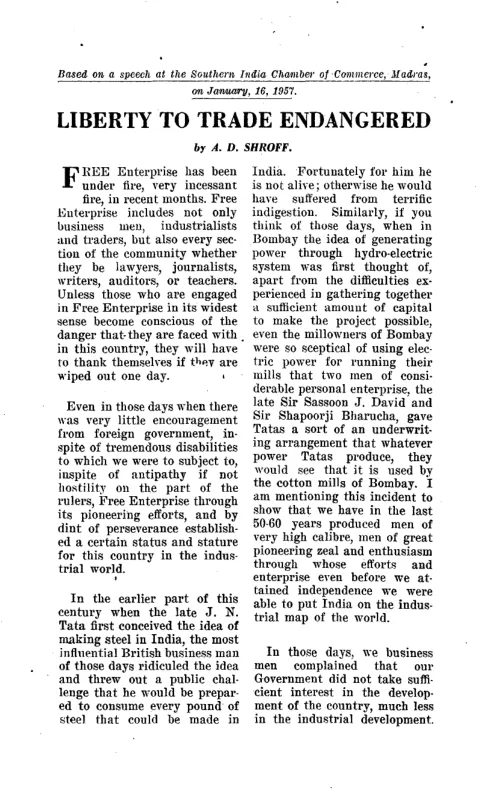
This pamphlet reproduces a speech by A. D. Shroff delivered at the Southern India Chamber of Commerce, Madras, on 16 January 1957 and issued by the Forum of Free Enterprise in Bombay. Shroff argues that Free Enterprise has come under sustained attack in recent months in India, with the State Trading Corporation, compulsory industrial deposits, and the nationalisation of life insurance treated as illustrations of an expanding regulatory state that drifts steadily from a planned economy into the daily regulation of economic life.
Shroff is careful not to argue for an unqualified laissez-faire — he concedes that controls are necessary in any planned economy and that intelligent Indian businessmen accept some measure of regulation as inevitable in the modern world. His complaint is that the cumulative effect of recent measures amounts to a gradual diminishing of the democratic way of life and individual liberty. He sets this critique against the pioneering tradition of Indian business, recalling how the late J. N. Tata first conceived of making steel in India against British ridicule, and how the late Sir Sassoon J. David and Sir Shapoorji Bharucha underwrote the offtake of Tatas’ hydro-electric power for the Bombay cotton mills — evidence that industrial independence was built by private enterprise long before the state took an active developmental interest.
The second half of the address turns to immediate threats. Shroff warns that the State Trading Corporation has cast “avaricious” eyes over cement, manganese and iron ore exports, and even smaller trades like lemongrass and sandalwood oil, despite having neither personnel nor experience. He calls the proposed compulsory deposit of Rs. 80–100 crores on industry a “man-made crisis of the greatest magnitude”, arguing it will force banks to recall credit lines already granted to business. He places a “Code of Conduct” before businessmen — distinguishing profit-making from profiteering — and urges the community to back the Forum of Free Enterprise as a restraining voice against “the crazy and frantic financial policies” emanating from Delhi.
Key points
-
Speech given to the Southern India Chamber of Commerce, Madras, on 16 January 1957 and circulated as a Forum of Free Enterprise pamphlet.
-
Shroff concedes that ‘Laissez-faire philosophy simply does not exist in the modern world’ but argues that Indian regulation has gone beyond a planned economy into daily interference with economic life.
-
He invokes the pioneering history of Indian business — J. N. Tata’s steel and power projects, underwritten by Sir Sassoon J. David and Sir Shapoorji Bharucha — to insist that industrial independence in India was built by private enterprise.
-
The State Trading Corporation is singled out as the ‘new activities the State has undertaken’, encroaching on cement, manganese and iron ore, and even lemongrass and sandalwood oil, despite having no expertise or personnel.
-
Nationalisation of life insurance is treated not only as a takeover of a business but as the extended patronage of an entire democratic ecosystem of agents, drawn into the ruling party’s machine.
-
Shroff frames the proposed compulsory deposits of Rs. 80–100 crores on industry as ‘a man-made crisis of the greatest magnitude’ that will force banks to withdraw credit limits already granted.
-
He places a ‘Code of Conduct’ before businessmen — distinguishing profit-making from profiteering — and argues that Free Enterprise must convince public opinion by acting fairly toward employees and consumers.
-
He urges the audience to keep the Forum of Free Enterprise active as a brake on ‘the crazy and frantic financial policies’ emerging from Delhi.
Metadata and summary are AI-extracted from the source PDF and reviewed for editorial accuracy. The original work is available via the Read PDF tab above (where present); paragraph-level citation inside the PDF is deferred to a future engagement.