edited volume · proceedings
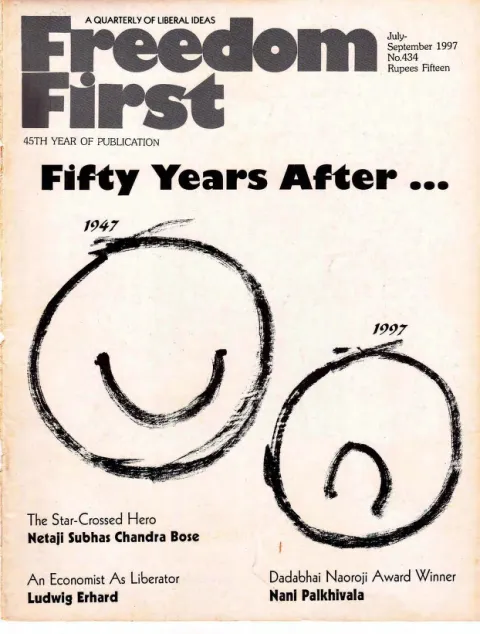
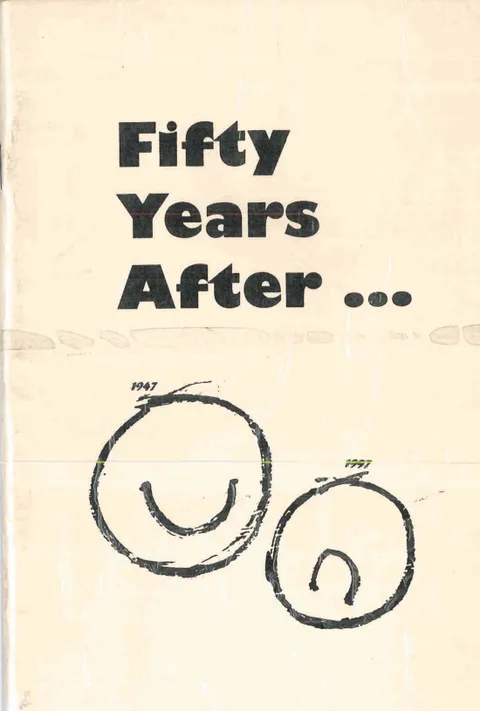
Fifty Years After ...
By Sadanand Varde, K. F. Rustomji, Arvind Deshpande, Maneesha Tikekar, Usha Mehta, Indumati Parikh, Jiban Mukhopadhyay
Published by: Mr. S. V. Raju, Executive Director, Project for Economic Education, 148, Mahatma Gandhi Road, Mumbai 400 001. · Mumbai · 1997
39 pages
Summary
Fifty Years After … is a slim proceedings booklet published in 1997 by the Project for Economic Education (Mumbai) with support from the Friedrich-Naumann-Stiftung, edited by S. V. Raju. It gathers presentations and discussion contributions from a seminar titled ‘India-Fifty Years After’ held in April 1997 in Mumbai, assembling freedom fighters, retired military officers, a retired judge, academics, and activists to take stock of India’s record fifty years on from independence. The volume is divided into a main-papers section (one extended lead essay by Sadanand Varde, pp. 1–8) and a longer ‘Discussions’ section (pp. 9 onward) containing shorter contributions from nine additional speakers, capped by a final essay on infrastructure by Jiban Mukhopadhyay beginning at printed p. 33.
The governing question across the volume is whether the freedoms for which the independence generation fought have been delivered to ordinary Indians. The contributors reach a broadly shared negative verdict: the economy was captured by a permit-licence-quota raj that produced a vast public sector, fiscal profligacy, and entrenched bureaucratic rent-seeking; democratic institutions have degenerated into a VIP Republic serving politicians and goondas rather than citizens; mass illiteracy, inadequate health care, and poor infrastructure remain stubborn failures fifty years on. Yet several speakers — notably Justice Jahagirdar and Dr. Usha Mehta — resist pure pessimism, arguing that the constitutional framework has proved resilient and that civil society, the armed forces, and voluntary organisations can still push reform forward. The discussions section adds concrete proposals on municipal schooling, family planning, nutrition, women’s employment, and community entitlements, giving the volume a policy-reform as well as retrospective character.
Key points
-
Sadanand Varde dates the moral decline of Indian public life to Indira Gandhi’s transformation of Congress into a family business and catalogues over two lakh crore rupees sunk in loss-making public sector units.
-
Varde skewers the ‘VIP Republic’ of rent-free MP bungalows and competitive populism that he says drains resources from education and health.
-
K. F. Rustomji opens the Discussions section reporting that four hundred million Indians live below the poverty line, seventy per cent are illiterate, and sessions courts take eight to ten years to convict.
-
Maj. Gen. (retd.) E. D’Souza identifies constitutional collapse and the absence of a viable alternative to Congress as India’s twin root failures, quoting B. K. Nehru on the gulf between founders and present rulers.
-
Arvind Deshpande’s essay ‘Today’s Pindaris’ invokes Achyut Patwardhan’s warning that 1990s India resembles 1837, twenty years before 1857 and a phase of anarchy.
-
Dr. Maneesha Tikekar attributes the failure to build civil society to excessive governmentalisation in a hierarchy-bound culture where politics fills the vacuum left by absent social mobility.
-
Dr. Usha Mehta, drawing on her own service under Gandhi, defends non-violent means and notes India alone among comparable post-colonial states has never fallen under military rule.
-
Justice R. A. Jahagirdar takes the most optimistic line, invoking Ambedkar’s opposition to panchayat rule against the Gandhian Gram Swaraj ideal and concluding ‘the patient is still alive and curable’.
-
Indumati Parikh reframes freedom through M. N. Roy’s definition of continuous removal of impediments to human development, addressing rural schooling, family planning, and primary health care failures.
Essays
Is This the Freedom We Fought For?
By Sadanand Varde
Sadanand Varde opens the volume with a deeply personal reckoning. A veteran of the 1942 freedom struggle, he confesses that the labels ‘freedom fighter’ carry no pride for him today, given how many who claim them have been hauled into court for criminal offences. He surveys fifty years of development and concludes they have been years of ‘wasted opportunities and lost morality.’ The State was placed at the head of the economy through the National Planning Commission, producing a closed economy, a huge loss-making public sector (over Rs 2 lakh crore sunk), and a culture where bureaucrats and ministers arrogated enormous powers to themselves. The result is a ‘VIP Republic’ in which parliamentary privilege shields criminals, the Shiv Sena can extort goondas under political patronage, and competitive populism — dual-card ration schemes, subsidised power — drains resources from education and health. Varde traces the moral decline to the moment Indira Gandhi turned Congress into a family business and personalist politics displaced principled leadership. He is cautiously hopeful about technology (TV and radio freeing communications from state control) and emerging federal pressures, but ends with a letter exchange between Sheila Kaul and Nanasaheb Goray parodying the ‘Dandi March Run’ as a symbol of the frivolity of those in power.
- Varde argues that the National Planning Commission placed the State at the head of the economy, producing a closed economy, high tariffs, and a parallel economy accounting for nearly half of national production.
- The public sector absorbed over Rs 2 lakh crore in capital, most of it loss-making; crores in investments returned less than 2.5% on investment.
- Parliamentary institutions have deteriorated into a ‘VIP Republic’: MPs occupy government bungalows rent-free, use their offices to extort constituents, and cannot be arrested while Parliament is in session.
- Competitive populism — dual-card ration systems in Andhra Pradesh, open-ended subsidies in power and education — wastes resources and is not cost-effective.
- The moral decline of public life is dated to Indira Gandhi’s decision to treat Congress as a family affair, triggering the era of coalition politics and criminality in public life.
- Technology (independent TV and radio channels) is identified as a structural antidote to State control of communications.
- Varde ends with a satirical letter exchange mocking the ‘Freedom Run’ gimmick under Rajiv Gandhi as emblematic of the hollow official celebration of independence.
Democracy only for the Few?
By K. F. Rustomji
K. F. Rustomji opens the Discussions section with a blunt assessment of India’s achievements. He acknowledges genuine progress in agriculture and expansion of the middle class, but notes that 44% of the population — around 400 million — live below the poverty line, 70% of the country is illiterate, and the justice system has broken down: murder cases now take 8–10 years to reach a sessions court verdict, and conviction rates are near zero. He describes a justice system that has substituted police torture and extrajudicial killing for due process.
- Middle class has expanded but 400 million remain below the poverty line and 300 million are illiterate.
- The justice system is effectively non-functional: serious cases take 8–10 years in sessions courts and conviction rates are nearly zero.
- Police have substituted torture and extrajudicial killing for deterrence, which Rustomji describes as uncivilised.
- The home minister Indrajit Gupta is quoted as acknowledging a general fall in performance of the policing system across the country.
The Armed Forces
By Maj.Gen. (retd.) E. D’souza
Maj. Gen. (retd.) E. D’Souza recounts a small incident from the night of 14/15 August 1947 to frame his reflections on the armed forces. He identifies two fundamental problems: the collapse of the Constitution’s spirit and India’s failure, in fifty years, to find a long-term viable alternative to the Indian National Congress. He quotes B. K. Nehru on the divergence between the constitutional values of founders like Nehru, Patel, and Rajaji and the values of today’s rulers (Laloo, Jayalalitha, Mulayam Singh). He draws an analogy with South Africa’s constitutional process and emphasises that for liberal democracy to survive, India needs leaders who look at poverty rationally — citing Gandhi, J.P. Narayan, and M. N. Roy as models.
- D’Souza identifies two root causes of India’s failures: collapse of constitutional values and the absence of a viable alternative to Congress dominance.
- He cites B. K. Nehru’s warning about the gap between the constitutional values of founders and current rulers.
- He draws an analogy with the South African constitutional process, noting that India’s 70% OBC and SC population mirrors the percentages that shaped South Africa’s new constitution.
- He argues that for liberal democracy to survive after freedom, leaders who look at poverty rationally — not sentimentally — are needed.
Today’s Pindaris
By Arvind Deshpande
Arvind Deshpande’s contribution ‘Today’s Pindaris’ uses the historical Pindari marauders as a metaphor for the current political class. He recounts Achyut Patwardhan’s invitation to speak at a ‘People’s Parliament’ in Delhi and Patwardhan’s warning that India is entering a phase equivalent to 20 years before 1857 — 20 years after the Mughal collapse, when Peshwas fell and ‘there was total anarchy.’ Deshpande argues that the two basic problems facing India are political: the collapse of the Constitution and the failure to find a viable alternative to the Indian National Congress.
- Deshpande uses the Pindari metaphor to characterise today’s political criminals and goondas who have captured the state.
- Achyut Patwardhan is quoted warning that India in the 1990s resembles India around 1837 — 20 years after the Mughal collapse and the fall of the Peshwas.
- The two basic problems identified are: (1) constitutional collapse and (2) the failure to find a long-term viable political alternative to Congress.
Let’s Look Forward
By Admiral Ramdas (retd.)
Admiral Ramdas (retd.) offers a brief forward-looking statement emphasising that the quality of leadership, discipline, and the role of the armed forces are the keys to improvement. He states that the armed forces have a basic subscription to democracy and have always rallied to national causes, and explicitly notes that ‘we always rallied to national causes like floods, restoring disrupted civil services, electrical failures’ and do not recruit on a caste basis.
- Ramdas identifies quality of leadership, sense of discipline, and sound values as the three priorities for improvement.
- The armed forces are presented as a remaining bastion of non-caste, non-partisan national commitment.
- He calls for armed forces to maintain a basic subscription to democracy and to help ensure national cohesion.
Our Failures
By Dr. Maneesha Tikekar
Dr. Maneesha Tikekar’s short contribution ‘Our Failures’ attributes India’s inability to create a genuine civil society to the excessive governmentalisation and politicisation of the entire society. She argues that in a hierarchy-bound society where social mobility is not easily available, politics becomes an avenue for status and money. She identifies four causes of continued failure: politicisation of public life; the constitutional morality being reduced to technicalities; the sudden coming of mass society without a genuine mass society having been cultivated (India has borrowed many things through technology without cultivating indigenous ideas and ideologies); and the resulting tendency of rulers to be populist.
- Tikekar attributes the failure to create civil society to excessive governmentalisation and politicisation of society.
- She argues that in hierarchy-bound societies, politics fills the vacuum left by absent social mobility.
- Constitutional morality has been reduced to mere formalities while moral substance has been overlooked.
- India has borrowed technology and mass-society forms without cultivating indigenous ideas and ideologies, making populism structurally inevitable.
Keeping Alive the Ideals of the Freedom Struggle
By Dr. Usha Mehta
Dr. Usha Mehta draws on her personal experience as a freedom fighter under Mahatma Gandhi to reflect on what keeping the ideals of the freedom struggle alive means. She insists that Gandhi’s emphasis on the convertibility of means and aims — the movement must remain non-violent — is as relevant now as it was then. She argues that the armed forces should not develop any political ambitions and cites M. C. Chagla’s encouraging statement during the Emergency as evidence that institutions can hold. She acknowledges systemic failures (the Army Rule lasting 37 years in Pakistan as a counter-example) but argues that India is ‘the only country which has retained its constitutional framework and government all these fifty years.’
- Usha Mehta grounds her address in personal memory of fighting under Gandhi and insists on the non-violent convertibility of means and aims.
- She praises the armed forces for never developing political ambitions and cites this as a key institutional achievement.
- She holds up India’s unbroken constitutional framework as exceptional among post-colonial states — uniquely among comparable nations, India has never gone under military rule.
- She quotes M. C. Chagla’s encouraging statement during the Emergency as evidence of judicial and institutional resilience.
- She warns against ‘quarrelling with the Constitution’ and calls for using it as a tool rather than blaming it for situations that arise.
The Patient is still Alive and curable
By Justice R. A. Jahagirdar (retd.)
Justice R. A. Jahagirdar (retd.) takes the most explicitly optimistic line in the volume. His essay ‘The Patient is still Alive and curable’ argues that India’s constitutional fabric has survived despite all provocations — including Emergency — and that the judiciary and armed forces have been the key pillars of stability. He draws a pointed contrast between India and Ghana: both became independent at the same time, but Ghana went into darkness after Nkrumah was overthrown, while India retained its constitutional framework across fifty years. He attributes poverty in India partly to the Gandhian fixation on charkha and swadeshi rather than modern economic development, notes Ambedkar’s opposition to panchayat rule, and contends that even a pessimist must acknowledge that ‘the patient is still alive and we can still cure him and make him live and kicking again.’
- Jahagirdar argues that India uniquely among comparable post-colonial states has retained its constitutional framework for fifty years, never going under military rule.
- He draws an invidious comparison with Ghana: India vs. Nkrumah’s Ghana; Nehru vs. Nkrumah — India came out ahead.
- He attributes initial attributions of poverty to foreign rule (charkha, swadeshi) as a historical mistake that delayed modern economic development.
- He invokes Ambedkar’s opposition to panchayat rule as a counterpoint to the Gandhian ideal of Gram Swaraj.
- He closes on a qualified optimism: the patient is ill but alive and curable.
Too Many People, Too Little Health Care, Too Many Illiterates
By Indumati Parikh
Indumati Parikh’s is the longest essay in the volume, running from printed pp. 18–23. She opens by arguing that ‘freedom’ was never truly understood by most Indians — belonging to a hierarchical culture where freedom was within community, caste, and religion, the concept of individual freedom was alien to the independence generation’s mass base. She argues that the real meaning of freedom is the continuous removal of impediments to human development, citing M. N. Roy’s definition. She then works through four major failure domains: the sham of rural schools (government figures claim 56% female literacy but her fieldwork finds girls absent from classrooms, drop-outs lapsing back to illiteracy after two years, unwritten rules preventing promotion past 4th standard in municipal schools); the population problem (India was the first country to adopt family planning policy in 1951 but implementation was left to a Catholic health minister opposed to artificial birth control); health care (primary health care centres are poorly manned and equipped, people do not know how to use them, tribal communities lack basic nutritional knowledge); and the need for non-formal education and appropriate technology as grassroots tools.
- Parikh argues that ‘freedom’ was never internalised by the mass of Indians raised in hierarchical, caste-bound community structures where freedom meant communal membership, not individual autonomy.
- She cites M. N. Roy’s definition — freedom is the continuous removal of impediments to the development of human beings — as the correct benchmark.
- Rural schooling is described as a sham: girls are absent from classrooms, drop-outs relapse into illiteracy within two years, municipal school rules prevent promotion past 4th standard.
- The population problem was compounded by entrusting family planning implementation to a Catholic health minister who introduced the rhythm method against government warnings.
- Primary health care centres are poorly staffed and poorly used because people are not educated about preventive and promotive health.
- Non-formal education and appropriate technology — usable by and understandable to anybody — are proposed as the route out of the impasse.
Metadata and summary are AI-extracted from the source PDF and reviewed for editorial accuracy. The original work is available via the Read PDF tab above (where present); paragraph-level citation inside the PDF is deferred to a future engagement.
People in this work
- Sadanand Vardeauthor
- K. F. Rustomjiauthor
- Arvind Deshpandeauthor
- Maneesha Tikekarauthor
- Usha Mehtaauthor
- Indumati Parikhauthor
- Jiban Mukhopadhyayauthor
- Eric D'Souza
- L. Ramdas
- R. A. Jahagirdar
- Indira Gandhi
- BK Nehru
- Jawaharlal Nehru
- Vallabhbhai Patel
- C. Rajagopalachari
- Mahatma Gandhi
- Jayaprakash Narayan
- M. N. Roy
- M. C. Chagla
- B. R. Ambedkar
- Achyut Patwardhan
- Rajiv Gandhi