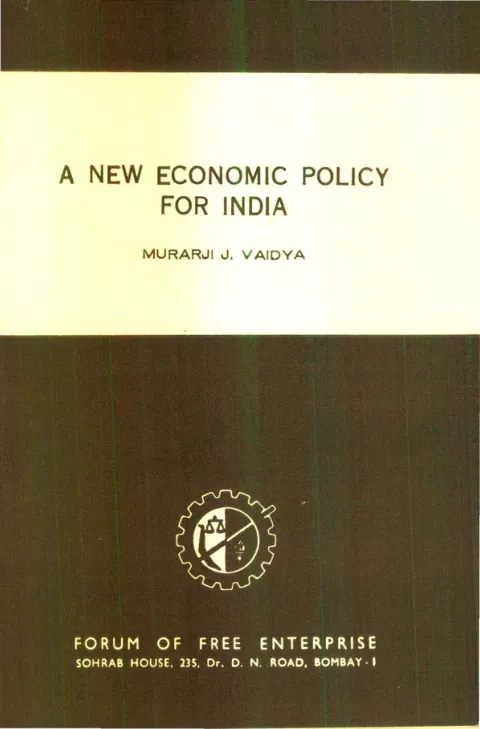
speech
DANGER OF OUTMODED SOCIALISM TO INDIA'S WELFARE
FORUM OF FREE ENTERPRISE, SOHRAB HOUSE, 235, D. NAOROJI ROAD, BOMBAY-1 · Bombay · 1966
23 pages
Summary
Murarji J. Vaidya’s 1966 presidential address to the Forum of Free Enterprise — published as a pamphlet in January 1967 — diagnoses India’s mid-1960s economic crisis as the cumulative consequence of the ‘so-called socialist economic ideology’ embraced by the Government since 1955. Writing in the wake of the rupee devaluation, runaway food imports, soaring prices and an aborted Third Plan, Vaidya argues that centralised comprehensive planning has produced not equality but inflation, food scarcity, capital flight and the political concentration that he sees as freedom’s first casualty in self-described ‘People’s Democratic Republics.’
The pamphlet marshals a battery of contemporary evidence — Reserve Bank price-rise figures, Parliamentary Committee reports on Public Undertakings, Audit Reports, World Bank and U.N. FAO assessments, and press accounts of agricultural waste — to indict deficit financing, zonal trading barriers, monopoly procurement and the loss-making expansion of the Public Sector. Vaidya draws ironic contrasts with reforms inside the Communist bloc itself: 86% of Yugoslav agricultural land in private hands, the Liberman Thesis of the ‘profit motive’ reshaping Soviet enterprise, and Polish and Hungarian retreats from collectivisation. India, he insists, is moving against this current rather than with it.
The constructive half of the address calls not for abandoning planning but for transforming the Planning Commission into a purely advisory, non-political body of technical experts, and for the State to confine itself to infrastructure: administration and law-and-order, transport, communications, agricultural extension, education, public health and sanitation. Vaidya closes on the polemical frame that titles the pamphlet — India stands ‘at the crossroads,’ between persisting in the ideological errors of the past at the risk of jeopardising the democratic way of life, or adopting ‘realistic economic measures based on the laws of the market’ that would, in his phrase, ‘give an edge to the honest’ rather than to the dishonest.
Key points
-
Frames India’s mid-1960s economic crisis — galloping inflation, rupee devaluation, food scarcity, capital flight — as the cumulative consequence of the socialist ideology adopted by the Government since 1955, not as an overnight phenomenon.
-
Argues that the centralised comprehensive planning ideal has failed everywhere it has been tried, and that ‘People’s Democratic Republics’ are in practice dictatorships of political and military cliques rather than vehicles of equality.
-
Documents that Communist states themselves are retreating from state ownership: 86% of Yugoslav agricultural land in private hands, the Liberman Thesis on profit motive in the USSR, Polish reforms, and the rediscovery of price incentives in Kommunist.
-
Indicts the Public Sector’s record with concrete data — Rs. 111 crores of losses by 1964-65, Hindustan Machine Tools failing to declare a dividend, the Indore fan factory, Bhilai Steel surpluses, Traco Cable delays — and notes the flight of 14,063 officials from public undertakings to private firms.
-
Critiques deficit financing (Rs. 2,100 crores in Second and Third Plans), zonal trading barriers that profited state governments at the cost of producers and consumers, monopoly procurement at unremunerative prices, and the FCI as ‘the biggest middleman’.
-
Calls for transforming the Planning Commission into a purely advisory, non-political technical body and confining the State to infrastructure: administration, transport, communications, agricultural extension, education, public health, postal services.
-
Cites Reserve Bank Governor warnings, Parliamentary Committee on Public Undertakings reports, Audit Report (Commercial), World Bank Mission findings and U.N. FAO data as the evidentiary base for the indictment.
-
Closes on the ‘crossroads’ frame: India must choose between persisting in ideological error or adopting market-based measures that ‘give an edge to the honest’ rather than penalise honest entrepreneurs and citizens.
Metadata and summary are AI-extracted from the source PDF and reviewed for editorial accuracy. The original work is available via the Read PDF tab above (where present); paragraph-level citation inside the PDF is deferred to a future engagement.