essay
State Trading And Democracy
"Doctrinaire Dogmas"
THE FORUM OF FREE ENTERPRISE, "Sohrab House", 235, Dr. Dadabhai Naoroji Road, BOMBAY 1. · Bombay · 1956
4 pages
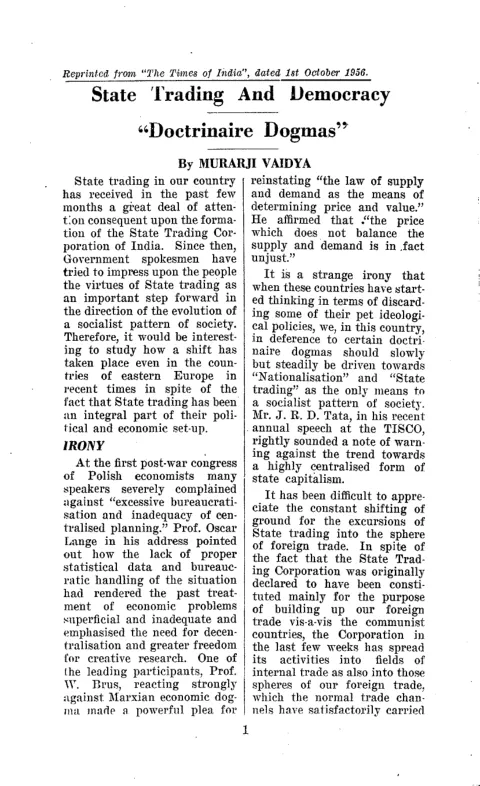
State Trading And Democracy
By MURARJI VAIDYA
Summary
Reprinted from The Times of India of 1 October 1956 and circulated as a pamphlet by the Forum of Free Enterprise, Murarji Vaidya’s “State Trading And Democracy: ‘Doctrinaire Dogmas’” attacks the recently formed State Trading Corporation of India. Vaidya argues that even as communist-bloc economists are quietly retreating from their command-economy commitments, India is drifting in the opposite direction — toward nationalisation and state trading — in deference to ideological slogans rather than evidence.
He marshals two principal authorities. First, he reports on the post-war congress of Polish economists in which Prof. Oscar Lange complained of the lack of proper statistical data and bureaucratic mishandling of economic problems, and in which Prof. W. Brus made a powerful plea for reinstating the law of supply and demand against Marxian dogma. Second, he cites J. R. D. Tata’s annual TISCO address, which warned of a drift toward a highly centralised form of state capitalism. Vaidya then catalogues the State Trading Corporation’s rapid incursion into cement, manganese and iron ore, iron and steel, oils and oilseeds — moves he reads as a direct contradiction of the assurances given to the private sector in the Prime Minister’s Industrial Policy statement, which had promised scope, freedom and encouragement for private enterprise alongside the public sector.
In the “Larger Issues” section Vaidya broadens the critique: state trading concentrates economic and political power in the same hands, and the global record of state monopolies (outside communist regimes whose apparent success masks shortages, high prices and red-tapism) is one of dismal failure. He warns that nascent Indian democracy and its still-imbalanced industrial structure cannot afford to drive successful private traders out of the commodities they have built up. The piece closes by urging the business community — and the newly founded Forum of Free Enterprise — to combine integrity with active social engagement, so that legitimate grievances against private trade do not become pretexts for further state expansion into caustic soda, soda ash, tyres and tubes, or steel imports.
Key points
-
Reprint of Murarji Vaidya’s Times of India article of 1 October 1956, issued as a pamphlet by the Forum of Free Enterprise (Sohrab House, Bombay).
-
Frames the formation of the State Trading Corporation of India as an ironic embrace of ‘doctrinaire dogmas’ precisely when communist-bloc economists are reconsidering them.
-
Cites a post-war Polish economists’ congress where Prof. Oscar Lange criticised bureaucratic mishandling and Prof. W. Brus pleaded for reinstating the law of supply and demand.
-
Invokes J. R. D. Tata’s annual TISCO speech warning against a highly centralised form of state capitalism.
-
Catalogues the Corporation’s rapid expansion into cement, manganese ore, iron ore, iron and steel, and oils and oilseeds in apparent contradiction to assurances given in the Prime Minister’s Industrial Policy Resolution.
-
Argues that the global history of state trading (outside communist monopolies) is one of dismal failure, producing shortages, high prices, loss to the exchequer, and red-tapism.
-
Warns against further canalisation of trade in commodities such as caustic soda, soda ash, tyres and tubes, and steel imports.
-
Calls on the private business community and the newly started Forum of Free Enterprise to foster healthy traditions and take active social responsibility for the common man.
Generated by the v1.5 extraction pipeline. Awaiting editorial review.
Metadata and summary are AI-extracted from the source PDF and reviewed for editorial accuracy. The original work is available via the Read PDF tab above (where present); paragraph-level citation inside the PDF is deferred to a future engagement.