
speech
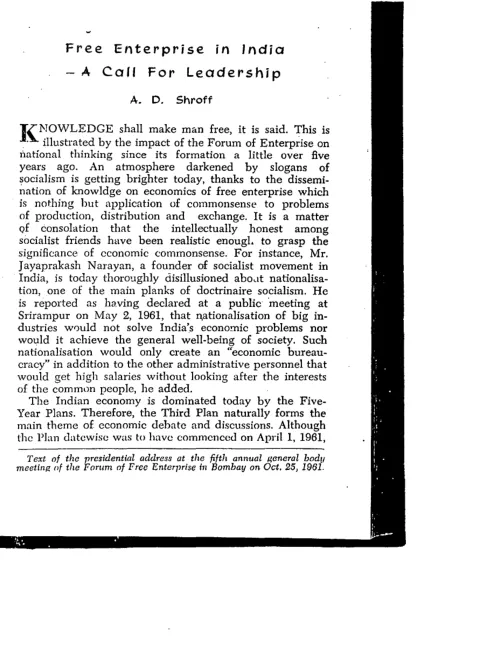
Free Enterprise in India - A Call For Leadership
By A. D. Shroff
Forum of Free Enterprise · Bombay · 1961
18 pages
Summary
A. D. Shroff’s presidential address to the fifth annual general body meeting of the Forum of Free Enterprise (Bombay, 25 October 1961) is a sweeping liberal indictment of India’s Third Five-Year Plan and the doctrinaire socialism that animates it. Shroff opens with the observation that even committed socialists like Jayaprakash Narayan are now disillusioned with nationalisation, and reads the lengthy delay between draft and parliamentary approval of the Third Plan as itself a comment on the costs of centralised planning. He frames the Third Plan as a “carbon copy of the Soviet Communist model” — heavy industry, collectivised agriculture, centralised ownership, and a gross disregard for basic human liberties — and argues that even communist regimes (the USSR under Khrushchev, China after the Great Leap, Yugoslavia, Poland) are quietly retreating toward price signals, private smallholdings, and incentives. By contrast, French indicative planning, which works through consultation with industry and incentives rather than coercion, is offered as the better model for a democracy.
Drawing heavily on Colin Clark’s Growthmanship, Shroff argues that the controlling factor in economic growth is the human factor, not the volume of state investment, and that India’s planners have wasted capital, distorted production, and built up a costly apparatus of officialdom by treating public expenditure as automatically productive. He then catalogues the operational failure of Indian state enterprises — the State Trading Corporation’s cement profiteering and the cancelled Pakistan sugar deal, the rupee-payment scandal flagged by Murarji Vaidya, low returns on state investments confirmed by the Finance Minister, the unaccountable accounting at government companies, unilateral hikes in telephone and air fares, and the H.M.T. “Sujata” watch episode in which Japanese-made watches were distributed as gifts to M.P.s and journalists — to argue that monopolistic government undertakings hold consumers to ransom while lowering public morality.
In parallel, Shroff documents what he calls a “sustained attack on the fundamental requirements of private enterprise and a democratic society” — vituperative attacks on a press described as “jute Press” by a professional politician, the steady erosion of Article 31 property rights, the takeover of Deccan sugar factory farms under the Maharashtra Land Ceiling Act despite their yields being four times the national average, and the criminalisation of politics evidenced by reports of M.P.s consorting with Chambal dacoits, M.L.A. kidnapping charges, and Home Minister Charan Singh’s own admission that criminal elements had entered political parties. He concludes that “under socialism, politics has become an industry of major proportions,” with a new professional-political class whose privileges depend on the state sector and who face no market discipline.
The closing call is to private enterprise itself: to assume leadership beyond business — in education, civic life, social service, and the shaping of public opinion in favour of “realistic planning” — and to stop ceding these spheres to professional politicians. Shroff points to the Indian Chamber of Commerce’s Dandakaranya work, the Indian Merchants’ Chamber’s economic research unit, the Andhra Chamber’s employment exchange, and private flood-relief and rural-uplift work as harbingers of a more responsible non-state leadership. He closes with Acharya Vinoba Bhave’s January 1959 warning that concentrated power in the name of welfare digs democracy’s own grave, and with Mahatma Gandhi’s reminder that a state that does everything for the people is the negation of democracy.
Key points
-
The Third Five-Year Plan is characterised as a “carbon copy of the Soviet Communist model” — heavy industry, collectivisation, centralised ownership, neglect of consumer goods, and disregard for basic human liberties — and judged incompatible with India’s democratic structure.
-
Communist economies themselves (USSR under Khrushchev, China’s Ta Kung Pao on “small freedoms”, Yugoslavia, Poland) are quietly shifting back toward market incentives and private ownership, undermining the Indian planners’ chosen model.
-
French indicative planning — consultation with 3,000 industry representatives through 25 commissions, incentives instead of coercion, qualitative living-conditions targets — is offered as a democratically compatible alternative.
-
Citing Colin Clark’s Growthmanship, Shroff argues the controlling factor in growth is human rather than capital, that capital-output-ratio thinking is discredited, and that India’s pre-occupation with state investment betrays an urge to enlarge the public sector for its own sake.
-
State enterprises are catalogued as inefficient and corrupting — State Trading Corporation profiteering and a Pakistan sugar deal lost over a missed telegram, the rupee-payment scandal flagged by Murarji Vaidya, sub-1% returns on state investment, the H.M.T. “Sujata” watch episode, unilateral telephone and air-fare hikes.
-
A sustained attack on private enterprise and democratic preconditions is identified: vituperation against the press (the “jute Press” slur), steady erosion of Article 31 property rights, the Maharashtra Land Ceiling Act takeover of high-yielding Deccan sugar factory farms, and arbitrary regulatory ceilings on private initiative.
-
Shroff argues that under socialism politics has itself become “an industry of major proportions,” with a perquisite-driven political class (Union Ministers paid Rs. 2,250 but worth Rs. 6,000 with free electricity and perks) shielded from market or regulatory discipline.
-
Private enterprise is called to leadership beyond business — in education, civic amenities, social service, and shaping public opinion for realistic planning — with the Indian Chamber of Commerce, Indian Merchants’ Chamber, and Andhra Chamber cited as positive signs.
Notable passages
"A. D. Shroff's presidential address to the fifth annual general body meeting of the Forum of Free Enterprise (Bombay, 25 October 1961) is a sweeping liberal indictment of India's Third Five-Year Plan and the doctrinaire socialism that animates it."
"the Third Plan as a "carbon copy of the Soviet Communist model" — heavy industry, collectivised agriculture, centralised ownership, and a gross disregard for basic human liberties"
"the rupee-payment scandal flagged by Murarji Vaidya, low returns on state investments confirmed by the Finance Minister, the unaccountable accounting at government companies"
Metadata and summary are AI-extracted from the source PDF and reviewed for editorial accuracy. The original work is available via the Read PDF tab above (where present); paragraph-level citation inside the PDF is deferred to a future engagement.
People in this work
Related across the archive
 Primary workFree Enterprise in India — A Call For Leadership
 ExcerptFree Enterprise in India: A Call for Leadership - A.D. Shroff, 1961
 Primary workTHE EMERGENCY HIGHLIGHTS NEED FOR A NEW ECONOMIC POLICY
 Primary workGOVERNMENT ECONOMIC POLICIES : INDUCEMENTS FOR CAPITAL FORMATION AND INVESTMENT IN INDUSTRIES
 ThePrintFree-enterprise features are reshaping Russia’s socialist institutions: AD Shroff