non liberal
Vinoba Bhave
Vinayak Narahari Bhave
1895–1982
Also known as: Acharya Vinoba Bhave, Vinoba, विनोबा भावे
How Vinoba Bhave is discussed in this archive
Referenced in 11 other works , including Co-operative Farming , Economic Prophecies , and Congress Misrule and the Swatantra Alternative .
In Economic Prophecies : Vinoba is paired with JP as the second hypothetical Gandhian prime minister: even Sarvodaya leadership at the top of government, Shenoy argues, would be insufficient to reverse India's economic course without a thorough cut to public-sector outlays.
In Congress Misrule and the Swatantra Alternative : Masani invokes Vinoba Bhave — a moral authority of the Gandhian establishment — as an unimpeachable witness to the dangerous concentration of power under the Second Five Year Plan, lending Sarvodaya credibility to a liberal critique of state capitalism.
In Free Enterprise in India — A Call For Leadership : Acharya Vinoba Bhave's January 1959 warning that concentrated power in the name of welfare digs democracy's own grave is invoked by Shroff in his closing to anchor free enterprise advocacy in India's own moral tradition.
In Free Enterprise in India - A Call For Leadership : Acharya Vinoba Bhave's January 1959 warning is invoked alongside Gandhi's in Shroff's closing call for private enterprise to assume civic leadership.
In Co-operative Farming : B.P.
Mentioned in (47)
Primary works (41)
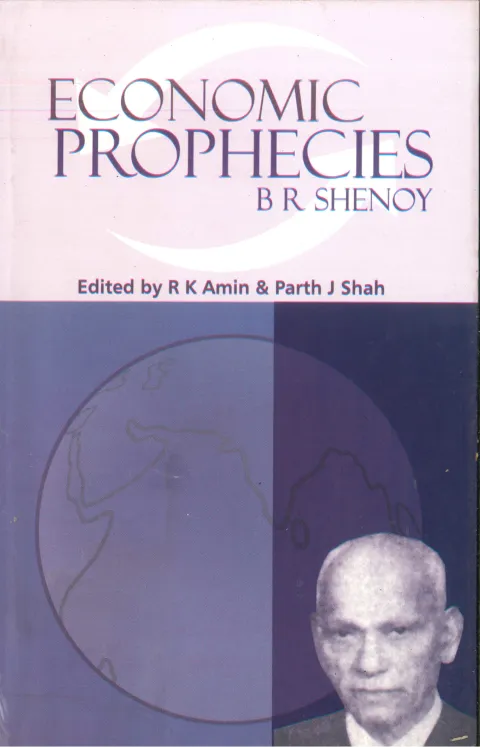
- Economic Prophecies · 2004
- "Shenoy closes by arguing that even a Gandhian government — with J P Narayan or Vinoba Bhave as prime minister — could not correct the chaos without a thorough restructuring of policies including heavy cuts in public-sector outlays." · Vinoba named as a hypothetical Gandhian prime minister whose moral authority alone could not redeem the planning-era economy

Show all 41
- Congress Misrule and the Swatantra Alternative · 1966
- "Masani argues that the Second Five Year Plan has concentrated economic and political power to a dangerous degree, citing Acharya Vinoba Bhave's own warning about power being held by five or six people at the apex." · Vinoba is enlisted as Gandhian cover for Masani's anti-planning critique
- Free Enterprise in India — A Call For Leadership · 1961
- "He invokes Acharya Vinoba Bhave's 1959 warning and Mahatma Gandhi's caution against a government that 'did everything for the people' while people did nothing—anchoring the case for free enterprise in India's own democratic and Gandhian inheritance." · closing rhetorical move tying the Forum's liberal case to Indian moral authority
- Free Enterprise in India - A Call For Leadership · 1961
- "He closes with Acharya Vinoba Bhave's January 1959 warning that concentrated power in the name of welfare digs democracy's own grave" · closing moral anchor in the Gandhian tradition
- Co-operative Farming · 1960
- "even Acharya Vinoba Bhave has chosen to distribute Bhoodan lands to landless individuals rather than to collectives" · Bhave's Bhoodan practice is used as a moral trump card against compulsory cooperative farming
- "Invokes Vinoba Bhave's distribution of Bhoodan land to individual cultivators as evidence that even sympathetic moral authorities reject collectivisation" · Bhave's choice to give land to individuals rather than collectives is the essay's clinching argument
- ECONOMICS OF FREEDOM · n.d.
- "Acharya Vinoba Bhave's caution against centralising everything under the Welfare State" · Bhave cited as part of Masani's trio of Indian authorities warning against statism

Opinion pieces (1)
- A Resilient Soul: Ramadevi Chowdhuri
- "Her childhood was influenced by freedom fighters and thinkers like Mahatma Gandhi, Vinoba Bhave, Sri Aurobindo, and JP Narayan." · Bhave is listed as one of the key figures who shaped Chowdhuri's worldview
Excerpts (4)
- Economics of Freedom
- "His greatest living disciple, Acharya Vinoba Bhave, only recently followed up that warning in more concrete terms when he observed: "We cannot say people will be happy under State Capitalism…In the name of the Welfare State, nothing should be done to centralise everything."" · Bhave's statement is used to show that the anti-centralisation argument has living support within the Gandhian tradition itself
- Free Enterprise in Danger - B.R. Shenoy
- "even a hypothetical government of Gandhian ascetics - with J.P. Narayan or Vinoba Bhave as prime minister - could make no significant difference to these developments under the prevailing 'schizophrenic policies'" · Both Narayan and Bhave illustrate Shenoy's structural-not-moral diagnosis of India's economic problems
- THE DANGERS OF JOINT CO-OPERATIVE FARMING
- "In Koraput, Acharya Vinobha Bhave and Mr. Jaya Prakash Narayan tried to ask the local people to cultivate them as a village and not to ask for distribution of the land." · Vinoba's failed gramdan experiment cited as concrete evidence against cooperative farming
- The Essence of Democracy
- "in the course of his whirlwind tour of Gujarat in support of Vinoba's Bhoodan Movement." · Vinoba's movement identified as the occasion for JP's controversial statements on democracy