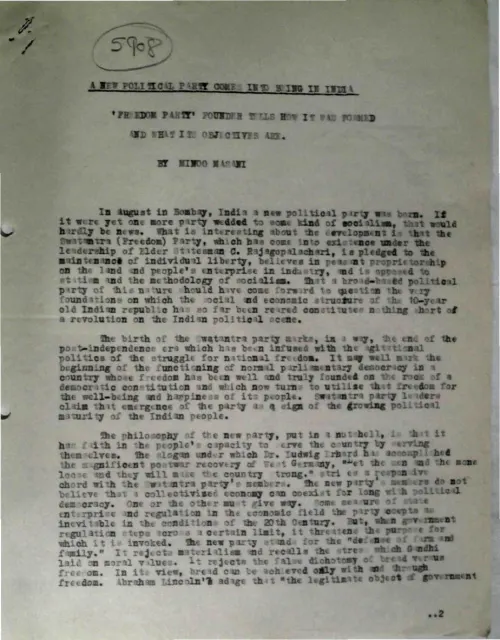
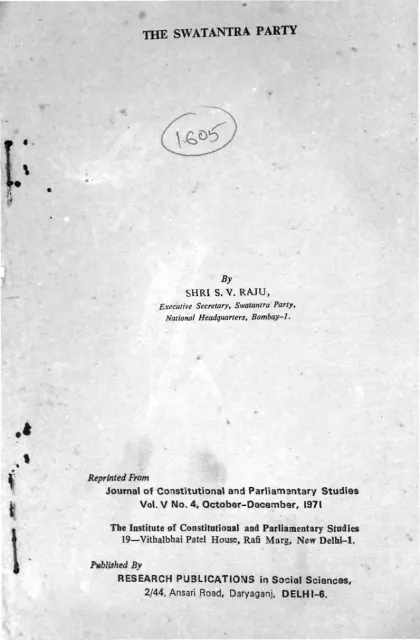
book · collected works
Congress Misrule and the Swatantra Alternative
Manaktalas : Bombay · Bombay · 1966
210 pages
Summary
In the rendered pages (front matter, foreword, introduction, and the opening of Section I), M. R. Masani assembles his parliamentary speeches into a sustained indictment of Congress economic policy and a programmatic case for the Swatantra Party as the only credible democratic alternative. C. Rajagopalachari’s brief foreword frames the volume as criticism of the highest quality, arguing that the Swatantra Party exists to give India good government. Masani’s own Introduction, written on the eve of the 1967 General Elections, addresses the scepticism of the educated classes toward the Party’s electoral viability and marshals voting statistics to argue that Congress is a ‘paper tiger’—a minority party whose parliamentary majority distorts actual public support. He contends that the real choice facing India is between Communist dictatorship and the liberal democratic programme of Swatantra.
The opening sub-essay of Section I (‘Call for a New Party’, delivered in Bangalore in May 1959) sets the ideological frame for the whole collection in the rendered pages. Masani argues that the Second Five Year Plan has concentrated economic and political power to a dangerous degree, citing Acharya Vinoba Bhave’s own warning about power being held by five or six people at the apex. He traces a line of causation from the ‘Socialist Pattern’ through excessive taxation, the destruction of peasant proprietorship under the Nagpur Resolution, and the collectivisation of agriculture, to a Soviet-style outcome incompatible with parliamentary democracy. He invokes Milovan Djilas’s ‘The New Class’ and the testimony of demographer S. Chandrasekhar on Chinese communes to show that state capitalism produces a new exploiting bureaucratic class rather than social justice. Karl Marx is cited—ironically—for the observation that those who own property are free, a point Masani turns against the Congress logic of abolition.
Key points
-
Rajagopalachari’s foreword (p. v) certifies the volume as reproducing edited speeches to convey the Swatantra Party’s programme with ‘all the vigour it can command’.
-
The Introduction argues that Congress is a ‘paper tiger’ whose highest vote share was 48 per cent under Nehru and had fallen to 44.72 per cent by 1962, making it permanently a minority party in terms of popular votes in the rendered pages.
-
Masani presents the 1967 election as a binary choice between Communist Party rule and liberal democracy embodied in Swatantra, not a contest between Congress and its left-leaning rivals.
-
Ceylon’s 1965 displacement of a Congress-type government by Dudley Senanayake’s liberal government is cited in the rendered pages as proof that such a democratic transition is achievable.
-
The ‘Call for a New Party’ speech identifies the Nagpur Resolution’s push for joint cooperative farming as a Soviet-style collectivisation that would give state officials ‘virtual power of life and death over the peasant’.
-
Masani deploys Milovan Djilas’s ‘The New Class’ and S. Chandrasekhar’s account of Chinese communes to argue that state capitalism produces a more exploitative bureaucratic class than private capitalism in the rendered pages.
-
The Introduction characterises Swatantra as fundamentally an agrarian and peasant party, not an urban intelligentsia or business party, drawing on 1962 Election Commission data showing its vote base was predominantly rural.
Metadata and summary are AI-extracted from the source PDF and reviewed for editorial accuracy. The original work is available via the Read PDF tab above (where present); paragraph-level citation inside the PDF is deferred to a future engagement.