speech
Socialism and Poverty
FORUM OF FREE ENTERPRISE, SOHRAB HOUSE, 235 DR. D. N. ROAD, BOMBAY-1 · Bombay · 1970
31 pages
Part of A. D. Shroff Memorial Lecture
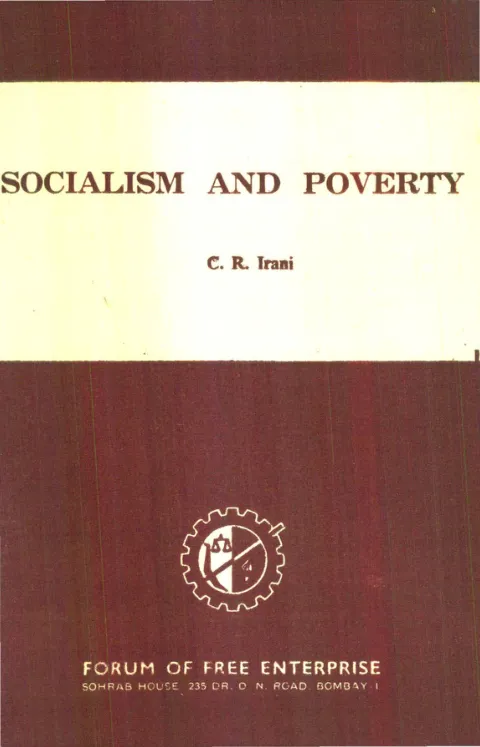
Socialism and Poverty
By C. R. Irani
Summary
Delivered as the A. D. Shroff Memorial Lecture at Calcutta on 27 October 1970 and published by the Forum of Free Enterprise in January 1971, C. R. Irani’s address traces the word ‘Socialism’ from its early-nineteenth-century origins to its uses in independent India. Irani walks the audience through the founding figures — Robert Owen, P. J. Proudhon, Ferdinand LaSalle, Louis Blanc, and the Fabians, particularly George Bernard Shaw — to argue that early Socialism was a moral protest against the abuses of the Industrial Revolution, never a finite economic doctrine. He treats Karl Marx’s intervention as a rupture rather than a continuation: Marx hardened a humanist protest into rigid dogma, despised the peasantry, and bequeathed prophecies that subsequent history has falsified. Irani leans heavily on Milovan Djilas’s account of the ‘New Class’ to argue that twentieth-century Communism produced not the withering of the State but its capture by a privileged bureaucratic minority.
The second half of the lecture turns to India. Irani contends that the country’s central problem is not distribution but production: dividing existing wealth would only spread poverty. He quotes Jawaharlal Nehru’s Kathmandu admission that ‘Socialism in a poor country only distributes poverty’ to argue that India’s official creed has been pursued in defiance of its author’s own caveat, with the result that ‘Socialism has become a dirty word’ and an Indian New Class has consolidated behind the licensing and controls regime. He then applies Gandhi’s talisman — recall the face of the poorest and helpless man — to a battery of empirical tests: per-capita income at constant prices, food-grain and milk availability, the cost of living, exports, employment, and the comparative distribution of national income against Norway, France and West Germany.
The statistics are uniformly indicting. Per-capita income at constant prices was lower in 1968/69 than in 1960/61; food-grain availability had fallen from 394 to 438 grammes per head (sic); the licence-permit raj had become, in the Central Vigilance Commissioner Subimal Dutt’s phrase, ‘a happy hunting ground for the corrupt and the dishonest’; exports were short of the Fourth Plan target by 11 per cent; the back-log of unemployment had grown across three Plan periods even as the Fourth Plan document quietly dropped any mention of the figure. Throughout, Irani’s polemical move is to insist that nationalisation, controls and Socialist rhetoric have neither produced wealth nor equalised it — they have instead empowered an unaccountable administrative class and stifled the productive capacity that alone can banish poverty. The rendered chunk closes mid-argument on unemployment statistics, with the lecture’s prescriptive conclusions still to come.
Key points
-
Frames Socialism historically as a nineteenth-century humanist reaction to the Industrial Revolution rather than as an economic system, citing Owen, Proudhon, LaSalle, Louis Blanc and the Fabians.
-
Treats Karl Marx as the figure who hardened a fluid set of principles into rigid dogma, and uses Professor Parkinson’s biographical critique to argue Marx lacked any practical experience of the world.
-
Relies on Milovan Djilas’s ‘New Class’ thesis to argue that Communism in practice produces a privileged bureaucratic minority rather than emancipation of workers or peasants.
-
Argues that India’s core problem is the production of wealth, not its distribution: dividing existing wealth among the population would only redistribute poverty.
-
Invokes Nehru’s Kathmandu admission that ‘Socialism in a poor country only distributes poverty’ to charge that Indian policy has ignored its own architect’s caveat.
-
Marshals data — per-capita income at constant prices falling between 1960/61 and 1968/69, declining milk and edible-oil consumption, modest food-grain and cotton-cloth gains — to indict twenty years of Socialist planning.
-
Identifies industrial licensing, the regulatory apparatus and ‘speed money’ (citing CVC Subimal Dutt) as the mechanism through which an Indian ‘New Class’ has entrenched itself.
-
Closes the rendered portion by pivoting to unemployment, noting that the back-log grew across the first three Plans and that the Fourth Plan document drops the figure entirely.
Generated by the v1.5 extraction pipeline. Awaiting editorial review.
Metadata and summary are AI-extracted from the source PDF and reviewed for editorial accuracy. The original work is available via the Read PDF tab above (where present); paragraph-level citation inside the PDF is deferred to a future engagement.