edited volume · anthology
Planning & Nationalisation
Rethinking in India & Abroad
By L. N. BIRLA, N. Das
FORUM OF FREE ENTERPRISE, "SOHRAB HOUSE", 235 DR. D. N. ROAD, BOMBAY-1 · Bombay
32 pages
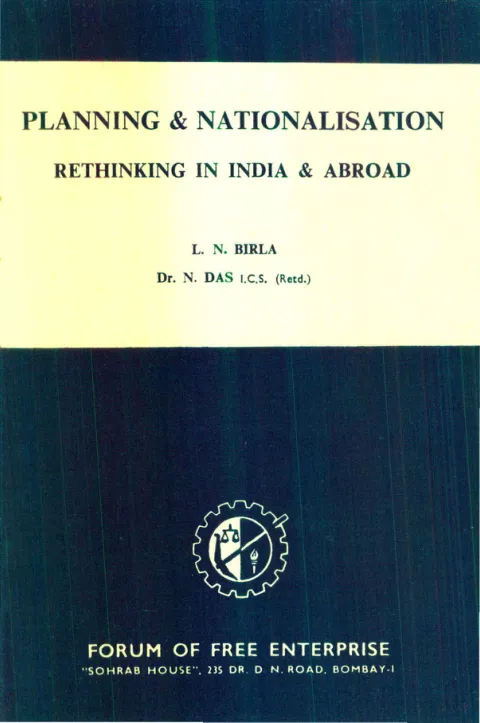
Planning & Nationalisation
By L. N. BIRLA, Dr. N. DAS I.C.S. (Retd.)
Summary
Published by the Forum of Free Enterprise in January 1967, this pamphlet collects three short addresses on Indian planning by L. N. Birla and Dr. Nabagopal Das (I.C.S. Retd.). The two Birla pieces — reproduced from the Indian Express (November 12, 1966) and Hindusthan Times (October 3, 1966) — indict the Fourth Plan as an exercise in ‘wishful’ aggregation that has consistently subordinated the Indian consumer to heavy-industry dogma, mounting taxation, and bureaucratic expenditure. Das’s contribution opens a comparative survey of how the doctrine of nationalisation and command planning is being rethought in socialist economies, beginning with the USSR’s struggle to reconcile state ownership with consumer demand.
Together the three essays form a coherent Forum of Free Enterprise argument: that India’s planning apparatus must shift from physical-output targets and public-sector expansion to consumer satisfaction, agricultural priority, and a freer role for private enterprise — a corrective the pamphlet draws both from Indian experience under three Plans and from doctrinal reappraisals visible inside the socialist bloc itself.
Key points
-
L. N. Birla’s ‘Consumer, Forgotten Factor in Indian Planning’ (Indian Express, 12 November 1966) argues fifteen years of planning have privileged producer-goods industries over daily consumer needs such as food, cloth and housing.
-
Birla reports that per-capita cloth availability fell from 15.8 metres before World War II to 14.4 metres in 1965, while over three-fourths of industrial investment went to producer goods.
-
He calls for a ‘new economic logic’ that drops prestige projects like Bokaro, lowers taxation that has crushed corporate savings, and judges the Plan by physical supply rather than financial targets.
-
In ‘An Alternative to Wishful Planning’ (Hindusthan Times, 3 October 1966), Birla shows Public Sector enterprises returned only 1.2 per cent on capital against an assumed 12 per cent and met 41 per cent of physical targets versus 71 per cent for the Private Sector.
-
He notes per-capita income fell from Rs 326 in 1960-61 to Rs 325 in 1965-66 despite a Rs 8,630-crore Third Plan outlay, and urges confining government to infrastructure while freeing agriculture from controls.
-
Birla contends the Public Sector is not an alternative to the Private Sector but a costlier rival that crowds out scarce investment funds through compulsory instruments and taxation.
-
Dr. Nabagopal Das opens his address by observing that nationalisation, once socialism’s linchpin, has lost much of its old appeal even within socialist economies.
-
Das begins a comparative survey of the USSR’s struggle to reconcile state ownership with consumer demand, suggesting India’s planning should absorb the same doctrinal reappraisal underway inside the socialist bloc.
Essays
Planning & Nationalisation — Consumer, Forgotten Factor in Indian Planning
By L. N. BIRLA
L. N. Birla argues that fifteen years of perspective planning have failed the Indian consumer because the Plans have privileged producer-goods industries and aggregate GNP arithmetic over the daily needs of the population — food, cloth, housing, milch cattle, education. He marshals statistics on declining per-capita cloth availability, sluggish foodgrain output, and a population spiral that medical progress has accelerated without compensatory family planning, and warns that more than three-fourths of industrial investment going to producer goods is ‘unrelated to the realities of living of the masses’.
The essay calls for a ‘new economic logic’ that drops prestige projects like Bokaro, lowers taxation that has crushed corporate savings, and judges the Plan by physical supply rather than financial targets. The consumer, Birla concludes, ‘is visibly on the war path’, and the violent unrest spreading across the country is the predictable price of austerity preaching unaccompanied by goods. The piece was first published in the Indian Express on November 12, 1966.
- Fifteen years of Indian planning have produced disappointing per-capita outcomes — cloth availability fell from 15.8 metres pre-WWII to 14.4 metres in 1965.
- Plans wrongly favour producer goods over consumer goods; over three-fourths of industrial investment is earmarked for producer goods.
- High taxation has dried up corporate savings (Rs. 112.5 crores in 1963-64) and contributed to inflation.
- Prestige projects like Bokaro should be set aside; the capital-output ratio will disappoint.
- The Soviet example shows even command economies are turning consumer-oriented, a corrective India should heed.
- Consumer-goods industries absorb more labour than capital-goods industries, easing the unemployment backlog of ten million.
An Alternative to Wishful Planning
By L. N. BIRLA
In this second essay, L. N. Birla turns to the Draft Fourth Plan and finds it a Rs. 23,750-crore exercise in ‘dreamstuff’ resting on four assumptions — agricultural production stepping up as envisaged, sufficient foreign aid, rising exports, and defence expenditure capped at Rs. 5,500 crores — that are all ‘beyond the control of the planners.’ He documents that the Third Plan overshot its outlay by Rs. 1,130 crores yet left consumption at distress levels, while Public Sector enterprises returned only 1.2 per cent on capital employed against the planners’ assumed 12 per cent and fulfilled only 41 per cent of their physical targets compared with 71 per cent for the Private Sector.
From this Birla mounts a structural attack on the assumed complementarity of public and private investment, calling Public Sector organisation ‘not an alternative to Private Sector organisation’ but a costlier rival that crowds out funds through compulsory instruments and disproportionate taxation. The remedy is to free the entrepreneur to invest in consumer industries, confine Government to infrastructure (power, roads), give agriculture the highest priority and free it from controls, and prefer quick-maturing projects to mystical hopes. The essay closes with the call that ‘our planning technique must avoid spinning words and spring to reasoned action — Preferably, action by the people.’ It was first published in the Hindusthan Times on October 3, 1966.
- Per-capita income fell from Rs. 326 (1960-61) to Rs. 325 (1965-66) at constant prices, despite a Rs. 8,630-crore Third Plan outlay.
- All four foundational assumptions of the Draft Fourth Plan lie outside the planners’ control.
- Public Sector industrial enterprises hit 41% of targets; Private Sector hit 71%; gross profit on Government capital was 1.2%.
- Public Sector is ‘not an alternative’ to Private Sector organisation but a higher-cost competitor for scarce funds.
- Bokaro illustrates the trap: Rs. 1,000-crore investment would require steel prices far above current market levels to break even.
- Government should retreat to infrastructure (power, roads); the entrepreneur must choose industry, location, and scale; agriculture deserves priority and freedom from controls.
Re-Thinking on Nationalisation and Centralised Planning in Socialist Countries
By Dr. Nabagopal Das, I.C.S. (Retd.)
Dr. Nabagopal Das opens his address by observing that nationalisation — once ‘the linchpin of socialism’ — has lost much of its old enchantment even in socialist countries. He sets out a working distinction between socialism and capitalism as simply public versus private ownership of the means of production, noting that an Anglo-Scandinavian model of private ownership with redistributive social services has expanded the meaning of socialism; nonetheless, following Marx, public ownership remains the doctrinal sine qua non of a fully socialist programme.
Das then sketches why nationalisation was thought indispensable: free competition would have channelled private investment to high-profit niches rather than to the harmonious development a poor country needs, and only state control of the means of production allows attention to turn to equal opportunity and income redistribution. He begins the comparative case with the USSR, where state ownership delivered command-economy planning but where the bureaucracy was forced to administer what the market does automatically — once scarcity eased, between 1959 and 1964 inventories of textiles and apparel nearly doubled while sales lagged, exposing the system’s indifference to consumer choice. (The argument continues past the rendered chunk.)
- Nationalisation, once the ‘linchpin’ of socialism, is being reconsidered even inside socialist states.
- Socialism and capitalism reduce to public vs. private ownership of the means of production; equal income distribution is desirable but not essential to socialism.
- For Marx, nationalisation was the indispensable pre-requisite of planning.
- Free competition would have steered private capital to quick-profit niches rather than balanced development, justifying state ownership in poor countries.
- USSR shows the limit: the command economy maximises physical output rather than consumer satisfaction, and once scarcity eased, unsold inventories ballooned.
Generated by the v1.5 extraction pipeline. Awaiting editorial review.
Metadata and summary are AI-extracted from the source PDF and reviewed for editorial accuracy. The original work is available via the Read PDF tab above (where present); paragraph-level citation inside the PDF is deferred to a future engagement.