
edited volume · anthology
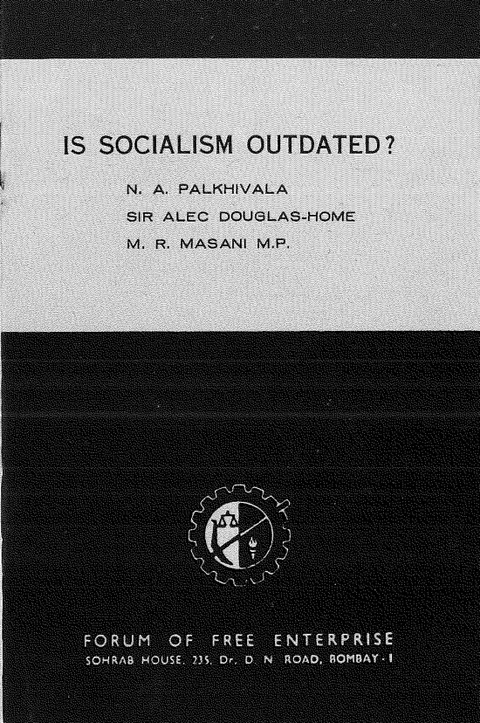
Is Socialism Outdated?
Published by M. R. PAI for the Forum of Free Enterprise. "Sohrab House", 235. Dr. Dadabhai Naoroji Road, Bombay-1, and printed by H. NARAYAN RAO at H. R. MOHAN & CO. (PRESS), 9-B, Cawasjee Patel Street. Bombay-1. · Bombay · 1966
15 pages
Summary
This March 1966 Forum of Free Enterprise booklet stitches together three short polemics that frame socialism as an exhausted creed and liberalism as its successor. N. A. Palkhivala’s ‘The Shells of Socialism’ (reproduced from the Economic Times of 7 February 1966) attacks Asoka Mehta’s Saugor University convocation address and the drift toward bank nationalisation; former British Prime Minister Sir Alec Douglas-Home’s ‘Why Socialism Always Fails’ (via INFA) argues that socialism collides with human nature and the profit motive; and Swatantra Party MP M. R. Masani’s ‘Will Liberalism Survive Socialism?’ (from Swarajya Annual 1966) parades Soviet shortages, Indian wage stagnation, and West German prosperity to argue that ‘isms have become wasms’ and that liberalism — not State-ism — is the quicker road to social justice. The three pieces share a common publisher, a common antagonist (Indian planning orthodoxy in the wake of Nehru’s death and the food crisis), and a common rhetorical posture: socialism is morally enervating, economically sterile, and globally in retreat.
Key points
-
The booklet gathers three 1966 polemics, by N. A. Palkhivala, former British Prime Minister Sir Alec Douglas-Home, and Swatantra Party MP M. R. Masani, arguing that socialism is an exhausted creed.
-
Palkhivala’s The Shells of Socialism, reprinted from the Economic Times of 7 February 1966, attacks Asoka Mehta’s Saugor University convocation address for signalling further bank nationalisation.
-
Palkhivala notes that the State Bank already held 25 per cent of paid-up capital and 32 per cent of deposits of all Indian scheduled banks, making further nationalisation redundant.
-
Palkhivala records Nehru’s 22 May 1964 reassurance against bank nationalisation and T. T. Krishnamachari’s reversal of that position on 5 June 1964 as evidence of Cabinet drift.
-
Palkhivala argues India’s food crisis calls for incentives to landholders rather than heavier taxation, and reclaims the Constitution’s language of justice and equality of opportunity against the empty label of socialism.
-
Sir Alec Douglas-Home’s Why Socialism Always Fails argues that state ownership denies the profit motive and reward for skill, so that production under socialism sinks to the pace of the slowest worker.
-
Douglas-Home observes that even Russia itself was shifting toward incentive, profit and reward under what he calls a bureaucratic form of state capitalism.
-
M. R. Masani’s Will Liberalism Survive Socialism reframes Mahatma Gandhi as a liberal who tested every policy by its effect on the poorest rather than as a socialist.
-
Masani contrasts Soviet housing, food and wage inequality with the rising living standards of West Germany, Japan, Britain, France and Scandinavia under free-market economies, concluding that all isms have become wasms.
Essays
The Shells of Socialism
By N. A. PALKHIVALA
Palkhivala uses Asoka Mehta’s convocation address at Saugor University as a launchpad for a broader assault on the central-planning consensus. He argues that Mehta’s hints at bank nationalisation jolted the capital market and unnerved investors at a time when Indian banking was already two-thirds public-sector and when the Indian National Congress lacked consensus on the question — citing Nehru’s May 1964 reassurance and T. T. Krishnamachari’s June 1964 reversal as evidence that ‘the Cabinet alone should speak as a body’. He contrasts Mehta’s preoccupation with curbing private monopoly against the country’s real crisis: a food emergency that demands incentives to landholders, not heavier imposts. The essay ends by reclaiming the language of the Constitution — ‘justice’, ‘equality of status and opportunity’ — and arguing that genuine socialism means levelling up through private enterprise, not the ‘rigid shells’ of state ownership.
- Frames Asoka Mehta’s Saugor convocation as a portentous and possibly unauthorised signalling of further nationalisation.
- Notes that the State Bank already accounts for 25 per cent of paid-up capital and 32 per cent of deposits of all Indian scheduled banks — making further nationalisation redundant.
- Records Nehru’s 22 May 1964 reassurance against bank nationalisation and T. T. Krishnamachari’s 5 June 1964 reversal as evidence of Cabinet drift.
- Argues that India’s food crisis requires incentives to landholders, not ceilings on irrigated holdings.
- Insists wealth must be created before it is distributed, and that the Constitution’s Preamble uses ‘justice’ and ‘equality of opportunity’ — not the ‘empty label’ of socialism.
Why Socialism Always Fails
By SIR ALEC DOUGLAS-HOME
Former British Prime Minister Sir Alec Douglas-Home offers a brisk first-principles argument that socialism fails because it presumes men are equal in capacity when nature has made them unequal. State ownership, he argues, denies the profit motive and reward-for-skill that drive the average man to excel, and so production sinks to the pace of the slowest. He surveys Russia, Britain, and the wider socialist world to claim that nationalisation has eroded efficiency, hardened inequality of a different sort, and forced Socialists into the same machinery of incentives, prices, and taxes that they once denounced. The piece closes with the conservative concession that one can only dismiss a creed by championing a better one — setting up the next essay’s defence of liberalism.
- Roots socialism’s failure in a clash with human nature: men are not equal and society moves at the pace of the slowest under collective ownership.
- Argues nationalisation kills the profit motive, widens the reward gap between skilled and unskilled, and produces mediocrity.
- Notes that even Russia is ‘changing to cater to incentive and profit and reward’ under the form of a bureaucratic state capitalism.
- Contrasts Socialism’s expansion of state ownership against Conservatism’s vision of the state serving — not dominating — the individual.
- Concedes that no creed can be discarded without a better alternative, framing the case for the liberal economy that follows.
Will Liberalism Survive Socialism?
By M. R. MASANI M.P.
Masani opens with an autobiographical confession that he was once an ardent socialist and author of Socialism Reconsidered, then locates his own liberal turn in the example of Mahatma Gandhi, whom he reads as an enemy of state violence and a tester of every policy by its effect on the poorest. He sets up two tests — the Lenin-Gandhi-Oxford definitions of socialism, all of which collapse around the requirement of state ownership — and runs them through the experience of the Soviet Union, Eastern Europe, India, and the Western free economies. Soviet life is shabby, agriculturally calamitous, and economically unequal; India’s ‘soviet-style’ planning since 1947 has produced stagnant wages, a withering middle class, and a ‘new class’ of commissars and protected businessmen; meanwhile West Germany, Japan, Britain, France, and Scandinavia have raised their living standards through free-market economies. Citing Hobhouse and Parkinson, Masani redefines liberalism as the politics of self-directing personality and ‘opportunity’, and closes with the slogan that ‘in our time all isms have become wasms’, invoking Carlos Romulo’s ‘I am going forward’ as the liberal’s reply to the left-right question.
- Reframes Gandhi as a liberal whose test of any system was its impact on ‘the poorest and the weakest’, not as a socialist.
- Argues that every classical definition of socialism — Lenin’s, the Oxford Dictionary’s, the British Labour Party’s — reduces to state ownership of the means of production.
- Uses Soviet housing, food, clothing, wage inequality (20:1 vs India’s 25:1), and the income tax + wealth tax exceeding 100 per cent to deny socialism’s promises of equality and prosperity.
- Identifies a ‘new class’ of commissars and protected Indian businessmen who replace the old exploiters under state patronage.
- Holds up West Germany under Erhard, Japan, France, Britain, the Scandinavian countries, the US, Australia, and New Zealand as evidence that free economies — not ‘Etatisme’ — lift wages and living standards fastest.
- Quotes Nehru in Kathmandu (1959) conceding that ‘Socialism in a poor country can only mean that it will remain permanently poor’, and uses it as an indictment of Indian planning.
- Concludes with the ‘isms have become wasms’ line and Carlos Romulo’s ‘I am going forward’ as the liberal’s directional reply.
Metadata and summary are AI-extracted from the source PDF and reviewed for editorial accuracy. The original work is available via the Read PDF tab above (where present); paragraph-level citation inside the PDF is deferred to a future engagement.
People in this work
Related across the archive
 ExcerptIs Socialism Outdated?
- ExcerptN. A. Palkhivala's Views on Socialism
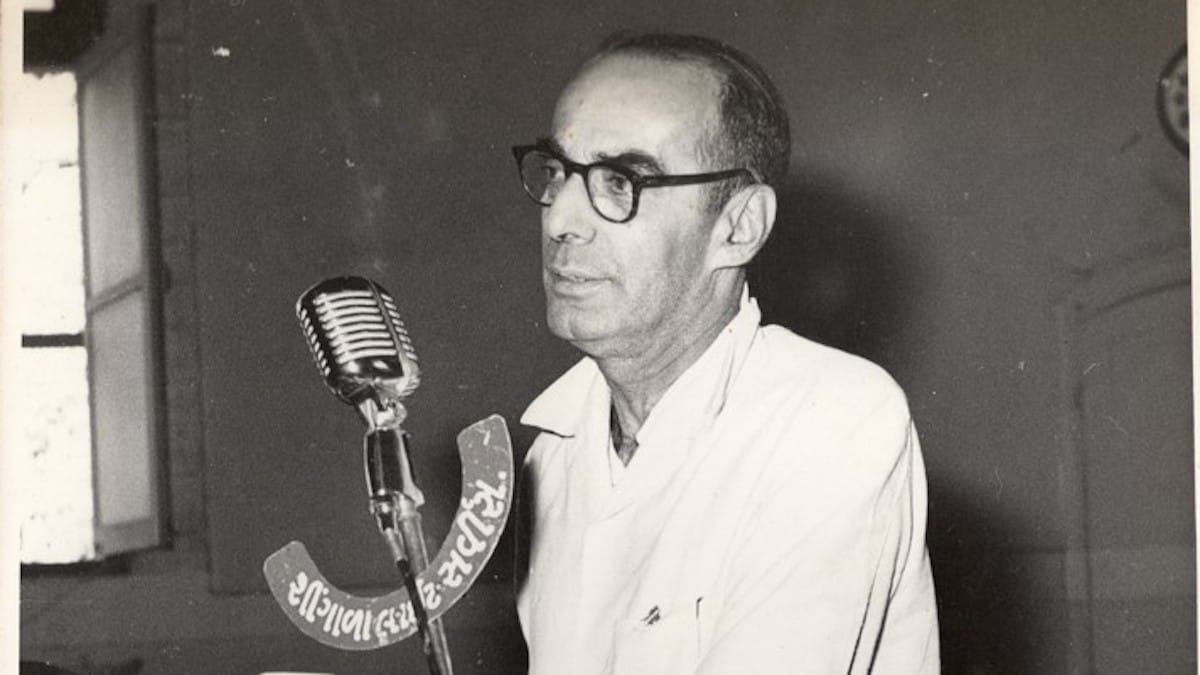 ThePrintLiberal methods reach social justice faster than socialism: Minoo Masani
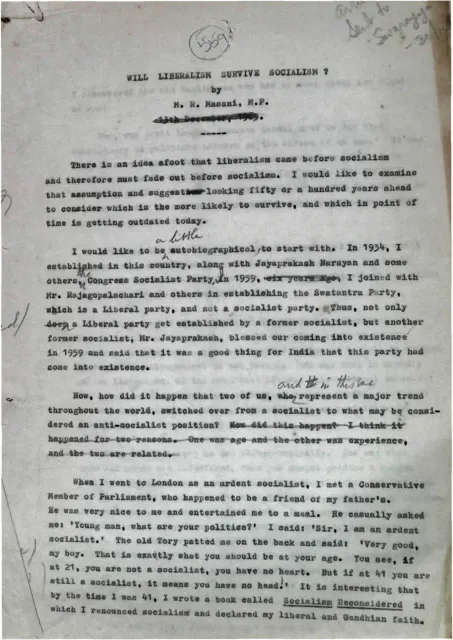 Primary workWILL LIBERALISM SURVIVE SOCIALISM ?
 ThePrintSocialism doesn’t deliver prosperity or produce equality. Does it give freedom? Of course not