edited volume · proceedings
For Freedom, Farm And Family
By MA Sreenivasan, C. Rajagopalachari
Published by M. R. Pai, for Forum of Free Enterprise, "Sohrab House", 235 Dr. Dadabhai Naoroji Road, Bombay 1, and printed by P. A. Raman at Inland Printers, Victoria Mills Building, 55, Gamdevi Road, Bombay 7. · Bombay · 1959
19 pages
Summary
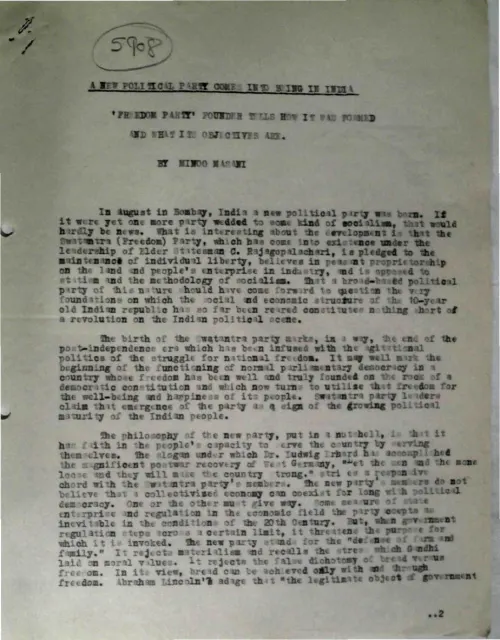
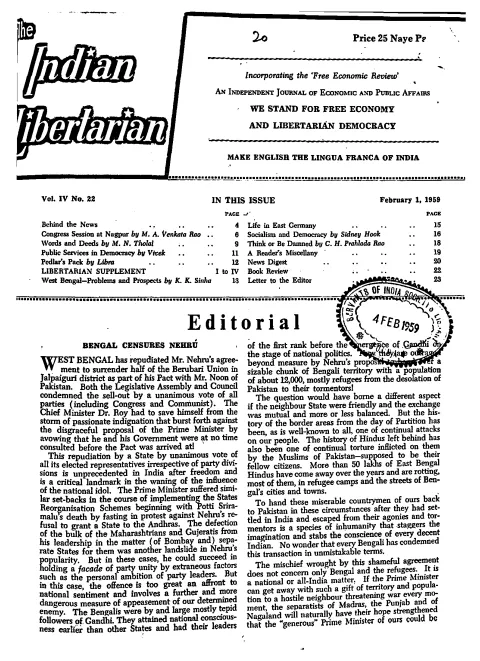
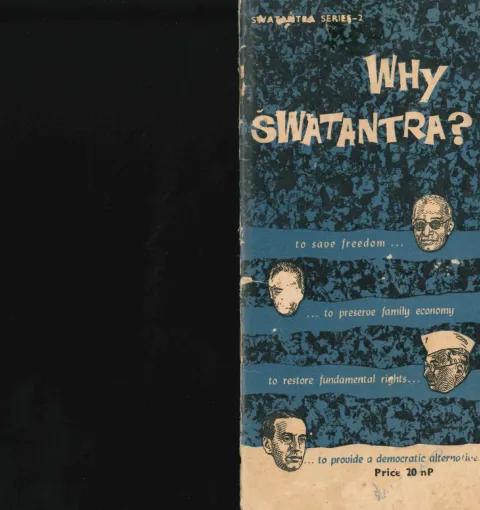
This Forum of Free Enterprise booklet collects three speeches from a meeting organised by the Forum’s Bangalore Centre on 29 May 1959 — a gathering that helped launch the political mobilisation which would crystallise as the Swatantra Party. The order is preserved: a welcome speech by M. A. Sreenivasan, chairman of the Bangalore Centre, titled “Coop and Kotow”; the main address “Nagpur and After” by M. R. Masani, M.P.; and the presidential speech “For Freedom, Farm and Family” by C. Rajagopalachari. The argumentative centre is a frontal attack on the Congress’s Nagpur Resolution of January 1959 on joint cooperative farming, read as the latest step in a drift toward state capitalism and “Communist dictatorship”. All three speakers call for a non-Socialist opposition — a “Middleclass Front” and “Small Man’s Party” — to defend peasant proprietorship, parliamentary democracy and free enterprise against what Rajaji names a “Totalitarian State”.
Key points
-
M. A. Sreenivasan’s welcome speech, ‘Coop and Kotow’, frames the Bangalore gathering as a stand by Rajaji and Minoo Masani against slums, dearer food, a falling rupee and unemployment eleven years after independence.
-
Sreenivasan casts the Congress’s Nagpur Resolution on joint farming as a ‘Violent Co-operation’ that threatens the very freedom won through Gandhian non-violent non-co-operation.
-
M. R. Masani’s address, ‘Nagpur and After’, argues the Nagpur Resolution and Nehru-government policy are pushing India toward Communist dictatorship by destroying peasant proprietorship and disenfranchising voters.
-
Masani cites Iron Curtain Eastern Europe, Hungary, Tibet and Polish reformers’ recantations to insist that State Capitalism and collective agriculture cannot coexist with parliamentary democracy.
-
He calls for a new ‘Middleclass Front’ and ‘Small Man’s Party’ rooted in peasant proprietors, professionals and teachers, quoting Ludwig Erhard’s slogan ‘Let the men and the money loose’.
-
C. Rajagopalachari’s presidential address, ‘For Freedom, Farm and Family’, blames citizens’ loss of independent thinking for the country’s drift and names ‘megalomania’ the disease of Indian planning.
-
Rajaji attacks the Nagpur Resolution’s joint farming and management proposals as destructive of the owner-cultivator’s incentive to produce food.
-
He warns against State Trading in foodgrains, quoting the Gujarati proverb that when the state takes to trade the people take to begging, and against taxation that closes one business to fund another.
-
All three speakers converge on building a non-Socialist opposition before the 1962 election to defend peasant proprietorship, parliamentary democracy and free enterprise against a ‘Totalitarian State’.
Essays
”Coop and Kotow”
By MA Sreenivasan
Sreenivasan’s welcome speech frames the Bangalore meeting as a stand by two “champions of freedom” — Rajaji and Minoo Masani — against the dimming of the “lamps of freedom” eleven years after Independence. He marshals the doubts of the common man into a series of rhetorical questions about persistent slums, dearer food and cloth, falling rupee value, unemployment, bureaucratic proliferation and an army of party men sitting in officialdom, asking whether the Nagpur Resolution’s “Violent Co-operation” will undo the freedom won by Gandhian non-violent non-co-operation. He closes with the hope that Rajaji’s “invisible telescope” and Masani’s inside knowledge will provide authentic answers to the questions troubling the country.
- Positions Rajaji and Masani as fearless champions of freedom willing to travel and speak only because the situation is grave.
- Catalogues popular grievances: slums, dearer food and cloth, falling rupee, unemployment, ten ministers and proliferating offices where one served before.
- Frames the Nagpur Resolution as a “Violent Co-operation” that threatens the freedom won by Gandhian Non-violent Non-co-operation.
- Mocks the “Socialistic Juggernaut of Avadi” for being driven without brakes or steering.
- Hands over to Rajaji and Masani as authoritative diagnosticians of the country’s confusion.
Nagpur and After
By M. R. Masani, M.P.
Masani’s main address takes up the diagnostic question Sreenivasan posed and answers it: the Nagpur Resolution and the broader Nehru-government policy are pushing India toward Communist dictatorship by destroying peasant proprietorship, concentrating power in a few hands, dismantling the law of supply and demand, and disenfranchising the voter through a near-monopoly Congress. He surveys trends — falling per capita income, rising prices, decline in agriculture, mortgaging of national credit — and warns that “State Capitalism” plus collective agriculture cannot coexist with parliamentary democracy. He cites the experience of Iron Curtain Eastern Europe, Hungary, Tibet, and the recantations of Polish reformers reading Adam Shaff, against Indian socialists’ belief in benign collectivisation. The constructive half of the speech argues that the Forum of Free Enterprise’s public-relations work is no longer enough: India needs a new political party — a broad-based “Middleclass Front” and “Small Man’s Party” trusting people, peasant proprietors and the price mechanism — to provide an effective alternative at the 1962 elections. Masani ends with Ludwig Erhard’s slogan “Let the men and the money loose” and a hope for a non-Socialist coalition led by Rajaji, with whom Jayaprakash Narayan and Prof. N. G. Ranga share the diagnosis.
- Reads the Nagpur Resolution as confirmation that Nehru-government policies are taking India toward Communist dictatorship.
- Lists the worsening trends — falling per capita income, killed incentives, concentration of power — that make collectivisation plausible.
- Insists State Capitalism and parliamentary democracy cannot coexist; cites Tibet, Hungary, Poland, Yugoslavia and Adam Shaff as evidence.
- Argues a non-Socialist opposition is essential because the last election left voters with no alternative pattern to vote for.
- Calls for a “Middleclass Front” and “Small Man’s Party” rooted in peasant proprietors, professionals, technicians and teachers — quoting Erhard’s “Let the men and the money loose”.
For Freedom, Farm and Family
By C. Rajagopalachari
Rajaji’s presidential address argues that the deepest cure for the country’s drift is the recovery of independent thinking by citizens who have grown indolent by leaving everything to Nehru. He identifies “megalomania” as the affliction of Indian planning and locates the single most urgent problem in food production, against which compulsory transfer of land from cultivating owners to multiple management — the Nagpur Resolution dressed up as “joint farming” or “co-operation” — will deepen the deficit by destroying the incentive of the owner-cultivator. He extends the warning to State Trading in foodgrains, citing the Gujarati proverb “when the State takes to trade, the people take to begging”, and to ever-heavier taxation that creates unemployment by closing one set of businesses to fill another. He ends with the famous formula that the time has come to protect the farm and the family against the inroads of a Totalitarian State, and to build — well before the 1962 election — an opposition first in the country and afterwards in Parliament.
- Diagnoses Indian citizens’ atrophy of independent thinking as the deepest cause of the drift, urging that everyone must think for themselves.
- Names “megalomania” the disease of planning and the deficit in food production the most urgent single problem.
- Attacks multiple ownership and multiple management of land — joint farming under the Nagpur Resolution — as the destruction of the cultivator’s incentive.
- Rejects State Trading in foodgrains and excessive taxation as forms of “unconscious socialism” that breed unemployment and dependency.
- Calls for an opposition built first in the country and then in Parliament to protect “the farm and the family” against the Totalitarian State.
Metadata and summary are AI-extracted from the source PDF and reviewed for editorial accuracy. The original work is available via the Read PDF tab above (where present); paragraph-level citation inside the PDF is deferred to a future engagement.