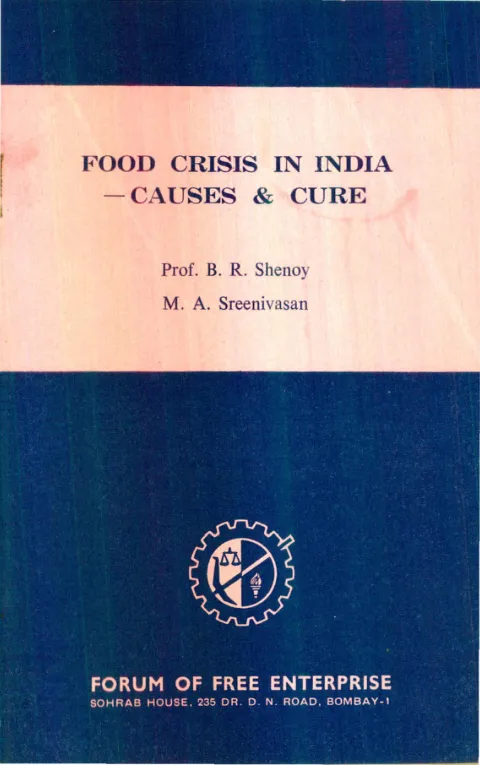
pamphlet
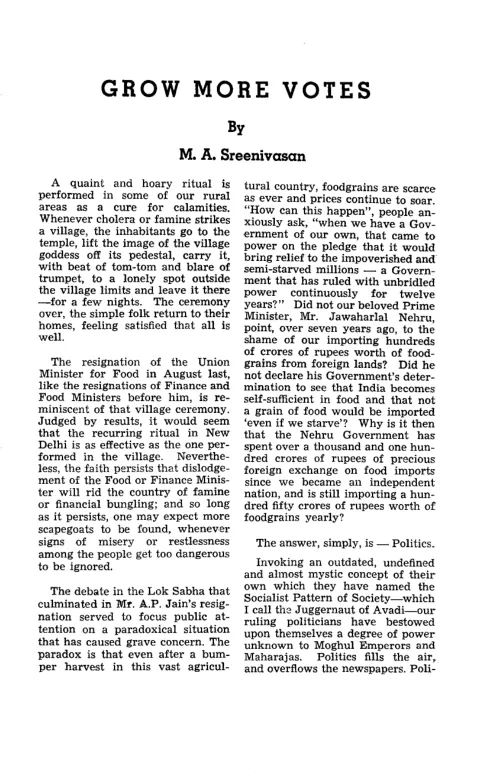
GROW MORE VOTES
Published by M. R. PAI for Forum of Free Enterprise, "Sohrab House", 235 Dr. Dadabhai Naoroji Road, Bombay 1, and printed by P. A. RAMAN at Inland Printers, 55 Gamdevi Road, Bombay 7. · Bombay · 1960
6 pages
GROW MORE VOTES
By MA Sreenivasan
Summary
“Grow More Votes” is a polemical Forum of Free Enterprise leaflet by M. A. Sreenivasan, dated 8 February 1960, that punningly turns the government’s “Grow More Food” campaign on its head. Triggered by Union Food Minister A. P. Jain’s resignation and the Lok Sabha debate that followed, Sreenivasan asks why an independent India of plenty of land and labour continues to import hundreds of crores of rupees worth of foodgrains every year. His single-word answer is “Politics” — agriculture, he argues, has been smothered by what he calls the “Juggernaut of Avadi,” the Socialist Pattern of Society, and by a ruling class of “political panjandrums” whose obsession with vote-catching slogans like “Land belongs to the People” and “Land to the Landless” has destroyed the security of land as property.
The leaflet defends private property in land by invoking the traditional Indian categories of sthira (permanent, immoveable property) and astha bhoga thejas swamyam (the owner’s right to enjoy his land as long as the sun and moon last), and laments that title to land is now “a scrap of paper that flutters about in each political breeze.” Sreenivasan attacks absentee landlordism by Congress politicians who own steel-works, sugar companies and chemical factories while their tenants quit cultivation, and warns that the Nagpur resolution on Joint Co-operative Farming — pushed despite the resignation of the Food Minister — masks compulsion as voluntarism.
Mobilising Anatole France’s aphorism about the thickness of a court-fee stamp, he claims the difference between “voluntary” and “compulsory” co-operation in India is now the thickness of “a Minister’s letter head — or a bureaucrat’s visiting card.” He frames the newly-launched Swatantra Party as the only serious political rival to a Congress that, since Gandhi’s death, has drifted toward what the Communist Party would have done in power, only “painless and performed under the chloroform of mass hypnosis.” The leaflet closes with a tart thanksgiving that the Prime Minister has acknowledged the “Senior Partner of the new Party” — God — and carries the standard Forum disclaimer that the views expressed are not necessarily those of the Forum of Free Enterprise.
Key points
-
Sreenivasan turns the government slogan “Grow More Food” into “Grow More Votes,” arguing that vote-seeking politics — not soil, climate or capital — is the binding constraint on Indian agriculture.
-
He blames the persistent foodgrain import bill of hundreds of crores of rupees on the “Juggernaut of Avadi” — the Socialist Pattern of Society adopted by the Congress — which he says concentrates power beyond that of Moghul Emperors and Maharajas.
-
He defends land as sthira (permanent property) and invokes the traditional formula astha bhoga thejas swamyam, contrasting it with the present condition in which title to land “flutters about in each political breeze.”
-
He attacks Congress politicians who hold shares in steel works, sugar companies, and chemical factories while functioning as absentee landlords, presiding over the fall of cultivated value and the flight of small owners.
-
He charges that Mr. S. K. Patil’s reformist voice is being “jammed” by his own party’s High Command after the Nagpur Joint Co-operative Farming resolution.
-
He uses Anatole France’s line about court-fee stamps to argue that in present-day India the line between voluntary and compulsory state action is “the thickness of a Minister’s letter head — or a bureaucrat’s visiting card.”
-
He treats the Swatantra Party as the first serious political rival to a Congress that, after Gandhi’s death, has drifted toward executing the Communist programme under mass hypnosis.
-
The leaflet is published by the Forum of Free Enterprise (235 Dr. Dadabhai Naoroji Road, Bombay) with M. R. Pai as publisher and the standard disclaimer that the views are not necessarily those of the Forum.
Generated by the v1.5 extraction pipeline. Awaiting editorial review.
Metadata and summary are AI-extracted from the source PDF and reviewed for editorial accuracy. The original work is available via the Read PDF tab above (where present); paragraph-level citation inside the PDF is deferred to a future engagement.