speech
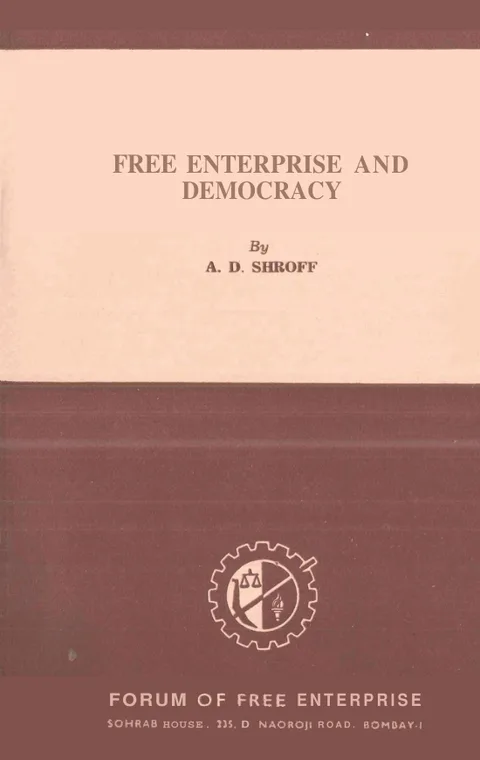
ECONOMICS OF FREEDOM
By Minoo Masani
FORUM OF FREE ENTERPRISE, 235, DR. DADABHAI NAOROJI ROAD, BOMBAY-1 · Bombay
9 pages
Summary
This pamphlet reproduces M. R. Masani’s address to the Rotary Club of Bombay, framed as a sustained argument against India’s drift toward what he calls ‘State Capitalism and State Landlordism’ on the Soviet–Chinese pattern. Masani opens by recalling a conversation with an influential ruling-party friend who shared his distaste for the Stalinist model yet still wished India to socialise large-scale industry and impose co-operative farming; the body of the talk explains why such a programme, however well-intentioned, must in his view extinguish political liberty.
The argument proceeds on three fronts. First, Masani sets out the consumer-sovereignty case for the market: only the discipline of the price system, supply and demand and the balance sheet allows the citizen to choose what to buy, where to work, and whether to strike — freedoms that vanish once the State is the sole employer and sole supplier. Second, he attacks the feasibility of democratic planning, arguing that no parliamentary majority can sensibly arbitrate the thousands of microeconomic choices a single national plan demands. Citing Aneurin Bevan, Harold Laski and R. H. S. Crossman, he insists that even British socialists concede the same logic — that ‘only power restrains power’, and that monopoly economic power in the State liquidates the autonomous social forces on which an Opposition depends.
Third, Masani enlists Indian witnesses: Gandhi’s fear of an expanded State that destroys individuality, Acharya Vinoba Bhave’s caution against centralising everything under the Welfare State, and Jayaprakash Narayan’s warning that the Welfare State ‘threatens as much to enslave man to the State as the totalitarian’. His positive prescription is the Mixed Economy he traces back to his 1946 Bombay Silver Jubilee lectures — Free Enterprise and State Enterprise functioning autonomously alongside each other, with peasant proprietorship and free trade unions intact — and he closes by warning that no constitution alone can save the Republic if the State swallows civil society.
Key points
-
Frames India’s choice as one between a Mixed Economy with peasant proprietorship and free enterprise on one side, and a Soviet/Stalinist-style monolithic totalitarian dictatorship on the other.
-
Uses the consumer-sovereignty argument: in a free economy, supply, demand and price make the consumer king, whereas a State monopoly leaves no exit for worker, peasant or consumer.
-
Argues that comprehensive central planning is incompatible with parliamentary democracy because a single national plan demands thousands of value-judgments no electorate can settle.
-
Invokes the principle that ‘only power restrains power’ and that autonomous social forces (industrial management, trade unions, peasant proprietors, religion) are the real assurance of liberty.
-
Cites British socialists Aneurin Bevan, R. H. S. Crossman and Harold Laski as conceding that the growth of central state bureaucracy under socialism threatens democracy and individual freedom.
-
Recruits Mahatma Gandhi, Acharya Vinoba Bhave and Jayaprakash Narayan as Indian moral authorities warning against the centralising drift of the Welfare State.
-
Defends the ‘Mixed Economy’ Masani had advocated since the 1946 Silver Jubilee Lectures of the Bombay School of Economics and Sociology — Free Enterprise and State Enterprise functioning autonomously side by side.
-
Closes with Gandhi’s dictum that an increase in the power of the State, however well-meaning, destroys the individuality that lies at the root of all progress.
Metadata and summary are AI-extracted from the source PDF and reviewed for editorial accuracy. The original work is available via the Read PDF tab above (where present); paragraph-level citation inside the PDF is deferred to a future engagement.