essay
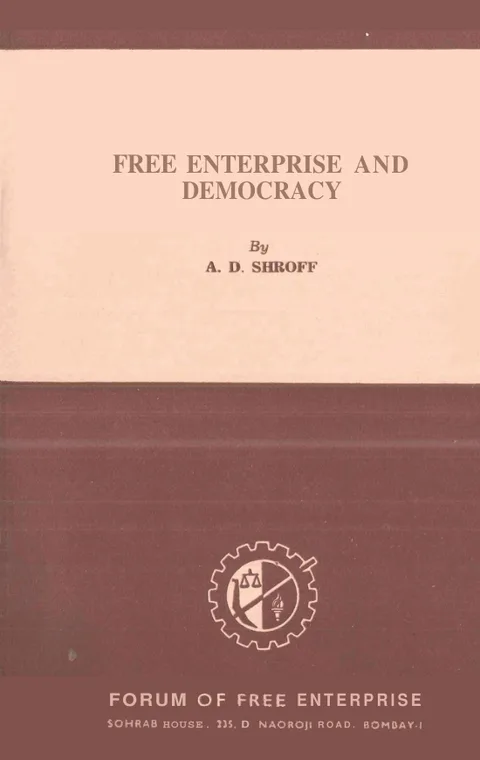
FREE ENTERPRISE AND DEMOCRACY
By A. D. Shroff
FORUM OF FREE ENTERPRISE, SOHRAB HOUSE, 235, D. NAOROJI ROAD, BOMBAY-1 · Bombay · 1956
9 pages
Summary
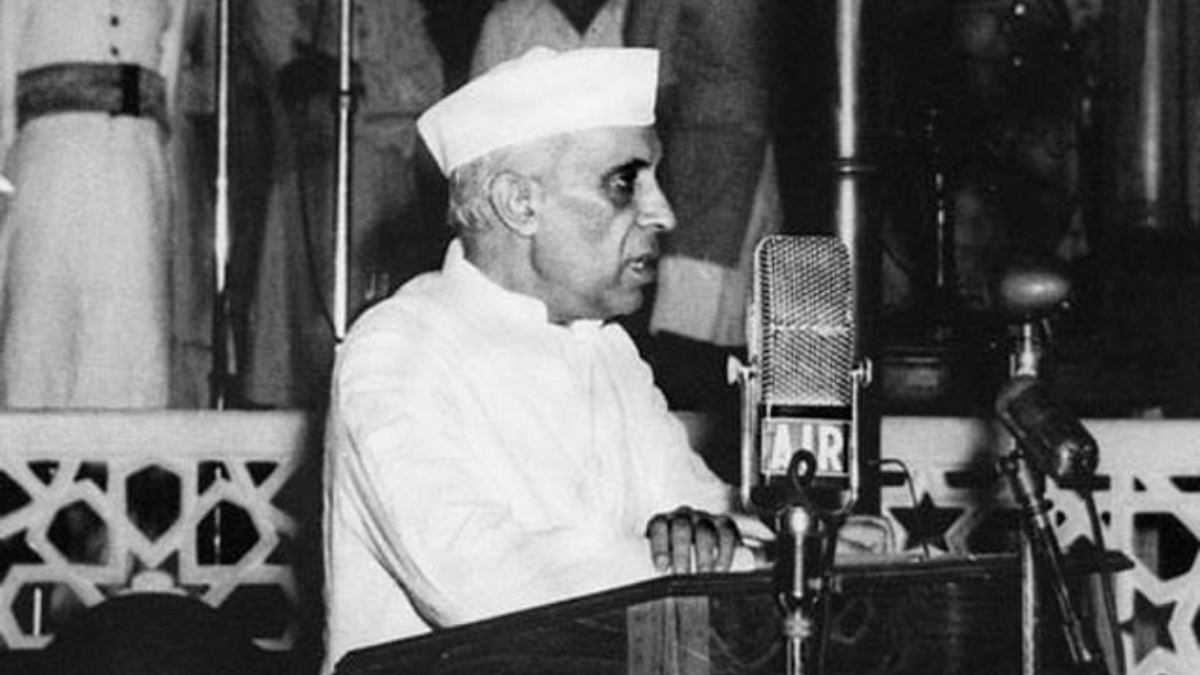
Published by the Forum of Free Enterprise in 1956 — and reproduced from the Annual Number of Commerce that same year — A. D. Shroff’s pamphlet is a direct rejoinder to Prime Minister Jawaharlal Nehru, who had recently told a Calcutta press conference that democracy and unrestricted private enterprise were incompatible. With the announcement of the ‘Socialist pattern of Society’ as the national goal, Shroff argues, the relationship between free enterprise and democracy has assumed great significance, and the country must decide whether the drift towards State Capitalism under the plea of a Welfare State threatens to ‘enslave man to the State as a totalitarian State’.
Shroff concedes that the doctrine of laissez faire is ‘dead as dodo’ and that the modern State legitimately regulates production, taxation, labour, and dividends. The real question is one of balance: a mixed economy in which a circumscribed free-enterprise sector and a State sector each play ‘an important and autonomous role’. He insists, against orthodox planners, that ‘there is nothing inherently socialistic in Planning’, and warns that once the State ‘begins to intrude in the field of private or free enterprise, it will soon develop into a monopolist wielding power of an enormous character’. Drawing on Gandhi’s warnings about the growing power of the State, Thomas Jefferson on the concentration of cares and powers, R. H. Tawney on the spirit behind planning, and R. H. S. Crossman on the menace of a ‘vast centralised State bureaucracy’, he reads recent events in Poland and Hungary as confirmation that nationalised industry breeds bureaucratic despotism and curtails democracy.
The positive case rests on an analogy: the free market is itself a daily plebiscite, in which producers, workers, consumers, investors, creditors, and employers check one another, and where ‘no single factor can ever hope to dominate a given situation for a long time’. Citing the Forum of Free Enterprise’s own Manifesto — ‘Monopoly of any kind, whether State or private, is undesirable’ — Shroff points to the Sindhri Fertiliser Factory, the Life Insurance Corporation, Indian Airlines, the State Trading Corporation, and the State Transport Corporation as semi-monopoly bodies that risk the very freedoms Indian democracy depends on. The joint-stock company, with its ‘about two and a half million’ investors and broad share-ownership in steel, cement, textiles, and electricity, he holds up as a genuinely co-operative and democratic alternative.
The pamphlet closes with a warning against the ‘schizophrenia’ of democratic socialists who accept freedom in theory and impose regimentation in practice. Free enterprise, Shroff concludes, must not be tolerated ‘on sufferance, to be tolerated on grounds of political expediency, with the sword of Democles hanging over it in perpetual threat’; the new India must derive its strength from ‘the solid foundations of democracy and freedom and not from the top-heavy buttresses of regimentation and concentration of power in a few hands’.
Key points
-
Framed as a direct response to Nehru’s Calcutta press-conference claim that democracy and unrestricted private enterprise are incompatible, and to the official ‘Socialist pattern of Society’ goal.
-
Concedes that laissez faire is obsolete and accepts a mixed economy in which a regulated State sector and an autonomous free-enterprise sector both play important roles.
-
Argues that planning is not inherently socialist; the real danger is the slide from planning into State Capitalism and a ‘vast centralised State bureaucracy’.
-
Marshals Gandhi, Thomas Jefferson, Tawney, and Crossman to show that concentration of economic power in the State destroys individual liberty and corrodes democracy.
-
Cites Poland and Hungary as recent evidence that public ownership leads to bureaucratic despotism and curtailment of democracy.
-
Reframes the free market as itself a democratic institution — a continuous plebiscite by producers, consumers, workers, and investors that checks monopoly.
-
Names concrete Indian state ventures (Sindhri Fertiliser Factory, Life Insurance Corporation, Indian Airlines, State Trading Corporation, State Transport Corporation) as semi-monopoly threats to economic and political freedom.
-
Closes with a plea that free enterprise be treated as indispensable to democracy, not tolerated on sufferance under a perpetual sword of Damocles of legislative and administrative restriction.
Notable passages
"Shroff argues, the relationship between free enterprise and democracy has assumed great significance, and the country must decide whether the drift towards State Capitalism under the plea of a Welfare State threatens to 'enslave man to the State as a totalitarian State'"
"once the State 'begins to intrude in the field of private or free enterprise, it will soon develop into a monopolist wielding power of an enormous character'"
"the free market is itself a daily plebiscite, in which producers, workers, consumers, investors, creditors, and employers check one another"
Metadata and summary are AI-extracted from the source PDF and reviewed for editorial accuracy. The original work is available via the Read PDF tab above (where present); paragraph-level citation inside the PDF is deferred to a future engagement.