
essay
A Formula for Increasing Agricultural Production
Published by M. R. PAI for Forum of Free Enterprise, "Sohrab House", 235, Dr. Dadabhai Naoroji Road, Bombay 1 · Bombay · 1964
4 pages
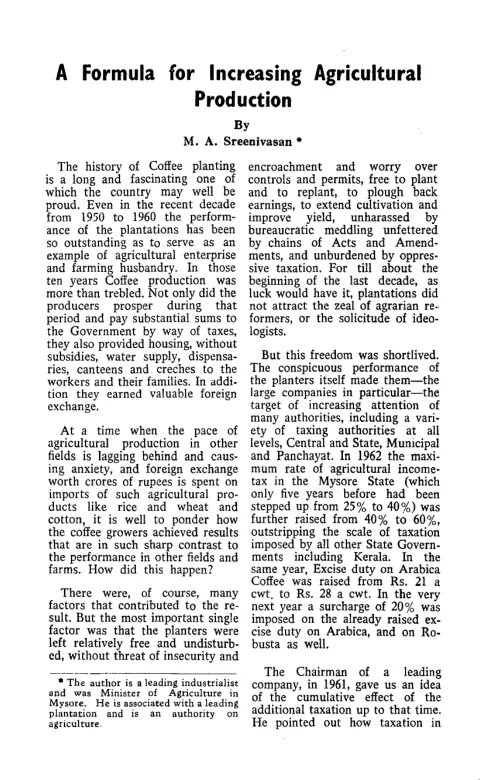
Summary
In this four-page FFE leaflet dated 8 March 1964, M. A. Sreenivasan — a former Minister of Agriculture in Mysore and a plantation-sector authority — argues that India’s coffee industry achieved its remarkable production gains in the decade 1950–1960 precisely because it was left relatively free from bureaucratic interference. Coffee output more than tripled over those ten years, earning the country substantial foreign exchange, and the plantation companies paid significant taxes while providing housing, water, canteens, and crèches to their workers and families. Sreenivasan attributes this success to the freedom planters enjoyed to manage their own estates without the encroachments that hamper other agricultural sectors.
The bulk of the essay is a detailed indictment of the legislative and fiscal assault that cut short this freedom from around 1962 onward. Sreenivasan catalogs the layered taxes — a Mysore agricultural income-tax raised from 25% to 40% then to 60%, Kerala excise duties on Arabica coffee, a 20% surcharge, fresh duties on Robusta — plus two new Acts (the Mysore Agricultural Income-Tax Amendment Act and the Mysore Forest Bill) and a mandatory fidelity-guarantee insurance scheme administered exclusively through the government-owned Life Insurance Corporation at a premium of Rs. 1,250 per year. He shows that by 1963 taxation consumed over 57% of a bumper crop and that the slab system falls most heavily on large companies, incentivising subdivision and fragmentation of plantations. He also attacks a Company Law amendment that bars deduction of directors’ remuneration as a legitimate business expense. Together, he argues, these measures have reversed the production incentive: output is falling, not growing.
Sreenivasan closes with a plea to the Planters’ Associations and the U.P.A.S.I. to press for a legislative reversal, and asserts that if the industry is granted another decade of the relative freedom it enjoyed in the 1950s it can reach still higher production peaks and earn more foreign exchange. The essay is squarely in the FFE mould of policy advocacy: free the producer, reduce taxation, remove bureaucratic controls, and output will follow.
Key points
-
Coffee production in Mysore more than tripled between 1950 and 1960 under conditions of relative economic freedom, earning valuable foreign exchange and vindicating a market-friendly model.
-
From 1962 onward a cascade of taxation — Mysore agricultural income-tax raised in steps to 60%, excise duties on Arabica and Robusta, and a 20% surcharge — consumed over 57% of a bumper crop by 1963.
-
The slab-rate system penalises large plantation companies disproportionately, incentivising subdivision of holdings: the number of holdings of 250 acres and above fell from 227 to 157 over seven years while sub-10-acre holdings rose to 38,000.
-
New legislation (Mysore Agricultural Income-Tax Amendment Act, Mysore Forest Bill) and a mandatory LIC fidelity-guarantee insurance scheme at Rs. 1,250 per year added further non-tax burdens.
-
A Company Law amendment that disallows directors’ remuneration as a deductible expense is singled out as an especially counterproductive measure.
-
Sreenivasan argues that paddy cannot be produced by legislation nor coffee grown by exhortation or export drives — only boom or near-boom conditions for the grower will raise output.
-
The essay calls on the Planters’ Associations and U.P.A.S.I. to lobby for a reversal of recent deals and a restoration of the freedom the industry enjoyed in the previous decade.
Metadata and summary are AI-extracted from the source PDF and reviewed for editorial accuracy. The original work is available via the Read PDF tab above (where present); paragraph-level citation inside the PDF is deferred to a future engagement.
People in this work
Related across the archive
 Primary workSuccess in Agriculture Through Free Enterprise
 Primary workMr. M. R. Masani's remarks while inaugurating the 86th Annual General Meeting of the United Planters Association of Southern India in Coonoor on September 4, 1979.
 Primary workFOOD CRISIS IN INDIA — CAUSES & CURE
 ExcerptLaying The Foundations For An Economic Miracle
 ExcerptEconomic Reforms In India: Where Are We And Where Do We Go?