pamphlet
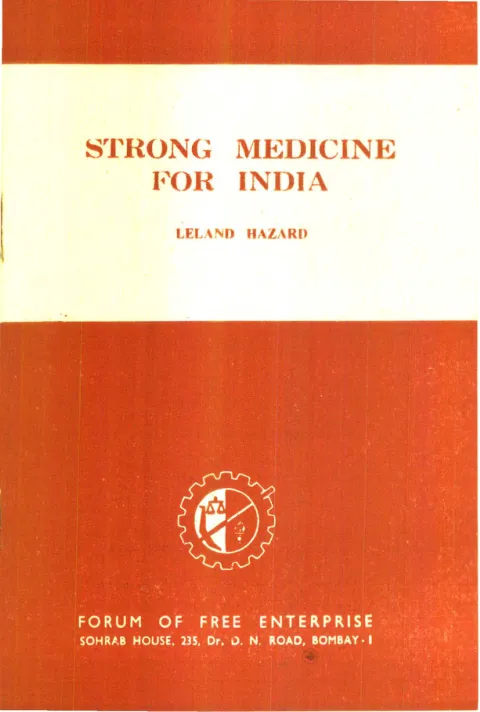
STRONG MEDICINE FOR INDIA
Published by M. R. Pai for the Forum of Free Enterprise, 235, Dadabhai Naoroji Road, Bombay 1, and Printed by Michael Andrades at the Bombay Chronicle Press, Horniman Circle, Bombay-1. · Bombay · 1966
20 pages
STRONG MEDICINE FOR INDIA
By LELAND HAZARD
Summary
Leland Hazard’s pamphlet, first published in the December 1965 Atlantic Monthly and reissued by the Forum of Free Enterprise in July 1966, is a Cold-War-era polemic that prescribes “strong medicine” for a country he depicts as militarily lifted by the Pakistan crisis but still hobbled by chronic economic and administrative diseases. Writing as a frequent visitor to India and a former industrialist-academic, Hazard urges the Western donor world to attach conditions to its aid: India must first put its own house in order before more grants, loans, and technical assistance keep flowing. He frames the failed Five-Year Plans, the swollen Delhi bureaucracy, and the cult of state ownership as obstacles that decades of well-meaning but unconditional foreign aid have allowed to harden.
The core argument is a critique of Nehruvian planning and what Hazard, citing John Kenneth Galbraith, calls “post office socialism.” He insists on decontrol of prices and competition, reform of the tax base, simplification of administration, and the replacement of seniority-bound generalist bureaucrats by technicians promoted on merit. He argues that the Ford and Rockefeller Foundations’ agricultural Package Programmes show what scientific, results-driven aid can do, but that they reach only a small fraction of India’s farmers; food, fertilizers, family planning, and basic industry must be scaled up together, and Western donors should stop being “abashed, as if they were the Greeks bearing gifts” about insisting on administrative reform as the price of continued help.
Hazard closes with two unconventional “nominations” for India’s national morale: a nationwide commercial and educational television system that could leapfrog illiteracy and the country’s fourteen-language divisions, and an indigenous nuclear-weapons programme, which he argues the West has no right to forbid and which would restore Indian self-respect after the deaths of Gandhi and Nehru. The booklet ends on an explicitly anti-Communist, pro-Western framing: India is anti-Communist and anti-Chinese, the freedom it cherishes lies in the West, and the affluent world cannot, in its own interest, look away from Indian misery.
Key points
-
Hazard argues that Western aid should be conditional on India first reforming her economic controls, tax base, and civil-service practices, rather than being delivered unconditionally as it has been for over a decade.
-
He attacks Nehru’s “socialistic pattern” and state-owned enterprises run without a profit motive, quoting John Kenneth Galbraith’s label “post office socialism” for the resulting non-profit delusion.
-
He treats the Five-Year Plans as visible failures — two already missed by large margins, the third “in process of failing” — and rejects the consensus that everything must move in “equally delicate balance.”
-
Agricultural transformation is presented as India’s unfinished revolution: fertilizers, hybrid seeds, irrigation, credit, and Ford Foundation Package Programmes are praised but cover only 2% of farmers, and population growth and birth control are framed as crucial constraints.
-
Hazard celebrates the machine-tool industry and the privately managed Air India as islands of “modern excellence” that disprove any cultural argument against Indian managerial competence.
-
His two morale-building “nominations” are a national private-plus-governmental television system (which he claims could skip the word and bridge fourteen major languages) and an indigenous Indian nuclear weapon, which he says the nuclear powers have no moral right to forbid.
-
He places India explicitly in the Western camp — anti-Communist, anti-Chinese, dependent on America for military protection since the 1962 Chinese strike — and treats Cold War alignment as the precondition for further aid.
-
The pamphlet’s polemical frame is medical: India is the patient, her old elite of “bespectacled intellectuals” is the failed treatment, and the West, paying the medical bills, has both the right and the duty to prescribe the cure.
Generated by the v1.5 extraction pipeline. Awaiting editorial review.
Metadata and summary are AI-extracted from the source PDF and reviewed for editorial accuracy. The original work is available via the Read PDF tab above (where present); paragraph-level citation inside the PDF is deferred to a future engagement.