speech
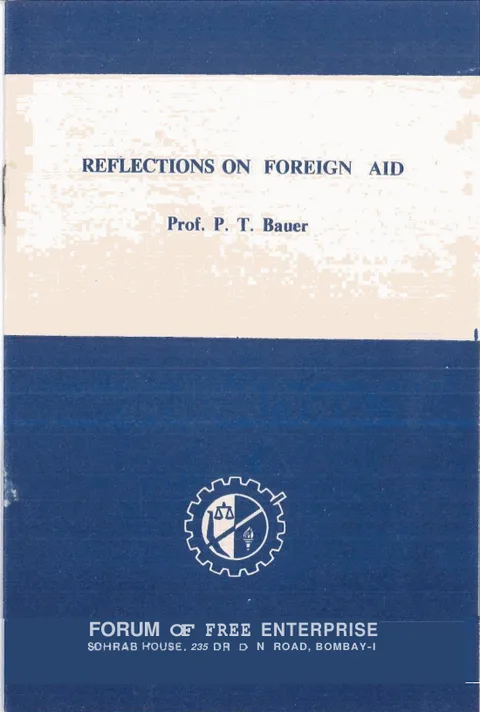
REFLECTIONS ON FOREIGN AID
Published by M. R. PAI for the Forum of Free Enterprise, 'Sohrab House', 235 Dr. Dadabhai Naoroji Road, Bombay-1, and printed by Michael Andrades at Bombay Chronicle Press, Syed Abdullah Brelvi Road, Fort, Bombay-1. · Bombay · 1970
11 pages
REFLECTIONS ON FOREIGN AID
By Prof. P. T. Bauer
Summary
Prof. P. T. Bauer’s lecture, delivered at the Forum of Free Enterprise in Bombay on 3 February 1970 and published as a Forum booklet in July 1970, mounts a frontal attack on the prevailing development-economics consensus that inter-governmental grants and subsidised loans are indispensable for the progress of poor countries. Bauer treats this consensus as an unexamined axiom and dismantles it on empirical and analytical grounds: all developed countries themselves rose out of poverty without foreign aid, many under-developed countries advanced rapidly between 1880 and 1960 without external transfers, and India, after fifteen years of large-scale aid, ended the 1960s more dependent on foreign food and foreign exchange than before. If a population is not interested in material advance — Bauer uses the Navajo case alongside other examples — neither aid nor anything else can produce development.
Most of the booklet inventories the active harms Bauer attributes to aid. Aid augments the resources of recipient governments and so ‘increases the weight of the Government in the society and economy and thereby promotes a concentration of power’; it biases development toward inappropriate Western prototypes (universities, civil-service forms, large-scale state industry); it underwrites comprehensive central planning that retards rather than promotes adjustment; it discourages domestic savings and chokes off private capital, which is usually more productive than subsidised public capital; and through ‘sheltered markets’ it operates as a covert transfer from Western taxpayers to Western exporters rather than to the world’s poor.
Bauer then takes apart the four standard justifications for aid. The argument from need leads to absurdity, since by that logic the most productive groups (Asians in East Africa, Indians in Burma) should be expelled to qualify their countries for further aid. The argument from moral duty fails because charity compulsorily extracted by the tax collector — ‘If I do not pay the income-tax, I go to jail’ — is not a moral act at all. The Cold-War argument that aid keeps poor countries out of the Communist bloc collapses on inspection: aid actually promotes centralised, closely controlled economies congenial to Communist sympathies, and the indiscriminate transfer of taxpayers’ money breeds suspicion rather than gratitude. And the restitution argument — that Western wealth was extracted from the under-developed world — fails the historical test, as illustrated by the Tashkent Conference of 1966, when Pakistan and India turned to the Soviet Premier rather than the United States despite a decade of substantial American aid. Bauer closes by acknowledging that his views are unpopular but insisting that the validity of an argument has nothing to do with its political popularity.
Key points
-
Foreign aid is the orthodoxy that Bauer treats as an unexamined axiom of contemporary development literature; his lecture exists to argue that the axiom is wrong.
-
Aid is neither necessary nor sufficient for development: developed countries grew without it, many poor countries grew rapidly without it, and India’s fifteen years of large-scale aid since the mid-1950s left it more dependent, not less.
-
Aid concentrates economic and political power in the recipient government, biases policy toward Western institutional prototypes, and underwrites comprehensive central planning that itself retards adjustment.
-
Aid discourages domestic savings and private capital inflow; private capital, even when more expensive, is usually more productive than subsidised public capital, and Indian Railways and Calcutta Tramways are cited as historical counter-examples of infra-structure built by private investment.
-
Much aid is in practice a subsidy from Western taxpayers to Western exporters via sheltered markets, not a transfer to the world’s poor.
-
The need-based case for aid leads to absurd implications, since the most productive groups (Asians in East Africa, Indians in Burma) earn above-average incomes and would have to be expelled to lower national averages and qualify for more aid.
-
Aid as a moral duty fails because tax-financed aid is compulsory, not voluntary, and so lacks the moral character of private charity; aid as Cold-War political strategy is counter-productive because it strengthens the centralised state and breeds suspicion of Western motives.
-
The restitution argument that Western prosperity was extracted from the under-developed world is rejected empirically; the Tashkent mediation of 1966 illustrates that aid does not even buy diplomatic alignment.
Generated by the v1.5 extraction pipeline. Awaiting editorial review.
Metadata and summary are AI-extracted from the source PDF and reviewed for editorial accuracy. The original work is available via the Read PDF tab above (where present); paragraph-level citation inside the PDF is deferred to a future engagement.