Summary
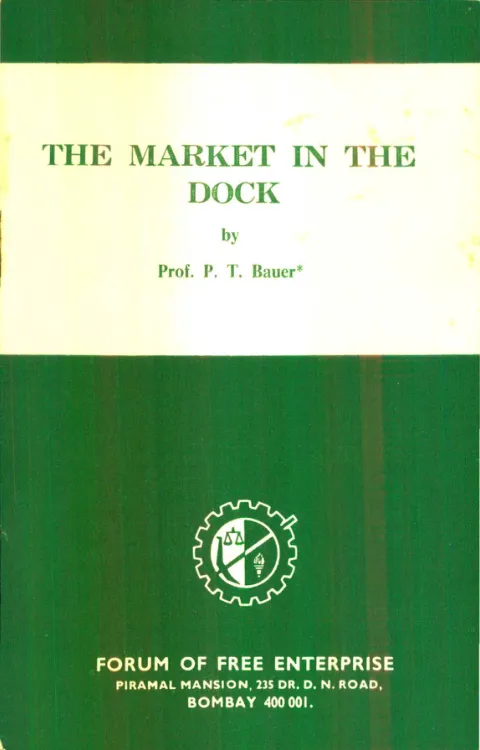
The Market in the Dock is the text of a December 19, 1979 lecture by Cambridge-trained development economist P. T. Bauer, then Professor of Economics at the London School of Economics, delivered in Bombay under the auspices of the Forum of Free Enterprise and published as a pamphlet in January 1981. A foreword by Minoo H. Mody, who presided over the lecture, frames Bauer’s central provocation: the market economy stands accused not because it has failed but because in much of the Third World it has never been tried. Mody links Bauer’s argument to a broader critique of the welfare state, which he calls “the most tragic mistake of the twentieth century”, and to the perplexity of governments who cannot reconcile demands for tax cuts with the bloated apparatus of subsidised state activity.
Bauer’s lecture itself opens by distinguishing predominantly market, centrally planned, and custom-dominated economies, and reminds readers that during the hundred years before the Second World War large parts of Asia, Africa and Latin America made substantial economic progress under market arrangements — well before any organised central planning. He then catalogues the limitations of markets honestly (they cannot guarantee happiness or universal prosperity) before turning the indictment outward: critics, he argues, treat the market’s inherent limits as defects while ignoring that planning does not create resources, only concentrates power, politicises economic life, obstructs the movement of resources to their best uses, and reinforces traditions of authority that already suppress individual self-reliance in the Third World.
The bulk of the lecture is an anatomy of where Third World hostility to the market originates: Western and Westernised academics, urban politicians and civil servants who staff opinion-making channels; the authoritarian inheritances of colonial administration; Marxist-Leninist ideology — particularly the doctrine of imperialism — which offers intellectuals both a totalising creed and a path to power; the official international organisations (the UN Secretariat, FAO, UNCTAD, ILO, UNIDO, UNDP, the World Bank, ECAFE, ECA and ECLA) which Bauer charges with propagating myths that international trade damages poor countries; the colonial-era state export monopolies in cocoa, rice, coffee, cotton and oilseeds that successor governments in Ghana, Burma and British Africa inherited, expanded, and used as power bases; and the structural bias of foreign aid, which by definition strengthens the state at the expense of the private sector. He punctures the romantic image of the subsistence economy by noting that famines and the worst epidemic diseases occur there, not in market economies, and closes the rendered pages by observing that both stagnation and rapid market-led advance are used as evidence against the market — “it is always in the dock, more often than not on palpably unfounded charges.”
Key points
-
Bauer’s central thesis, reinforced by Mody’s foreword, is that the market economy is in the dock not because it has failed but because in much of the Third World it has never seriously been tried.
-
Decentralised market prices and incomes coordinate production, consumption and investment voluntarily, whereas centrally planned and socialist economies substitute governmental for individual decisions.
-
Large parts of South-East Asia, West Africa and Latin America made substantial material progress under market arrangements between the late nineteenth century and the Second World War, refuting Gunnar Myrdal’s claim that central planning is indispensable for development.
-
Central planning, Bauer argues, does not augment resources but only concentrates power, politicises life, obstructs the movement of resources, and reinforces pre-existing authoritarian traditions.
-
Hostility to the market in the Third World is generated by Western and Westernised intellectuals, by Marxist-Leninist ideology rooted in Lenin’s Imperialism: The Highest Stage of Capitalism, and by the doctrine that prosperity in the West has been won at the colonies’ expense.
-
UN agencies (FAO, UNCTAD, ILO, UNIDO, UNDP, World Bank, ECAFE, ECA, ECLA) propagate the view that international trade damages the Third World and that state planning is necessary — and they staff and fund the planning commissions that replace the market.
-
Colonial-era state export monopolies in cocoa, rice, coffee, cotton and oilseeds — paying producers far less than world prices — were maintained and extended by independent governments and became durable bases of state power in Ghana, Burma and British Africa.
-
Foreign aid is structurally biased against the market because it flows to governments, strengthens the state sector, and rewards economies with severe payments problems or state-controlled regimes; subsistence economies, contrary to romantic portrayals, are where famines and the worst diseases occur.
Metadata and summary are AI-extracted from the source PDF and reviewed for editorial accuracy. The original work is available via the Read PDF tab above (where present); paragraph-level citation inside the PDF is deferred to a future engagement.