speech
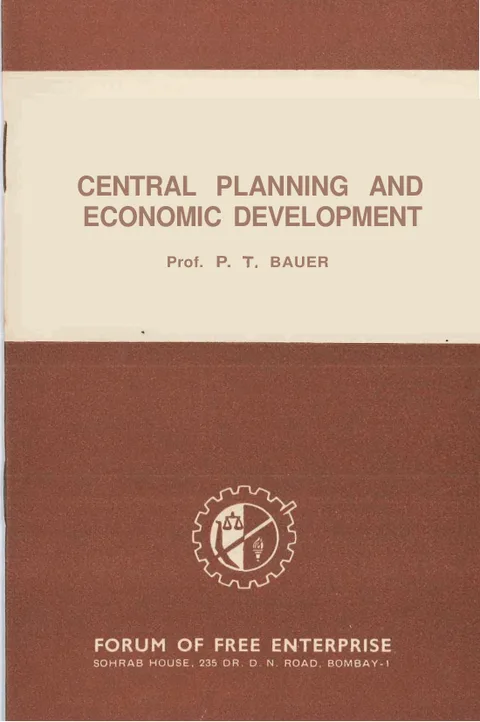
CENTRAL PLANNING AND ECONOMIC DEVELOPMENT
By Peter Bauer
Published by M. R. PAI for the Forum of Free Enterprise, "Sohrab House", 235 Dr. Dadabhai Naoroji Road, Bombay-1. and printed by H. NARAYAN RAO at H. R. MOHAN & CO. (PRESS), 9-B, Cawasjee Patel Street, Bombay-1. · Bombay · 1970
13 pages
Summary
Delivered on 2 February 1970 as the first Murarji J. Vaidya Memorial Lecture in Bombay and published by the Forum of Free Enterprise on 12 August 1970, this lecture by Peter Bauer of the London School of Economics is a frontal attack on the axiom — then dominant in development economics — that Comprehensive Central Planning, understood as state control of the composition of economic activity, is indispensable for the development of poor countries. Bauer takes Gunnar Myrdal as his principal target and treats the unanimity of governments, economists and aid agencies around this doctrine as itself the problem rather than evidence of its correctness, ranging Milton Friedman alongside himself as a dissenter and pointing to Japan, Hong Kong, Malaysia, Thailand and parts of West Africa as cases of substantial material progress achieved without comprehensive planning.
The constructive core of the lecture argues that comprehensive planning does not augment resources but centralises and actually creates power, replacing the decentralised decisions of consumers and producers with the choices of civil servants and politicians. Bauer raises three preliminary objections — that planning need not raise investment, that material progress is not the only end worth pursuing, and that people’s faculties and attitudes (not natural resources) drive development — before arguing that planning reinforces authoritarian traditions in underdeveloped societies, suppresses self-reliance, sharpens political tension by making the state the prize for all groups, and is empirically associated nowhere with rising general living standards.
In the closing pages Bauer narrows the legitimate tasks of government in poor countries to external relations, law and order, an honest monetary and fiscal framework, basic education and health, mass communications and agricultural extension — a list which, he insists, would already stretch the resources of the governments concerned. His indictment is that, in countries from Indonesia to Burma, regimes obsessed with planning the economy neglect even these elementary functions: ‘The Governments seem anxious to plan and they are unable to govern,’ more interested in controlling people’s lives than in augmenting their resources or liberating their minds.
Key points
-
Frames the lecture as an examination — and rejection — of the axiom that Comprehensive Central Planning is indispensable for the economic development of poor countries.
-
Identifies Gunnar Myrdal (Asian Drama; Development and Underdevelopment) as the most influential exponent of the planning-as-necessity thesis and names Milton Friedman as a dissenter.
-
Argues that comprehensive planning does not augment resources but centralises and creates power, transferring choice from consumers and producers to civil servants and politicians.
-
Cites Japan, Hong Kong, Malaysia, Thailand and parts of West Africa as instances of substantial 19th- and 20th-century material progress without comprehensive planning.
-
Insists that the determinants of material advance are people’s faculties, attitudes, beliefs and institutions — not natural resources or capital injections — and that planning reinforces an authoritarian tradition that suppresses self-reliance, experimentation and the desire for change.
-
Holds that planning intensifies political tension because state power becomes the prize for which all groups must compete, with especially destabilising effects in multi-racial societies.
-
Claims empirically that the adoption of comprehensive planning has nowhere raised general living standards, and that Soviet-type economies retain frontier controls precisely because of widespread material and non-material disillusionment.
-
Defines a limited but demanding set of legitimate government tasks — external affairs, law and order, sound money and fiscal policy, basic institutional framework, basic health and education, mass communications, agricultural extension and national defence — and accuses planning regimes of neglecting these in order to control private life.
Metadata and summary are AI-extracted from the source PDF and reviewed for editorial accuracy. The original work is available via the Read PDF tab above (where present); paragraph-level citation inside the PDF is deferred to a future engagement.