essay
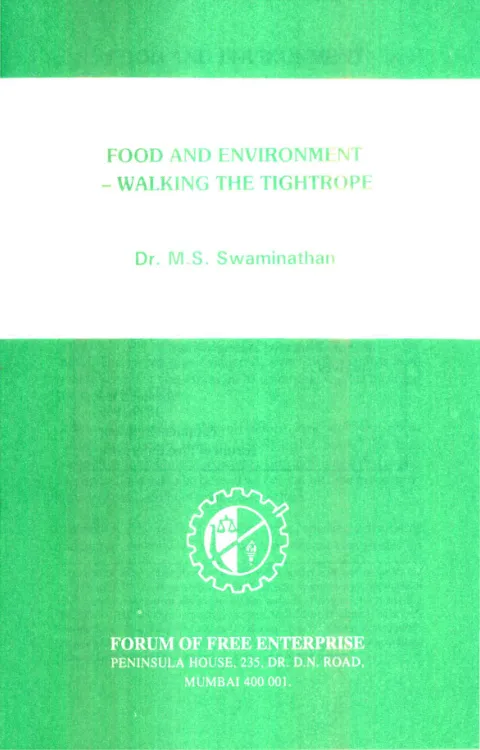
FOOD AND ENVIRONMENT – WALKING THE TIGHTROPE
FORUM OF FREE ENTERPRISE, PENINSULA HOUSE, 235, DR. D.N. ROAD, MUMBAI 400 001. · Mumbai
24 pages
Summary
Dr. M. S. Swaminathan’s Forum of Free Enterprise pamphlet, reprinted from the January–March 2000 issue of Financing Agriculture, addresses what he calls the central tightrope of the new century: producing more food from a shrinking base of land and water without further damaging the ecological foundations of agriculture. He opens with the World Scientists’ Warning to Humanity and the Hadley Centre’s sea-level projections to frame agriculture as inseparable from climate, biodiversity and the global commons, then narrates how post-1947 India moved from a 0.1 percent annual growth in food production to a ten-fold rise in wheat output by 1998–99 — the green revolution that ‘proved doomsday predictions wrong’.
The core argument is a call for an evergreen revolution: productivity gains rooted in ecology, equity and employment rather than in chemical intensification or proprietary control. Swaminathan walks the reader through three converging revolutions — the gene revolution, the ecotechnology revolution that blends traditional and frontier knowledge, and the information and communication revolution — and warns that because the new science is largely proprietary, public-good institutions must mobilise it for the unreached. He defends the precautionary principle on GMOs, calls for a Biosafety Protocol under Article 19 of the CBD, and urges broad-based National Commissions on Genetic Modification for Sustainable Food and Health Security composed of scientists, environmentalists, farmers’ and women’s organisations, civil society and regulators.
A long second movement examines intellectual property and benefit-sharing under TRIPS Article 27(b), pressing all nations to enshrine the ethics and equity principles of CBD Articles 8(j) and 15, restructuring UPOV into a Union for the Protection of Farmers’ and Breeders’ Rights, and rewarding tribal and rural custodians of medicinal plants such as Trichopus zeylanicus, Bacopa monnieri and Prunus africana. Illustrative MSSRF projects — GIS-driven hunger mapping in Dharmapuri district and the Gulf of Mannar Biosphere Reserve Trust modelled on UNESCO’s Seville vision — show what the prescriptions look like on the ground.
The pamphlet closes with lessons on development assistance, drawing on India’s experience with USAID’s Land Grant model, the Rockefeller Foundation’s role in establishing the IARI Post-graduate School in 1958 and the All-India Coordinated Research Projects, the Ford Foundation’s Community Development Programme and Water Technology Centre, CGIAR partnerships with CIMMYT and IRRI, and the PL 480 episode of 1965–66. The repeated lesson is that scientific leadership ‘must be home grown and not externally imposed’ — external aid succeeds only where strong national commitment, humility from donor agencies, and investment in NARS leadership training are already in place.
Key points
-
Frames 21st-century agriculture as a ‘tightrope’ between rising food demand and the ecological limits of land, water, biodiversity and climate.
-
Proposes an ‘evergreen revolution’ — sustainable productivity growth grounded in ecology, economics, social and gender equity, and employment generation — as the successor to the public-funded green revolution.
-
Identifies three converging revolutions (gene, ecotechnology, information & communication) and warns that frontier science is increasingly proprietary, requiring public-good mobilisation for the unreached.
-
Endorses the precautionary principle for GMOs and calls for an internationally agreed Biosafety Protocol under Article 19 of the Convention on Biological Diversity, plus broad-based National Commissions on Genetic Modification for Sustainable Food and Health Security.
-
Argues that TRIPS Article 27(b) of the World Trade Agreement must incorporate the ethics and equity principles of CBD Articles 8(j) and 15, and that UPOV should be restructured into a Union for the Protection of Farmers’ and Breeders’ Rights.
-
Illustrates MSSRF work — GIS-based hunger mapping in Dharmapuri district, Tamil Nadu, and the Gulf of Mannar Biosphere Reserve Trust — as templates for translating biodiversity policy into local action.
-
Reviews how Rockefeller and Ford Foundations, USAID’s Land Grant partnerships, and CGIAR centres (CIMMYT, IRRI) helped build Indian agricultural research capacity from 1957–1970, while criticising supply-driven, inflexible government aid.
-
Concludes that effective scientific leadership must be ‘home grown and not externally imposed’, and that development assistance works only where there is strong national commitment, donor humility, and investment in NARS leadership.
Metadata and summary are AI-extracted from the source PDF and reviewed for editorial accuracy. The original work is available via the Read PDF tab above (where present); paragraph-level citation inside the PDF is deferred to a future engagement.