speech
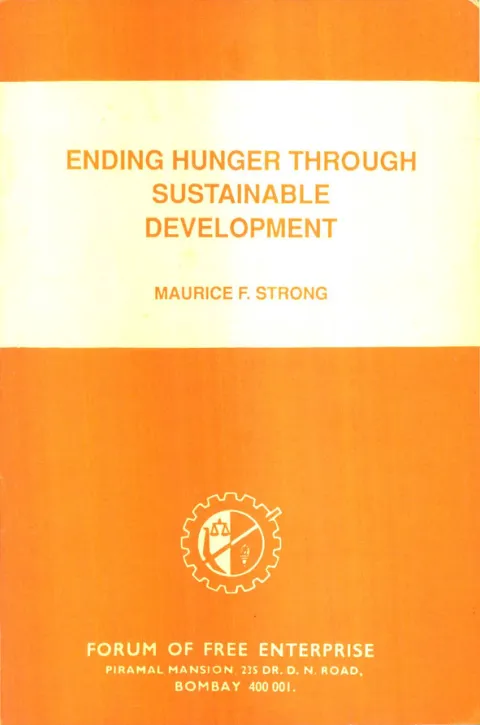
Ending Hunger Through Sustainable Development
FORUM OF FREE ENTERPRISE PIRAMAL MANSION, 235 DR. D. N. ROAD, BOMBAY 400 001. · Bombay · 1989
26 pages
Summary
Maurice F. Strong’s lecture — delivered as the Third Annual Arturo Tanco Memorial Lecture in Tokyo on 6 April 1989 and republished by the Forum of Free Enterprise — argues that the eradication of hunger cannot be separated from the broader project of sustainable development. Drawing on his work as the first head of UNEP and as a member of the Brundtland Commission, Strong frames the late twentieth-century food problem not as a Malthusian shortfall but as a crisis of access, distribution, and ecological capital: the world has been ‘literally living off the Earth’s capital’, and that capital is now seriously depleted. Despite the spectacular surplus production of 1950–1984 and a 300 per cent rise in Indian output under the Green Revolution, more than a hundred countries have become structurally dependent on North American grain, and Africa and Latin America have slid from self-sufficiency into deficit.
The lecture’s core argument is that sustainable food security must be built at three levels simultaneously — aggregate world supply, national access, and household-level command over food — and that each requires market-conscious policy and ecological literacy together. Strong is sharply critical of the long-standing tendency of developing-country governments to suppress food prices for urban consumers at the expense of farmer incentives, and he attacks the institutional neglect of the small farmer. Cash-crop colonial legacies, energy-intensive agriculture made uneconomic by oil shocks, the erosion of soil and watersheds, accelerating land degradation through desertification and salination, and the looming politics of water scarcity all converge, he argues, on a single recommendation: a synthesis of traditional and modern practice anchored in the productive capacity of small farmers.
Much of the booklet is given over to concrete case studies of community-led sustainability — two villages in the Indian Himalayan foothills supported by the Soil and Water Conservation Research and Training Centre, the Forest Department, and the Ford Foundation; an integrated health-and-watershed programme in rural Nepal; a settled Nomad community in northern Mali; agro-forestry extension reaching 110,000 Haitian farmers; and a peasant cooperative revival in Talamanca, Costa Rica with which Strong was personally involved. From these examples he distils an emerging ‘Agenda for Sustainable Development’ grounded in equity, decentralised leadership, market-oriented agricultural pricing, and a strengthened research-and-extension chain — beginning, in the rendered pages, with calls for stronger national agricultural research linked to the CGIAR system, better extension services, and farmer participation in improved-seed programmes.
Key points
-
Recasts hunger as a question of access and ecological capital rather than aggregate Malthusian scarcity, citing the Brundtland Commission’s definition of sustainable development.
-
Identifies three simultaneous requirements for sustainable food security: sufficient world production, national access, and household-level means to acquire food.
-
Documents how the 1950–1984 surplus era, the Green Revolution (notably a 300 per cent increase in Indian food production), and Western/North American grain dominance have left over 100 countries chronically import-dependent.
-
Attacks the systematic suppression of farm-gate food prices in developing countries — which subsidises urban consumers while squeezing peasant producers — as a principal cause of stagnating food production.
-
Argues that high-energy, chemical-intensive agriculture became uneconomic after the oil shocks and that future productivity gains require a synthesis of traditional energy-efficient methods with modern technique.
-
Frames water as the next strategic resource conflict, predicting that water could ‘become more important than oil as a source of conflict in the Middle East within the next decade’.
-
Showcases small-farmer-led sustainability projects in the Indian Himalayas, Nepal, Mali, Haiti, and Costa Rica as evidence that locally driven, externally supported initiatives can reconcile production growth with ecological repair.
-
Opens a policy agenda for sustainable development beginning with trade and exchange-rate neutrality toward agriculture, market-oriented pricing for farm products, stronger national research linked to CGIAR institutes, and farmer-inclusive extension and seed programmes.
Metadata and summary are AI-extracted from the source PDF and reviewed for editorial accuracy. The original work is available via the Read PDF tab above (where present); paragraph-level citation inside the PDF is deferred to a future engagement.