edited volume · anthology
Indian Planning at the Cross-Roads
By K. Santhanam
FORUM OF FREE ENTERPRISE, "SOHRAB HOUSE", 235 DR. D. N. ROAD, BOMBAY-1 / Published by M. R. Pai for the Forum of Free Enterprise, 235, Dr. Dadabhai Naoroji Road, Bombay 1, and Printed by S. J. Patel, at Onlooker Press, (Prop. Hind Kitabs Ltd.) Sassoon Dock Colaba, Bombay-5 · Bombay · 1965
13 pages
Summary
This November 1965 Forum of Free Enterprise booklet bundles three short interventions on the Fourth Five-Year Plan, issued as the Indian economy slid into monetary inflation, a foreign-exchange crunch, and chronic foodgrain shortages. The contributors are N. Dandeker, an M.P. with administrative experience in the I.C.S.; G. L. Mehta, a former Indian Ambassador to the U.S.A., former member of the Planning Commission, and Chairman of the Industrial Credit and Investment Corporation of India; and K. Santhanam, M.P., former Chairman of the Finance Commission, whose piece is reprinted from the Statesman of July 24, 1964. All three reject the Planning Commission’s proposed Rs. 21,500-crore Fourth Plan as conceived, but from distinct angles. Dandeker indicts the macro consequences of monetary expansion, the collapse of public utilities, the worsening foreign-exchange position, and “rupee payment trade” as a quack remedy, arguing that “totalitarian” planning has been eroding the Constitution. Mehta urges a smaller, more selective Plan, automatic licensing of projects that do not draw on foreign exchange, and scepticism about further public-sector steel plants, petro-chemical complexes, and the Cochin shipyard as Galbraith’s “symbolic modernism.” Santhanam pleads for a one-year extension of the Third Plan to March 1967, a moratorium on new starts, and self-financing public-sector industries, warning that the assumption that Fourth-Plan outlays must be proportionate to the Third has “become a vested interest.” The booklet is framed by sidebar pull-quotes from Eugene Black and A. D. Shroff defending private enterprise as an affirmative good.
Key points
-
The booklet bundles three short interventions on the Fourth Five-Year Plan, published by the Forum of Free Enterprise in November 1965 amid monetary inflation, a foreign-exchange crunch and foodgrain shortages.
-
All three contributors — N. Dandeker, G. L. Mehta and K. Santhanam — reject the Planning Commission’s proposed Rs. 21,500-crore Fourth Plan as conceived, though from distinct angles.
-
Dandeker, an M.P. with I.C.S. administrative experience, cites money supply growing 43.7 per cent between 1960 and 1964 against only 17.5 per cent growth in national income as evidence of monetary overheating.
-
Dandeker dismisses ‘rupee payment trade’ as a quack remedy for the foreign-exchange crisis and argues that totalitarian-style planning has been steadily eroding the Constitution.
-
G. L. Mehta, a former Indian Ambassador to the United States and former Planning Commission member, urges a smaller, more selective Plan with automatic licensing for projects that do not draw on foreign exchange.
-
Mehta voices scepticism about further public-sector steel plants, petro-chemical complexes and the Cochin shipyard, terming them instances of Galbraith’s ‘symbolic modernism’.
-
K. Santhanam, a former Chairman of the Finance Commission, pleads instead for a one-year extension of the Third Plan to March 1967 and a moratorium on new project starts.
-
Santhanam, whose piece is reprinted from the Statesman of 24 July 1964, argues that treating Fourth-Plan outlays as necessarily proportionate to the Third Plan has itself ‘become a vested interest’.
-
The booklet frames its arguments with sidebar pull-quotes from Eugene Black and A. D. Shroff defending private enterprise as an affirmative economic good.
Essays
I. The Present Economic Situation Demands Re-Thinking on Fourth Plan Strategy & Size
By N. DANDEKER, M.P.
Writing as the inflationary crisis of 1965 deepens, Dandeker diagnoses the Indian economy as “overheated by monetary inflation”: money supply rose roughly 43.7 per cent between 1960 and 1964 against a 17.5 per cent rise in national income, the general price level rose 32 per cent between 1952–53 and 1963 and another 25 per cent by July 1965, and foodgrains prices rose 30 per cent in eighteen months. He traces the regressive incidence of this inflation on the industrial worker, the landless rural labourer, the salaried middle class, the peasant farmer, and the small investor whose savings are eroded by direct taxation and “ridiculous small savings schemes.” He then catalogues the decay of public utilities — Law and Order, railways, electricity, water, sanitation, education, road transport, communications — and the way corporate taxation, licences, controls and a dead capital market have driven industry into the arms of state financial institutions.
On foreign exchange, Dandeker calls the Government a “squanderer” through public-sector mismanagement and dismisses the “rupee payment trade” as a magic-word remedy. He concludes that the Fourth Plan of Rs. 21,500 crores is an “adventurous step,” that the totalitarian planning mode of the Second and Third Plans has been “steadily eroding the fundamentals of our Constitution, because the Government had been bending the Constitution to the Plan,” and that what India needs is for the Government to plan its own business rather than everyone else’s. Without serious re-thinking on the strategy and size of the Plan, he warns, the economy faces a major disaster in which fixed-income groups will suffer worst.
- Money supply grew 43.7 per cent between 1960 and 1964 while national income grew only 17.5 per cent, producing structural inflation
- Foodgrains prices rose 30 per cent in the eighteen months ending July 1965, with the salaried middle class, peasant farmer and small investor bearing the brunt
- Public utilities — railways, electricity, water, sanitation, education, road transport — are in advanced decay; corporate taxation, controls and a dead capital market have starved private industry of finance
- “Rupee payment trade” is a magic-word remedy for foreign-exchange mismanagement that in fact worsens the balance of payments
- The Rs. 21,500-crore Fourth Plan is an “adventurous step”; the totalitarian mode of planning has been bending the Constitution to the Plan and must be re-thought
II. A Plea for Realism in Planning
By G. L. MEHTA
Mehta’s “plea for realism in planning,” delivered originally to the Central Advisory Council of Industries in New Delhi on 13 August 1965, is a senior insider’s case for shrinking and refocusing the Fourth Plan rather than scuttling it. He warns that the breast-beating produced by the present crisis should not lead the country to throw out the baby with the bath water; planners must still think long-term even if, as Keynes said, in the long run we shall all be dead. Recalling his own 1959 FICCI speech on “Some Lessons of the Second Plan,” Mehta repeats his objection to the “numbers game” — gross magnitudes derived from appeals to fortitude rather than from project-by-project calculation — and complains that the Fourth Plan’s headline figure has again been chosen as a “symbol” of hope.
He pushes for several concrete shifts: automatic licensing of industrial projects that do not draw on foreign exchange or scarce raw materials; more selective control of capital issues, illustrated by Rajaji’s quip about a cure that killed the patient’s wife; closer scrutiny of further petro-chemical complexes, additional public-sector steel plants and the long-delayed Cochin shipyard, which he treats as instances of what “Prof. Galbraith would call symbolic modernism”; and a tighter linkage between investment magnitudes and the policy environment for prices, controls and incentives. The Government, he argues, should set free a certain portion of the price system — control by liberalisation — and resist the press’s portrayal of price controls as the test of industrial growth.
- Rejects both “scuttling of plans” and the “numbers game” approach to fixing Plan size
- Proposes automatic licensing of industrial projects that do not require foreign exchange or scarce raw materials
- Calls for selective capital-issues control rather than blanket restraint; cites Rajaji on cures killing the patient
- Treats further petro-chemical complexes, new public-sector steel plants and the Cochin shipyard as Galbraithian “symbolic modernism”
- Argues that physical investment targets must be reconciled with policy decisions on prices, controls and incentives, including selective decontrol
III. Plan Consolidation to Reduce Strains on Economy
By K. SANTHANAM, M.P.
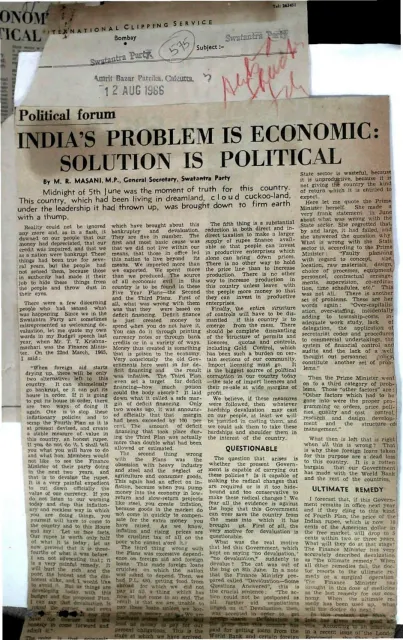
Santhanam’s piece — reprinted with the Editor’s permission from the Statesman of 24 July 1964 — argues that Lal Bahadur Shastri’s first year in office has stabilised the country and that the immediate task is plan consolidation rather than a fresh round of expansion. He dismisses talk of a “plan holiday” because economic activities are continuing processes, but insists the country is “unable to bear” the strain that the Vice-chairman of the Planning Commission’s current course will impose. Echoing Churchill’s refusal to liquidate the empire, he hopes the Finance Minister of India will fare better than the Prime Minister of Britain who failed to do likewise. His proposed remedy is a one-year extension of the Third Plan to March 1967 — freeing additional Plan resources, avoiding deferred completion of in-train projects, and delaying the Fourth Plan’s start to 1967–68.
He sketches a structural reform of the public sector around self-financing: each branch should work to a time limit by which it generates the savings needed for its own expansion, with the steel industry positioned similarly after the fourth public-sector steel plant is operational, and with handloom, khadi, textiles, and even the railways funded through annual budget contributions treated as re-lent for expansion. Triennial rather than annual conferences with the States would free up administrative bandwidth. He also questions whether much of the country’s industrial capital investment has become saturated, arguing for studies of capacity utilisation; and he insists that progress means controlling fewer commodities, scrutinising humbug investments in social overheads, and convincing the public that the planners are not hopelessly bound by procedures valid ten years ago.
- Rejects a “plan holiday” but urges extending the Third Plan by one year to March 1967, freeing resources for unfinished projects and postponing the Fourth Plan to 1967–68
- Every branch of the public sector should work to a time limit by which it generates the savings needed for its own expansion — including steel, railways, handloom, khadi and textiles
- The assumption that Fourth-Plan investment should be roughly proportionate to the Third Plan “for every item” has become a vested interest and threatens to make planning mechanical
- Triennial rather than annual planning conferences with the States would reduce wasteful procedure and free bandwidth for implementation
- Progress lies in setting free a certain portion of the price system, decontrolling commodities like steel and cement, and pruning humbug investments in social overheads
Metadata and summary are AI-extracted from the source PDF and reviewed for editorial accuracy. The original work is available via the Read PDF tab above (where present); paragraph-level citation inside the PDF is deferred to a future engagement.